


- The General Fisheries Commission for the Mediterranean approved new management plans for several iconic species during its latest meeting, held Oct. 26-30 in Rome.
- However, the organization did not pass expected fishing restrictions, including a proposal to expand protections for deep-sea areas and another to protect an ecologically important cold-water coral reef.
- Both proposals had widespread support from commission members just a few months earlier, leading some observers to conclude the U-turn by certain countries was related to political concerns that had little to do with fisheries.
The international organization responsible for regulating fisheries in the Mediterranean and Black seas concluded its annual meeting with the adoption of new management plans for some iconic species. However, it declined to pass expected fishing restrictions to protect certain ecologically important habitats. Half of all assessed species in the region are overexploited.
The 49th session of the General Fisheries Commission for the Mediterranean (GFCM), a body of the U.N. Food and Agriculture Organization (FAO), took place in Rome Oct. 26-30, bringing together 23 member countries and the European Union.
The meeting achieved some milestones, including establishing long-term harvest strategies for European hake (Merluccius merluccius) and deep-water rose shrimp (Parapenaeus longirostris) in the Strait of Sicily, and for giant red shrimp (Aristaeomorpha foliacea) in the Strait of Sicily, the Ionian Sea between Greece and southern Italy, and the Levantine Sea in the easternmost Mediterranean. However, the commission postponed making a decision on the establishment of two Fisheries Restricted Areas: One covering a cold-water coral reef between Spain and Morocco, and another expanding protection for deep-sea areas. Both proposals had broad agreement just a few months earlier, observers said.
“It is disappointing that, despite multiple proposals to restrict fishing to protect sensitive habitats, countries could not reach agreement and instead delayed adoption,” Esther Wozniak, senior policy officer for sustainable fisheries at the U.S.-based NGO The Pew Charitable Trusts, who took part in the meeting as an observer, said in a press release. “There was, however, important progress on improving fisheries management that should be commended,” Wozniak said, noting that the giant red shrimp fishery is the world’s first international invertebrate fishery with a harvest strategy.
The GFCM regulates fisheries in its jurisdiction through the adoption of Fisheries Restricted Areas (FRAs), where fishing is prohibited or restricted, and species-related management measures, including harvest strategies, which are long-term plans aimed at ensuring the sustainable exploitation of fish stocks through monitoring programs and automatic mechanisms to adjust fishing effort and catches.
According to the FAO, these policies have contributed to a decline in the proportion of fish stocks in the Mediterranean and Black seas classified as overexploited, from 87% in 2013 (or 57 of the 66 stocks GFCM monitored at the time) to 52% in 2025 (or 62 of the 120 stocks it then monitored).

A U-turn on deep-sea bottom trawling
To date, the GFCM has established 11 FRAs, covering a total marine area of 1.7 million square kilometers (656,000 square miles). The largest, established in 2005, prohibits bottom trawling in all waters deeper than 1,000 meters (3,300 feet) within the GFCM convention area to protect vulnerable deep-water ecosystems and habitats, many of which remain unmapped, including coral banks, hydrothermal vents and seamounts.
In 2026, both the GFCM Scientific Advisory Committee and the Working Group on Vulnerable Marine Ecosystems and Essential Fish Habitats recommended extending this ban to include depths between 800 m and 1,000 m (2,625 ft and 3,300 ft). This extension would expand protection for deep-water ecosystems by an additional 100,000 km2 (approximately 38,600 mi2).
“We believe it is urgent to protect these ecosystems, which perform a range of important functions,” Helena Alvarez, a senior marine scientist for the U.S.-based NGO Oceana, told Mongabay.
Together with the Italy-based NGO MedReAct, Oceana published a report earlier this year calling for the protection of deep-sea ecosystems in the Mediterranean Sea.
“These are typically formed by fragile coral and sponge reefs. These habitats play a role similar to that of trees in terrestrial forests,” Alvarez said, mentioning their role as feeding and breeding grounds, shelter for juveniles and “climate refugia” for several species, in a region that has proven to be a climate change hotspot.
During the meeting, Türkiye put forward the proposal to extend the trawling ban to 800 m. Egypt, Lebanon, Montenegro and Morocco endorsed the proposal. But the EU blocked it, calling for the decision to be reconsidered at the 2027 meeting.
That move took observers by surprise. The EU had led the GFCM in launching a pilot study in 2023 to extend the ban, and the EU’s fisheries commissioner, Costas Kadis, had expressed support for the measure in July.
The European Commission did not respond to Mongabay’s request for comment.
According to Domitilla Senni, MedReAct’s president, the EU’s position was driven by a “veto” from Italy and Spain. “They are blocking everything, it is an ideological position,” Senni told Mongabay, referring to what she described as the Italian government’s anti-European stance, particularly on conservation issues.
Italy’s minister of agriculture, Francesco Lollobrigida, commented on the overall outcome of the GFCM during a fishing industry event the day after the meeting closed, praising the Italian delegation’s success in pushing the EU to oppose any measures aimed at reducing the country’s fishing effort. “Brussels bureaucrats are self-referential. Once they get an idea into their heads, they push ahead with it until someone stops them,” he said.
When asked why Italy opposed the ban on bottom trawling between 800 m and 1,000 m, Graziella Romito, director general of maritime fisheries and aquaculture at the Italian Ministry of Agriculture, Food Sovereignty and Forests, told Mongabay that “Italy has several concerns, as we believe that there is not yet sufficient evidence to justify imposing this type of ban across the entire Mediterranean on a permanent, blanket basis.”


In 2024, Italy introduced a voluntary measure banning bottom trawling at depths greater than 800 m in the Tyrrhenian Sea, a part of the Mediterranean off the country’s west coast. The measure allows Italy to grant its fleet additional fishing days under EU regulations — a form of “compensation” that would no longer apply if the GFCM were to approve the FRA.
The GFCM members also rejected a second proposed FRA. This one aimed to establish a permanent ban on all professional and recreational bottom fishing in the Cabliers Coral Mound Province, the only known actively growing cold-water coral reef in the Mediterranean, in the southern Alboran Sea between Spain and Morocco. As recently as June, the GFCM Scientific Advisory Committee had reached an agreement on establishing this FRA, making its approval at the commission meeting appear little more than a formality.
“Everybody was clapping in this same room, it was a done deal,” Alvarez told Mongabay. Oceana has been calling for measures to safeguard the Cabliers reef for several years. “The area ticks all the boxes for protection,” such as providing nursery and spawning grounds for several species, including endangered ones, Alvarez said.
But the proposal, put forward by the EU, was blocked by Morocco, which requested that a decision be postponed until next year to allow more time for consideration.
Morocco’s Department of Maritime Fisheries did not respond to Mongabay’s request for comment. According to Alvarez, this shift in position is likely linked to the formation of Morocco’s new government in October 2026, and possibly to geopolitical issues, given that the country has no relevant fishing activities in the area.

New protections for iconic species
Among the key achievements of the 2026 GFCM meeting was the adoption of long-term harvest strategies for European hake and deep-water rose shrimp in the Strait of Sicily, and for giant red shrimp in the Strait of Sicily, the Ionian Sea and the Levantine Sea. All are considered overexploited.
The science-based, long-term management plans, put forward by the EU delegation, introduce total allowable catches — the maximum stock that can be caught in a season or year — and agreed sustainable exploitation levels for these species. In the short term, the plans provide, in some cases, for a slight increase in the number of fishing days and, in other cases, for the lifting of a ban on passive (or stationary) fishing gear. The Italian fishing community hailed these elements, which may have helped enable the consensus necessary to adopt the management plans.
“Together, these will set catch limits that not only move these species towards sustainability and support key seafood markets but demonstrate momentum throughout the Mediterranean for rebuilding some of the world’s most iconic fisheries,” Wozniak said.
The commission also approved a long-term harvest strategy for the common dolphinfish (Coryphaena hippurus), whose exploitation is considered sustainable.
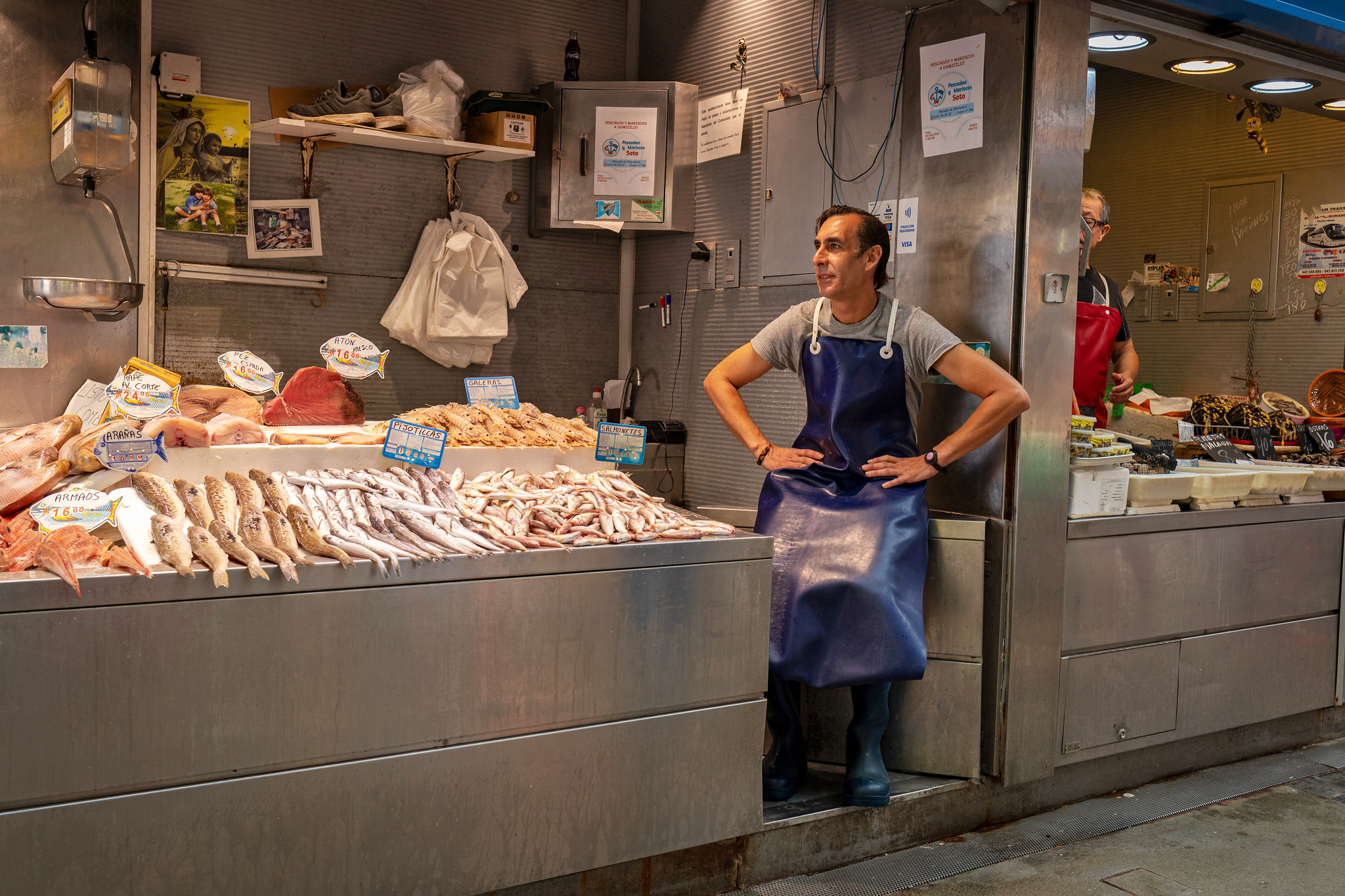
Banner image: Fishmonger at the Mercado Central de Atarazanas in Málaga, Spain. Image by Rolf Schotsch via Flickr (CC BY-NC-SA 2.0).
Spain proposes 23 new marine protected areas in the Canary Islands and Mediterranean
Citation:
Corbera, G., Lo Iacono, C., Gràcia, E., Grinyó, J., Pierdomenico, M., Huvenne, V. A., … Gili, J. M. (2019). Ecological characterisation of a Mediterranean cold-water coral reef: Cabliers coral mound province (Alboran sea, western Mediterranean). Progress in Oceanography, 175, 245-262. doi:10.1016/j.pocean.2019.04.010
Feedback: Use this form to send a message to the editor of this post. If you want to post a public comment, you can do that at the bottom of the page.

