


In the land of tigers, prey animals like deer and monkeys are often the first to sound the alarm when they sense the predator’s presence. Forest communities in Nepal, where the success of tiger conservation has come at the cost of rising human-tiger conflict, have long known to listen for these natural alerts.
This local wisdom inspired a recent pilot project using sensors dotted around a forest to detect these alarm calls and send out automated alerts telling people where tigers or leopards might be prowling, reports contributor Praveen Kumar Yadav for Mongabay. The developers said they’d hoped it could be deployed to prevent tiger attacks in the region, but they didn’t have the chance to find out: the project ended for lack of support.
Nepal’s wild tiger population recently reached a record 429 individuals, with 112 residing around Bardiya National Park in the southwest. That increase has come at a cost: Between 2010 and 2024, there were 245 tiger attacks on humans, resulting in 141 fatalities, according to a recent study.
To reduce encounters, researchers deployed solar-powered acoustic monitoring devices in the Dalla Community Forest, near Bardiya, between December 2024 and March 2025. These devices, costing roughly $50 each, ran an artificial intelligence model trained to listen to sounds coming from the forest and identify alarm calls from chital deer (Axis axis), rhesus macaques (Macaca mulatta), and gray langurs (Semnopithecus hector).
Communities in Bardiya, who share the same landscape as tigers to graze their livestock and collect firewood and other forest products, have long relied on these signals to watch out for tigers.
“Footprints, scat, and alarm calls from deer, langurs, red monkeys all tell us that a tiger may be nearby,” said Bhadai Tharu, chair of the Gauri Community Forest and a tiger-attack survivor.
Casey Anderson, a U.S.-based wildlife filmmaker and study co-author who led the project’s deployment, said the system built on existing human understanding. “We weren’t teaching the forest or the people who live there something new. In many ways, we were teaching a computer to recognize something those people already understood,” she said.
The system seemed promising: according to Thenghchu Tharu, a 60-year-old forest guard at Dalla Community Forest who monitored the pilot, the automated alerts matched the physical tracking signs he observed on the ground.
“If people are informed beforehand, they do not need to enter that area,” he said.
But the pilot stalled, due to running out of resources, staffing constraints, and a lack of local institutional backing, Anderson said.
His team have since moved their equipment to India to continue testing there. Sabnam Pathak from Nepal’s Department of Forests and Soil Conservation said new conservation tools require thorough long-term evaluation before they can be adopted at scale.
Read the full story by Praveen Kumar Yadav here.
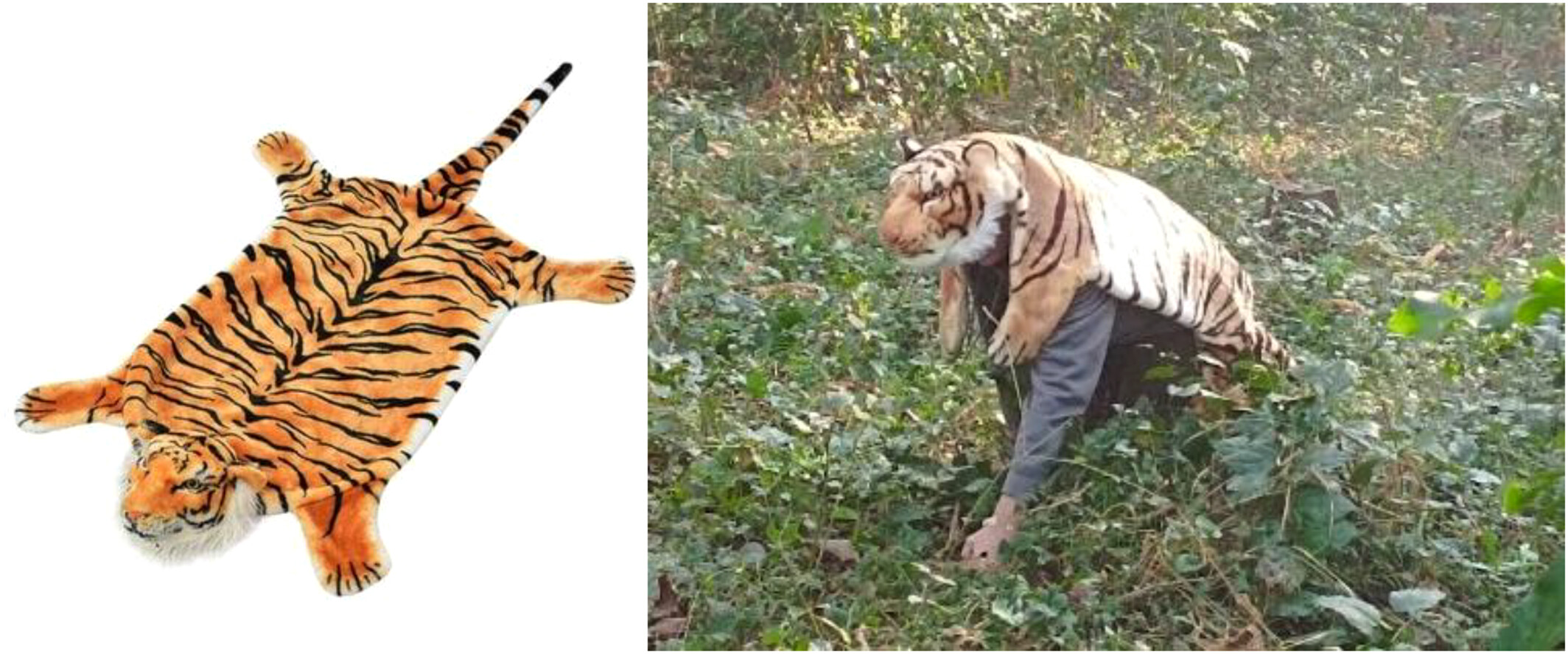
Banner image: The team used a faux tiger skin to elicit alarm calls from prey species. Image by Kershenbaum et al., 2026 (CC BY-NC-ND).
