


Reading Time: 5 minutes
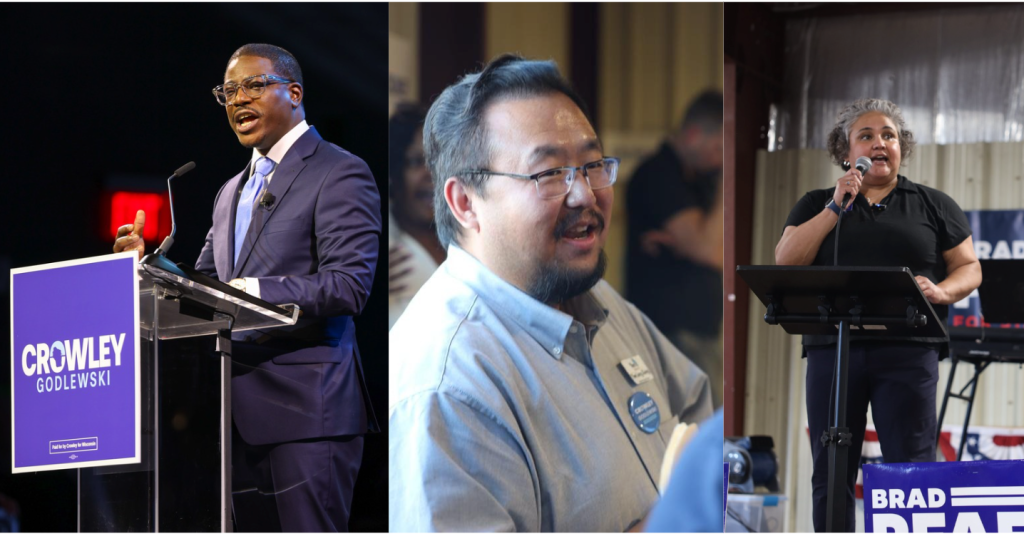
Tuesday’s Democratic sweep of statewide offices included three notable firsts: Wisconsin’s first Black governor and first Latino and Hmong statewide elected officials.
Gov.-elect David Crowley, Secretary of State-elect JoCasta Zamarripa and Treasurer-elect Yee Leng Xiong, all Democrats, formed the most racially diverse party slate — alongside Lt. Gov.-elect Sarah Godlewski — in Wisconsin history. The trio occasionally acknowledged that detail on the campaign trail, but it didn’t feature front and center in their messaging this year.
Wisconsin has had some of the largest racial disparities in the nation in infant mortality, income, education outcomes and incarceration rates. More than a quarter of Black Wisconsinites lived below the poverty line in 2024 — a higher rate than in all but three states and Washington, D.C.; Latino and Asian Wisconsinites also experienced higher poverty rates than their white counterparts and the national average for Latino and Asian Americans, respectively.
The gap between the share of Black and white Wisconsin students who graduate high school on schedule was the highest in the country between 2019 and 2024. Black children born in Wisconsin die in their infancy at roughly three times the rate of white children — a pattern public health experts say doesn’t map neatly to family income. Black Wisconsinites are roughly a third as likely as white Wisconsinites to own their homes, though gaps vary by city; and Black Wisconsinites’ incarceration rate was roughly 12 times higher than that of white Wisconsinites in 2022, a gap surpassed only in Vermont.
In his victory speech in Milwaukee, Crowley alluded to the challenges the state’s Black residents have long faced.
“Because of you, a boy who grew up facing eviction will soon take residence in the governor’s residence,” Crowley said. “Tonight Wisconsin made history, and being your next governor is humbling in its own right. I don’t take any of this lightly. And I know exactly the shoulders that I stand on.”
Crowley became Milwaukee County’s first elected Black executive in 2020, though former Milwaukee Common Council President Marvin Pratt served in the role on an interim basis in 2011.. At least one in five Milwaukee County residents have identified as Black since the 2000 census. That share rose to roughly one in four residents as of the 2024 American Community Survey, compared to roughly 6% of Wisconsin’s overall population.
Crowley attended Bay View High School with Cavalier Johnson, whom Milwaukee voters chose as their city’s first Black mayor in 2022.
Wisconsin’s first Black state lawmaker, Progressive Republican Lucian Palmer, likewise represented Milwaukee; he served in the Assembly for a single term from 1907 to 1909. Former Secretary of State Vel Phillips became Wisconsin’s first Black statewide elected official in 1978.
Witnessing history at the Crowley event wasn’t lost on Kenya Perry, 38, an east side Milwaukee resident.
“I think it’ll be great, not just for us minorities, but for everyone, because he not only represents us, but he’s representing everybody,” Perry said. “It doesn’t matter what color you are, what’s your background, what ethnicity or your religion or anything like that. He wants to come in and represent all people, not just one party.”

Zamarripa is also a lifelong Milwaukeean. She, too, is no stranger to firsts; Zamarripa became Wisconsin’s first Latina state lawmaker in 2010 and the first Latina member of Milwaukee’s Common Council in 2020. Roughly 20% of Milwaukee residents identified as Hispanic as of 2024, compared to about 8% of all Wisconsinites.
She told Wisconsin Watch on Monday that her race for secretary of state was also an opportunity to build out Latino voter outreach infrastructure.
“We’re the fastest-growing constituency in the great state of Wisconsin,” she said, not only in Milwaukee, but in manufacturing and agricultural hubs across the state. “Wherever there are midterm Latino voters, we mailed them a bilingual piece of mail,” she said, alongside partnerships with Spanish-language radio stations and ad buys in southeast Wisconsin and the Green Bay area. Roughly the same share of Kenosha and Racine County residents identified as Latino in 2024 — about 16% — as did 1 in 10 Brown County residents.
Zamarripa hopes Wisconsin Democrats will be able to “replicate” her campaign’s Latino voter outreach efforts, or perhaps even devote resources to recruiting Latino candidates for local and statewide offices. Among the communities on her mind: Arcadia in western Wisconsin’s Trempealeau County, the state’s only majority-Latino city as of 2024.
Voters in majority Latino precincts on Milwaukee’s South Side veered right in 2024, including 44-year-old Nextaly Rodriguez. He voted in his first-ever gubernatorial election at the Kosciusko Community Center polling site on Tuesday, choosing Crowley over Republican Tom Tiffany. “Just trying something new,” he said in Spanish.
Jesus Mancilla made it to the community center less than a half-hour before polls closed. The 18-year-old spotted U.S. Immigration and Customs Enforcement agents on his block during a wave of immigration arrests in and around Milwaukee in June; his older brother convinced him to vote for his immigrant parents’ sake. He wasn’t the only first-time Latino voter at the polling site. “I saw a couple of my friends leave (just now),” he said. Mancilla hasn’t sorted out his political identity yet, but he chose Crowley in the governor’s race.
Xiong is both Wisconsin’s and the nation’s first Hmong statewide elected officer. He hails from Marathon County, home to Wisconsin’s second-largest Hmong community. Roughly 1 in 10 Wausau residents identified as Hmong in 2024, more than in any other Wisconsin city.
Tens of thousands of Hmong refugees, including Xiong’s parents, settled in Wisconsin in the wake of the Vietnam War; last year marked the 50th anniversary of the first Hmong families’ arrival in the state. Hmong Wisconsinites now comprise sizable constituencies not only in Wausau, but also in Milwaukee, Sheboygan, Madison, Eau Claire and the Fox Valley.
The Hmong written language is still relatively young, so Xiong leaned into person-to-person outreach, producing a series of Hmong-language get-out-the-vote videos, hosting bilingual campaign events and making phone calls to Hmong-speaking voters.
Xiong isn’t sure his voter outreach efforts are easily replicable. “It comes with relationships,” he said, and cementing those relationships for future election cycles will require Democrats to maintain a presence in Wisconsin’s Hmong communities.
When the dust of Tuesday’s blowout settles, he expects Hmong voters, and Asian voters more broadly, to have played pivotal roles in flipping the Wausau-based 85th Assembly District — a seat for which he ran two years ago, losing by four points — and seats in greater Green Bay and Menasha.
As owner Sa Sor Lee opened the doors of Mortchee’s Carryout & Catering in Wausau on a windy Wednesday morning, she carried the joy and pride she had felt the night before at Yee Leng Xiong’s election party. Attendees watched Xiong’s vote total climb throughout the evening before the Associated Press called the race for him shortly after midnight.
Lee has known Xiong since he was 17 and mentored him through the H.M.O.N.G. Youth Program in Wausau, which stands for Helping Make Our Next Generation. She has watched him run for the local school board, the Marathon County Board and, ultimately, state treasurer. She also frequently contributed food to his campaigns.
Lee said Xiong’s victory means a lot to the Hmong community. “It means we can do a lot more than we think we can.”
“I’m so excited,” Lee added. “It’s not just him, but I think I felt like I am winning this election.”
Wisconsin Watch reporters Tom Kertscher and Brittany Carloni contributed to this report.

Wisconsin Watch is a nonprofit, nonpartisan newsroom. Subscribe to our newsletters for original stories and our Friday news roundup.
History made: Wisconsin elects first Black governor and first Latino and Hmong statewide officers is a post from Wisconsin Watch, a non-profit investigative news site covering Wisconsin since 2009. Please consider making a contribution to support our journalism.
