


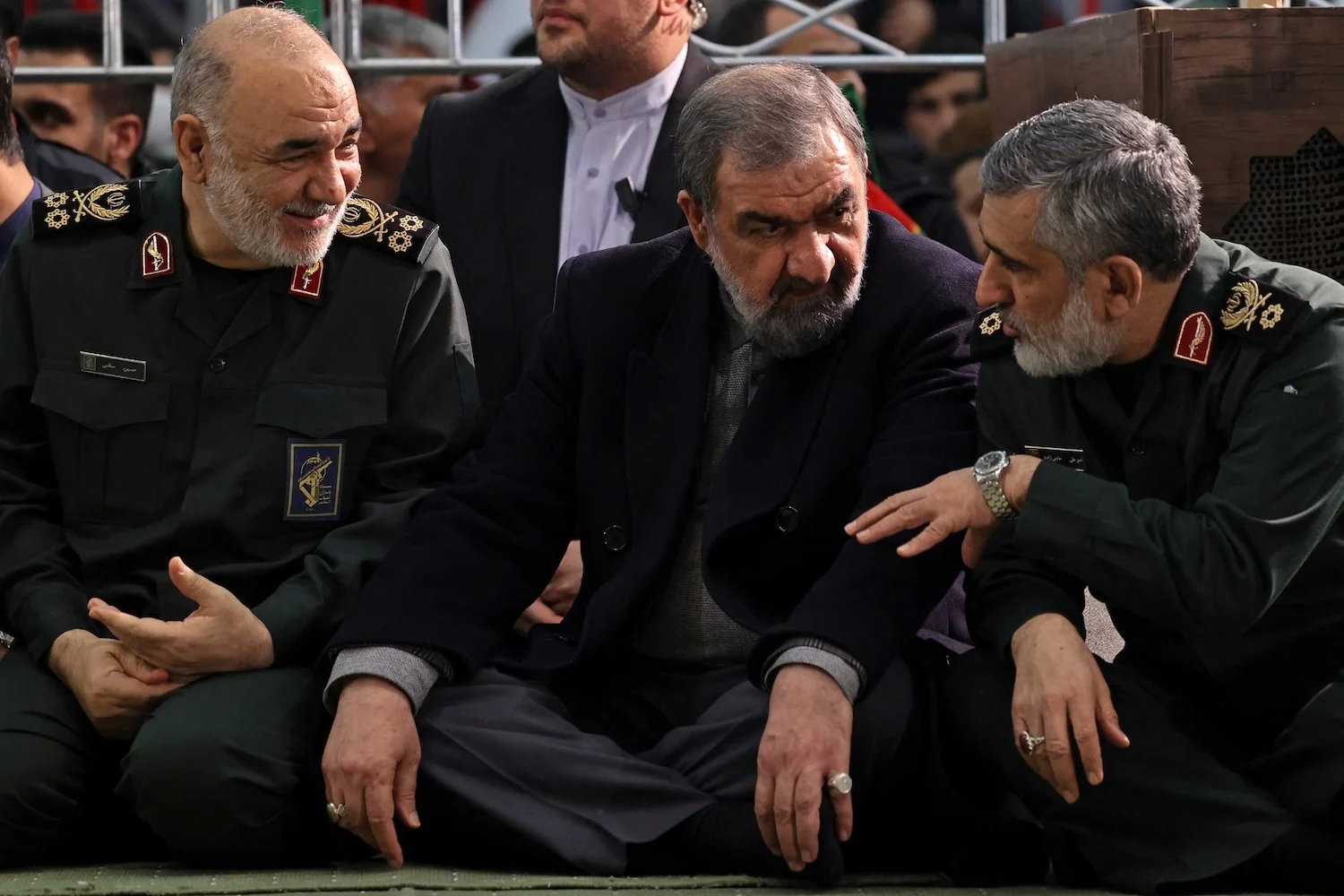
Last week, a high-ranking set of Saudi, Pakistani, and Turkish officials came to Tehran, where they met an Iranian delegation led by Mohsen Rezaei. Rezaei, former commander of the Islamic Revolutionary Guard Corps (IRGC), heads Iran’s Supreme National Security Council (SNSC). The SNSC is the country’s top decision-making body and brings together leaders from the IRGC and conventional military, along with representatives of the supreme leader and elected officials. In this meeting, Rezaei was joined by President Masoud Pezeshkian and Foreign Minister Abbas Araghchi.
That these officials—representing Iran’s top security body, its president, and its foreign minister—all participated in the meeting suggests a degree of consensus across Iran’s political spectrum. In the past, many Iranian diplomatic efforts had been the sole prerogative of the foreign ministry, without buy-in from military and security institutions, which made their implementation difficult. This meeting, on the other hand, demonstrates that, across different centers of power, Iran’s political and military establishment is serious about diplomacy.
The seniority of the Iranians’ interlocutors also underscores the importance of these talks. Pakistan was represented by Field Marshal Asim Munir, the country’s de facto most influential political figure. Saudi Arabia sent Defense Minister Khalid bin Salman, the younger brother and confidant of Crown Prince Mohammed bin Salman, while Turkey sent intelligence chief Ibrahim Kalin, a longtime close advisor to President Recep Tayyip Erdogan with extensive experience in regional diplomacy.
Saudi Arabia, Turkey, and Pakistan are also members of the Mecca defense pact, suggesting that Iran wants to play a greater role in the regional security architecture rather than acting outside of it. This is important, as Saudi Arabia in particular faces both continued attacks from Iran’s Houthi allies and risks becoming the target of IRGC strikes should the war break out again.
The meeting ended with a joint statement signed by Rezaei, Salman, Munir, and Kalin in which the four committed their countries to continued dialogue and regional “peace and security.” The statement was vague but signals that Iran does not want to immediately escalate and is instead open to having a productive relationship with its neighbors, some of whom it was targeting with missile and drone strikes just months earlier. This is supported by reports that the Iranian leadership responded positively to a letter sent last month by U.S. Vice President J.D. Vance to Rezaei, in which the former stressed the need for diplomacy.
But the meeting came on the heels of another significant development in the Iranian security landscape that signals that Iran is preparing to escalate if it must: the appointment of Mehrdad Akhlaghi as defense minister. His appointment indicates a shift in the defense establishment to a focus on offensive capabilities. Akhlaghi previously led the Shahid Bagheri Industrial Group (SBIG), where he worked on developing Iran’s ballistic missiles, particularly those that use solid-fuel propellants. Compared to liquid-fuel missiles, solid-fuel missiles are easier to store, require less maintenance, and are less vulnerable to detection. As much of the U.S.-Israel strategy during the war centered on neutralizing Iran’s missiles, the importance of these operationally advantageous missiles should war break out again will increase—a consideration that may have played a role in Akhlaghi’s appointment.
After the SBIG, Akhlaghi went up the Iranian military-industrial ladder. He led the Aerospace Industries Organization, which oversees the missile program as a whole. He then headed the Defense Industries Organization, which oversees the manufacturing of all Iranian military hardware, including drones, which were also key to Iran’s military operations in the Gulf during this year’s war. His appointment marks a shift from his predecessor, Aziz Nasirzadeh, who was a former fighter pilot and came from Iran’s conventional air force, rather than institutions associated with the IRGC and its weaponry. Nasirzadeh was killed during the Feb. 28 attacks and, since then, the defense ministry had been led in the interim by Majid Ebn-e-Reza.
Akhlaghi will be tasked with rapidly rebuilding Iranian military capabilities—mainly missiles and drones—that have been degraded by U.S. and Israeli attacks. This suggests that Iran is preparing, simply put, to pummel the Gulf countries if war breaks out again.
In a recent speech, Akhlaghi stated that “if [U.S. President Donald] Trump drops a single bomb, his forces are going to leave the region horizontally (i.e., in body bags).” That would require a significant campaign against the Gulf—precisely the type of escalation that Salman was likely seeking to prevent during his time in Tehran. Akhlaghi’s influence in Iran could extend beyond the defense ministry to the SNSC, where he can participate in deliberations and vote on matters concerning national defense.
An insistence on regional diplomacy while simultaneously appointing a defense minister whose primary responsibility revolves around rebuilding the capabilities designed to wreak havoc on the Gulf might seem contradictory. But these moves reveal Iran’s broader strategy of hedging, at the core of which is a simple reality: Iran does not seem to know what is coming next.
In this state of limbo, Iran is watching international developments for clues as to what may be in store. Israeli elections, for example, have been covered extensively in Iranian media. Conservative outlets close to the supreme leader’s office, for instance, have amplified reports that Gadi Eisenkot, unlike incumbent Prime Minister Benjamin Netanyahu, is against regime change operations in Iran, as he has recognized that the Islamic Republic cannot be overthrown militarily. Eisenkot does not fully oppose military operations but instead believes that, should Israel attack Iran, it should target specific installations, such as nuclear facilities, rather than launch an all-out war.
Such reporting shows that, before the election, there was some cautious optimism in Iranian political circles: An Eisenkot-led government would be less willing to restart the war against Iran and might revert to smaller-scale sabotage operations that were common before the wars. From Tehran’s point of view, a change in Israeli leadership could also reduce the likelihood of renewed U.S. intervention, given Iran’s belief that Israel dragged the U.S. into the war.
Though Likud emerged as the party with the most votes, Netanyahu’s coalition lost its majority, and Eisenkot has warned Netanyahu against conducting an attack in the absence of a majority—even going as far as to call on security officials to stand firm against the prime minister. Netanyahu will have a tough time forming a government, as he would need to coax members of Eisenkot’s bloc into defecting. But Eisenkot, whose party underperformed in the elections, will also not be able to form a government without the support of Arab parties, which he has previously expressed opposition to including in any coalition.
Iran is also watching the American midterm elections, which similarly provoke more questions than answers. Some Iranian media sources have relayed reports from U.S. outlets that a Democratic victory in the midterms could constrain Trump’s ability to sustain a prolonged military campaign against Iran. Yet even if Democrats win control of Congress, they will not take office until January, leaving Trump two months to act without facing the constraints of a Democrat-controlled legislature. Once his party is freed from electoral pressures and concerns over rising gas prices, he might capitalize on that window to resume military action—even as his vice president is attempting to pursue diplomacy.
This uncertainty lies at the heart of Iran’s strategic calculations. Iran wants to convince its neighbors that it can be a partner for peace, while rebuilding its capacity to wage war. Whether diplomacy succeeds—or even has a chance to succeed—will depend on several factors, including who comes to power in Israel and how Trump acts after the midterms. In the meantime, Tehran is hoping for the best but expecting the worst.
