


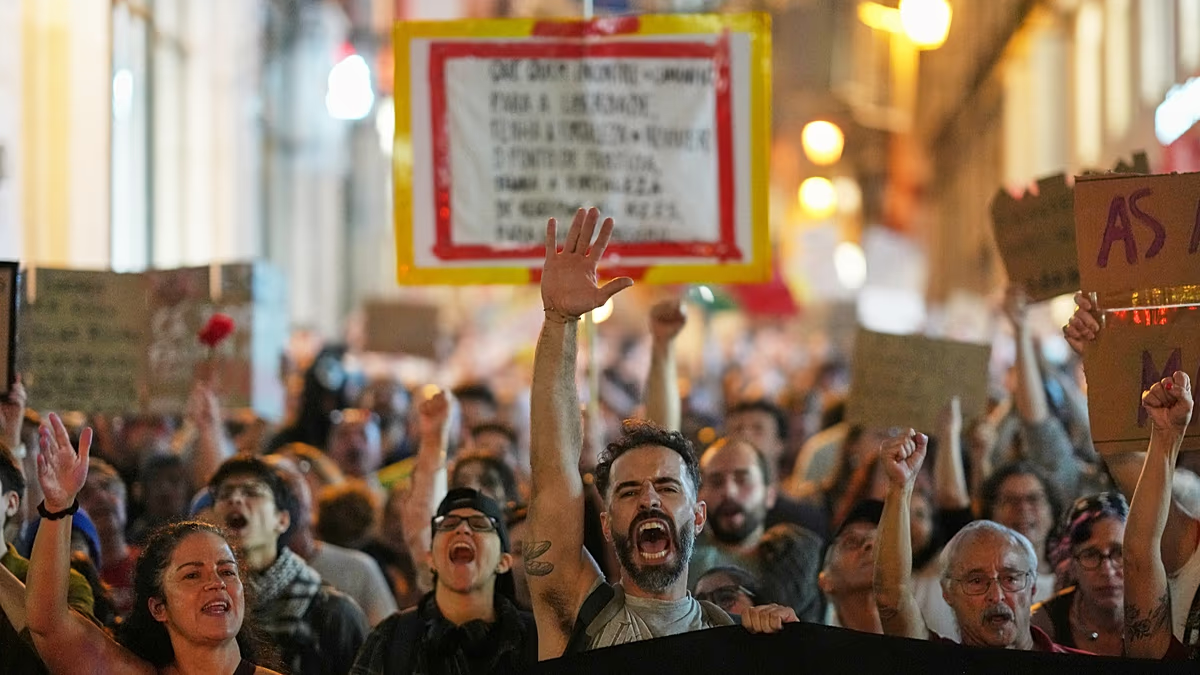
On Monday, after a court allowed her to set up her tent, Renata Cambra, who has taken the lead in the housing protests in Lisbon, became an inspiration for demonstrators, but that was not enough to trigger a new camp-out in Praça do Rossio.
ADVERTISEMENT

ADVERTISEMENT
Through a legal action, Renata Cambra secured a court ruling that the tent should not be considered an illegal occupation of public space, but rather an instrumental and symbolic element of the protest.
The decision, however, restricts this authorisation to occupy the square to the demonstrator who brought the case and in this proceeding the court did not rule on “the legality of a collective occupation” of Rossio, or on the recognition of a general right to put up “tents in public space by an indeterminate number of participants”.
The court also concluded that the 00:30 cut-off for holding demonstrations is not “absolute and automatic”, authorising Renata Cambra to remain with a tent in Praça do Rossio during the night.
The protest may continue until 24 November, the date scheduled for the final vote on the State Budget for 2027, including between 00:30 and 06:30.
Renata Cambra and the Acampada de Lisboa movement see this as a victory for the right to protest.
“One thing that was heard a lot here today in the People’s Assembly is this certainty that we can, here, all together, achieve concrete victories. And that is the outlook and also the great strength of this movement, because it is not a movement that is ready, at the first setback, or after just one day of action and struggle, to give up,” the activist said.
The PSP, represented by only three officers wearing carnations, also appeared to stay away from Rossio on this last night, after a violent early morning on Sunday, when there were fresh police charges in Lisbon and Porto.
The intervention ended with police charges and objects being thrown, leaving more than two dozen people injured among demonstrators and police officers.
The police action prompted President António José Seguro to ask the government and the Ombudsperson for clarification, and led a lawyer to announce a criminal complaint for abuse of power against the minister of internal administration and the director of the PSP.
The Ministry of Internal Administration (MAI) stressed that the administrative court’s ruling on the housing protests does not assess the legality of police interventions and does not recognise a right to install tents in public space.
In a statement, the ministry headed by Luís Neves said the decision “is limited to an individual and specific situation, confined to the applicant’s request”, in this case Renata Cambra.
The ministry also considers that the court decision safeguards police interventions in situations of danger.
New protest scheduled
A new protest, approved in a people’s assembly, was then scheduled for Tuesday evening, even though the setting up of the Christmas Market is due to begin on the same day.
The demonstrators say they will not leave the square and instead have urged the mayor of Lisbon, Carlos Moedas, to move the market to a different location.
The demonstrators also approved holding a meeting with the President, António José Seguro, after the Presidential Office signalled it was ready to receive representatives of the campers from Lisbon and Porto.
Preparing the meeting will be the responsibility of a working group, but no date has yet been set.
Since 10 October, demonstrations have been taking place around the country for the right to housing, calling for the reversal of the new tenancy law, an end to evictions without alternative housing, a brake on the purchase of homes by property funds, more public housing, bringing vacant properties back into use for housing purposes and “truly affordable” rent caps.
