


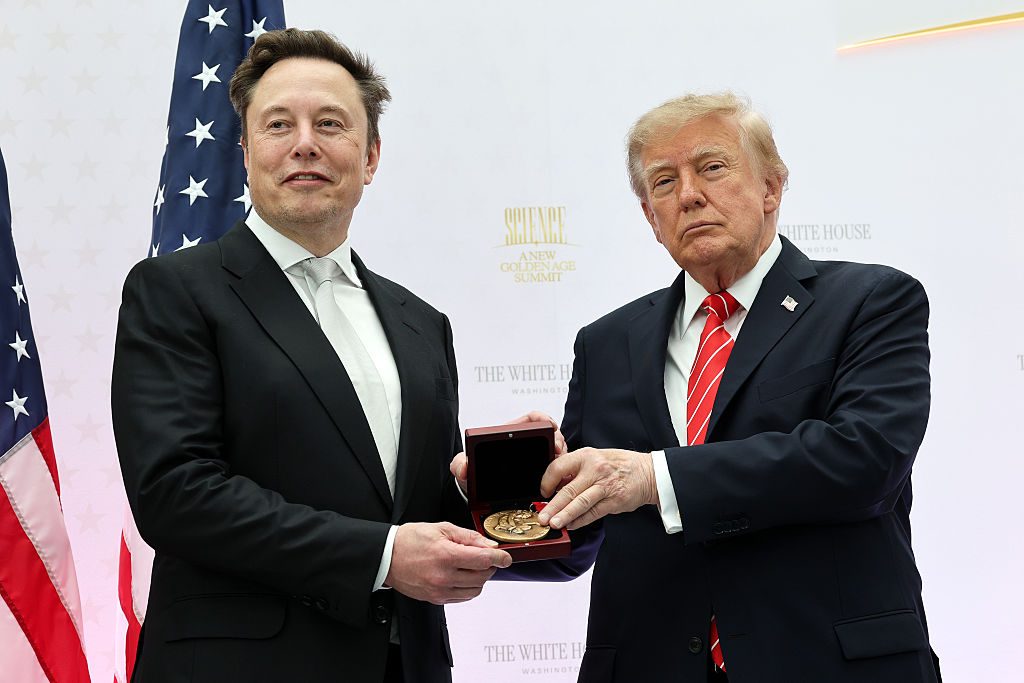
Tesla and SpaceX CEO Elon Musk, who received the National Medal of Science from President Donald Trump on Oct. 8, is the biggest political donor for the second election cycle in a row. (Photo by Win McNamee/Getty Images)
Tech mogul Elon Musk once again led all political donors, contributing more than $445 million to Republican candidates, political action committees and outside spending organizations ahead of the 2026 midterm election, according to an OpenSecrets analysis of federal campaign finance disclosures.
Musk also topped the donor rankings during the 2024 federal election cycle with more than $291 million. He was one of three donors to surpass $100 million this cycle. The others in the top three were shipping supplies company founder Richard Uihlein and his wife, Elizabeth, and trading firm co-founder Jeff Yass. They combined to contribute more than $706 million, all supporting Republican candidates and conservative causes.
Former New York City Mayor Michael Bloomberg, who ranked fourth overall, was the top donor to Democratic causes and candidates, contributing $83.4 million. The top 10 individual donors contributed $1.1 billion combined.
(function(){function e(){window.addEventListener(`message`,function(e){if(e.data[`datawrapper-height`]!==void 0){var t=document.querySelectorAll(`iframe`);for(var n in e.data[`datawrapper-height`])for(var r=0,i;i=t[r];r++)if(i.contentWindow===e.source){var a=e.data[`datawrapper-height`][n]+`px`;i.style.height=a}}})}e()})();
Of the top 15 individual donors, 12 directed the vast majority of their contributions — 90% or more — to causes and candidates with an ideological lean: eight to Republican-aligned groups, and four to Democratic ones.
Businesswoman Miriam Adelson, the third-leading donor in 2024, ranked fifth this year at $67.6 million. She was followed by Marc Andreessen and Ben Horowitz, venture capitalists and prominent supporters of artificial intelligence and cryptocurrency super PACs. Andreessen donated $57.3 million, while Horowitz contributed $56.9 million.
As in past cycles, these megadonors took advantage of campaign finance rules allowing unlimited contributions to independent outside groups such as super PACs, which can spend without limit to support or attack candidates so long as they do not coordinate directly with campaign committees. By contrast, direct contributions to campaigns, political parties or PACs — known as “hard money” — are strictly capped and disclosed.
Musk, for example, made $261,800 in hard-money donations — less than one-tenth of 1% of his total giving. That pattern held constant across the leaderboard: for 12 of the top 15 donors, more than 95% of their total contributions went to outside groups.
