


Sixty-five years ago, a bold vision took root in Houston: a NASA center dedicated to human spaceflight. Since its founding, NASA’s Johnson Space Center has helped lead the nation’s human spaceflight program, supporting missions from Project Mercury through Artemis.
Today, Johnson serves as NASA’s Center of Excellence for Human Spaceflight, and its workforce is helping to usher in a Golden Age of innovation and discovery. Johnson is home to America’s astronaut corps, the Mission Control Center, and the teams behind some of humanity’s greatest achievements in space. As NASA’s human spaceflight programs evolve, Johnson remains at the forefront of these efforts.
Houston is home to NASA’s Low Earth Orbit Program, comprising International Space Station operations and commercial partnerships and destinations in low Earth orbit. For missions beyond low Earth orbit, Johnson houses the Moon Base Program and Orion Program, while NASA’s Human Health and Performance Directorate and Human Research Program work to protect crew health and performance as missions extend farther from Earth.
On May 25, 1961, the center’s story began when President John F. Kennedy gave a speech before a joint session of Congress, committing the nation to achieve the goal of landing a man on the Moon and returning him safely to Earth before the end of the decade.
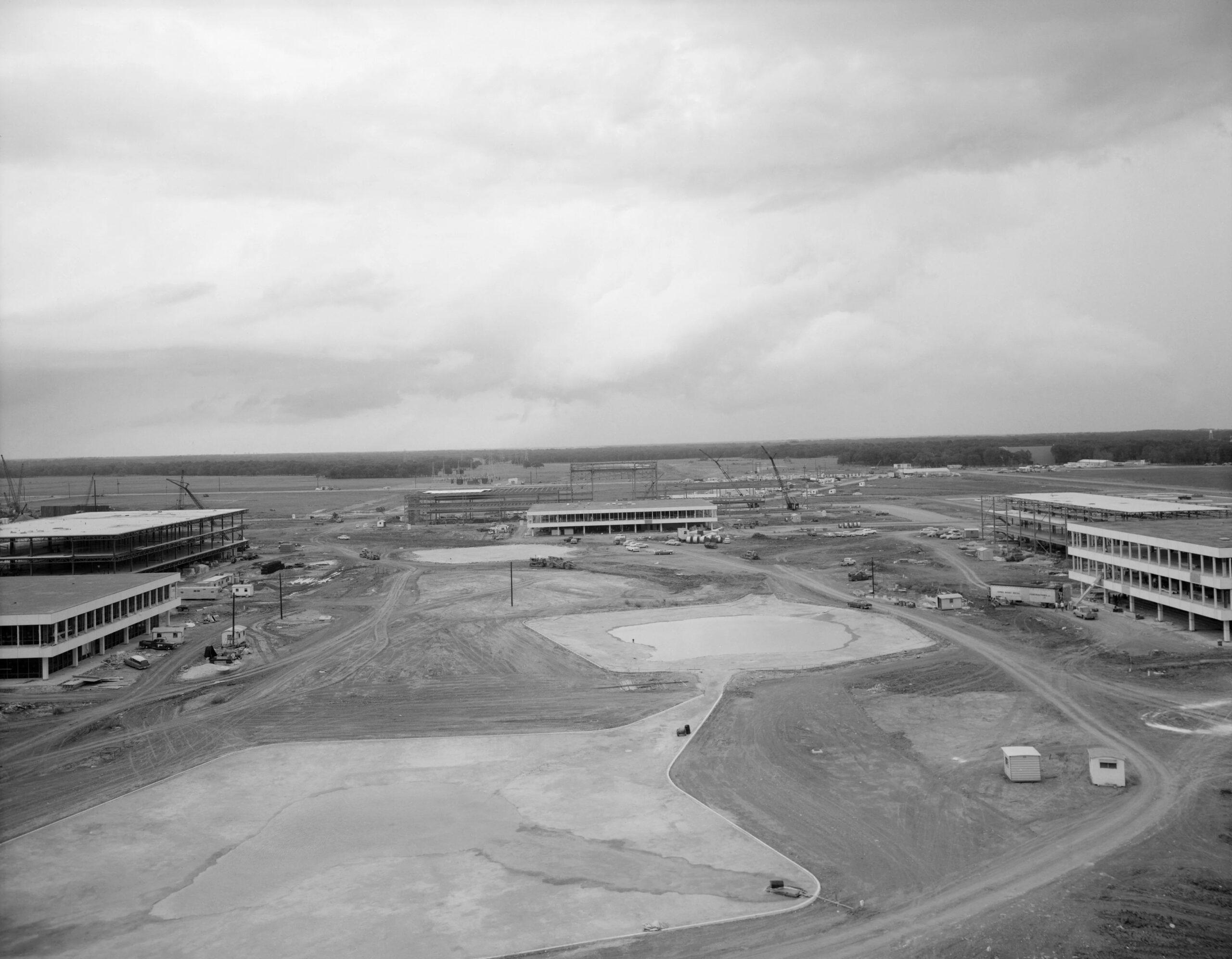
NASA’s Space Task Group, in charge of America’s human spaceflight program, was already working on Project Mercury to put astronauts into Earth orbit, but with the additional task of a human lunar landing, it soon outgrew its facilities at NASA’s Langley Research Center in Hampton, Virginia. The agency decided it needed a dedicated field center for human spaceflight and on Sept. 19, 1961, after evaluating multiple sites around the country, NASA announced that the new Manned Spacecraft Center would be built near Houston, Texas. The agency established the center on Nov. 1, 1961, and construction began in 1962. In 1973, it officially became NASA’s Lyndon B. Johnson Space Center in honor of President Johnson for his ardent support of America’s space program from its foundation.
The Manned Spacecraft Center officially opened on Nov. 1, 1961, and while construction continued on the Clear Lake site, employees worked in 13 leased buildings in southeast Houston. The design phase took six months and construction of the first buildings took 18 months, with the first employees moving onto the new site in late 1963.
Over the decades, the number of buildings grew, and continues to grow, to meet the demands of new spaceflight programs.
Construction of the nine-story Project Management Building began on Dec. 5, 1962, and concluded on March 15, 1964. Robert Gilruth, the center’s first director, moved into his office on March 5, 1964, on the top floor of the edifice then known as Building 2. The building swapped numbers with the Public Affairs Building, originally known as Building 1, on June 30, 1974.
The use of neutral buoyancy for spacewalk training began with the Gemini XII mission in 1966. In 1967, workers installed an above-ground circular pool called the Water Immersion Facility for astronaut training that supported Apollo and pre-Shuttle spacewalk training.. To accommodate the larger size of the space shuttle payload bay, spacewalk training moved to the Weightless Environment Training Facility iin 1980. Astronauts used it for nearly all shuttle spacewalk training until 1997, when the Neutral Buoyancy Laboratory in the Sonny Carter Training Center entered operations for both shuttle and space station training, as well as testing future space suits and lunar surface activities.
To prevent any back contamination from any possible lunar microorganisms, NASA designed the Lunar Receiving Laboratory in Building 37. Construction began in August 1966, with the first employees moving into their offices in June 1967. The astronauts from Apollo 11, 12, and 14 completed their three-week postflight quarantine in the lab, and scientists in the various laboratories studied the lunar samples all the Apollo missions returned.
Following the Apollo program, Life Sciences division and laboratories moved into the building until they relocated in 2017. Following demolition of Building 37, the Lunar Receiving Park, dedicated in 2026, honors the history of the laboratory.
Construction of Building 9 began in December 1965 and finished in March 1967. The building initially housed the Technical Services Facility. In April 1969, workers converted a portion of the building to include a mock lunar surface scene, complete with a mockup of a Lunar Module, used by Apollo 11 astronauts. To support the space shuttle program, workers completed an addition that housed the Mockup and Integration Laboratory in September 1974. Astronauts for all 135 shuttle missions used the mockups for training. An extension on the northwest side of thebuilding begun in 1986 and completed in 1988. It received mockups of Space Station Freedom and later of the International Space Station, and the building was renamed the Space Vehicle Mockup Facility. Today, the facility also houses training mockups of NASA’s Orion spacecraft, commercial mockups, and the Active Response Gravity Offload System, known as ARGOS.
Construction of Building 5, the Mission Simulation and Training Facility completed inApril 1965 and began supporting missions beginning with Gemini IV in June 1965. The building originally contained the Gemini spacecraft simulator and a Gemini translation and docking simulator. Apollo program simulators, including a command module and lunar module simulator, began arriving in December 1965. From 1967 and 1978, astronauts used the Water Immersion Facility for spacewalk training. In the early 1970s, the building also housed full-scale, high-fidelity trainers and simulators of Skylab’s components, which all nine Skylab astronauts used for mission training. In the late 1970s, the facility underwent major renovations to support the space shuttle program, with the addition of fixed base and motion base simulators. The Space Station Training Facility addition, completed in 1991, supported first Space Station Freedom and now International Space Station crew training, and also contains Orion and Starliner simulators.
Construction of Building 30 housing the Mission Control Center began in June 1963 and finished in November 1964, with technicians installing the real-time computer in April 1964 and the first employees moving in two months later. The center initially housed two mission operations control rooms to support Gemini and Apollo missions and simulations. By January 1965, the center monitored the uncrewed Gemini 2 mission and the crewed Gemini 3 mission in a flight following mode.
In June 1965, Houston had full control of Gemini IV and has controlled each of NASA’s human space flight missions ever since. The control center received a major upgrade to its computer systems in the mid-1970s to support upcoming space shuttle flights. On April 4, 2011, the building was renamed the Christopher C. Kraft, Jr. Mission Control Center, in honor of the man who created the concepts still in use today in human spaceflight control. The control center continues to support the space station around the clock as well as Artemis missions taking humans back to the Moon.
