


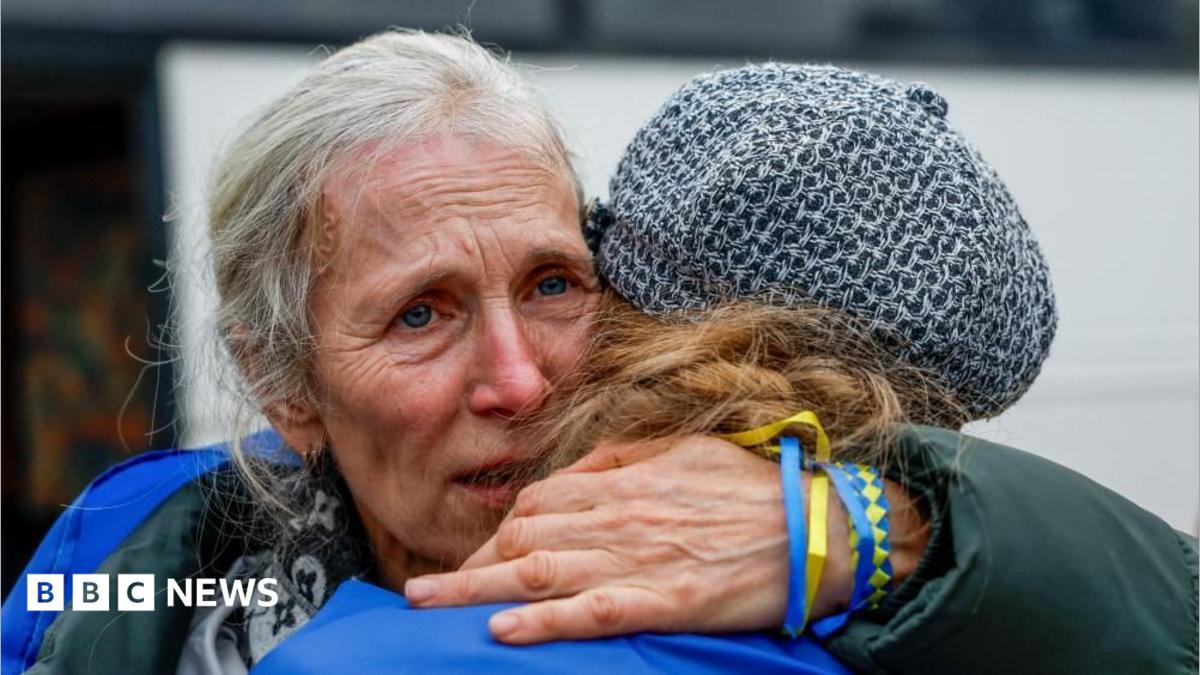
The ceasefire allowed the road out of the city to be cleared of mines and humanitarian aid to be delivered.
Ceasefire measures will remain in place until the end of Sunday 1 November.
Residents had a four-hour window to leave before a convoy of 25 buses, with space for 750 people, left the town on Friday afternoon – along with ambulances for people with limited mobility.
Ukrainian military positions lie just 5km (3.1 miles) from Oleshky but evacuees first had to travel into Russian-occupied territory and then to the southern Russian city of Anapa, where they flew to Gomel in Belarus, before finally travelling on to Ukraine.
Several hundred people are understood to have decided to stay in the war-torn city, despite widespread devastation and the lack of gas, electricity and running water.
Before the war, Oleshky was home to 24,000 people, but it was seized by Russia during the first days of its full-scale invasion.
Ukraine’s human rights ombudsman Dmytro Lubinets said on Friday morning that those who decided to stay “will receive all the necessary humanitarian assistance”.
Lubinets and his Russian counterpart Yana Lantratova travelled to Oleshky together on Friday, setting off from Armiansk, in the Russian-occupied Crimean peninsula.
Lubinets is the first Ukrainian official since the start of the war to visit Russian-occupied parts of Ukraine.
Zelensky praised Lubinets and his team for helping the evacuees be moved to safety.
The Ukrainian President also thanked those who had helped bring attention to the “true humanitarian catastrophe in Ukrainian territory temporarily occupied by Russia”.
Footage shared by Zelensky showed Oleshky residents waving Ukrainian flags as they boarded a bus.
