


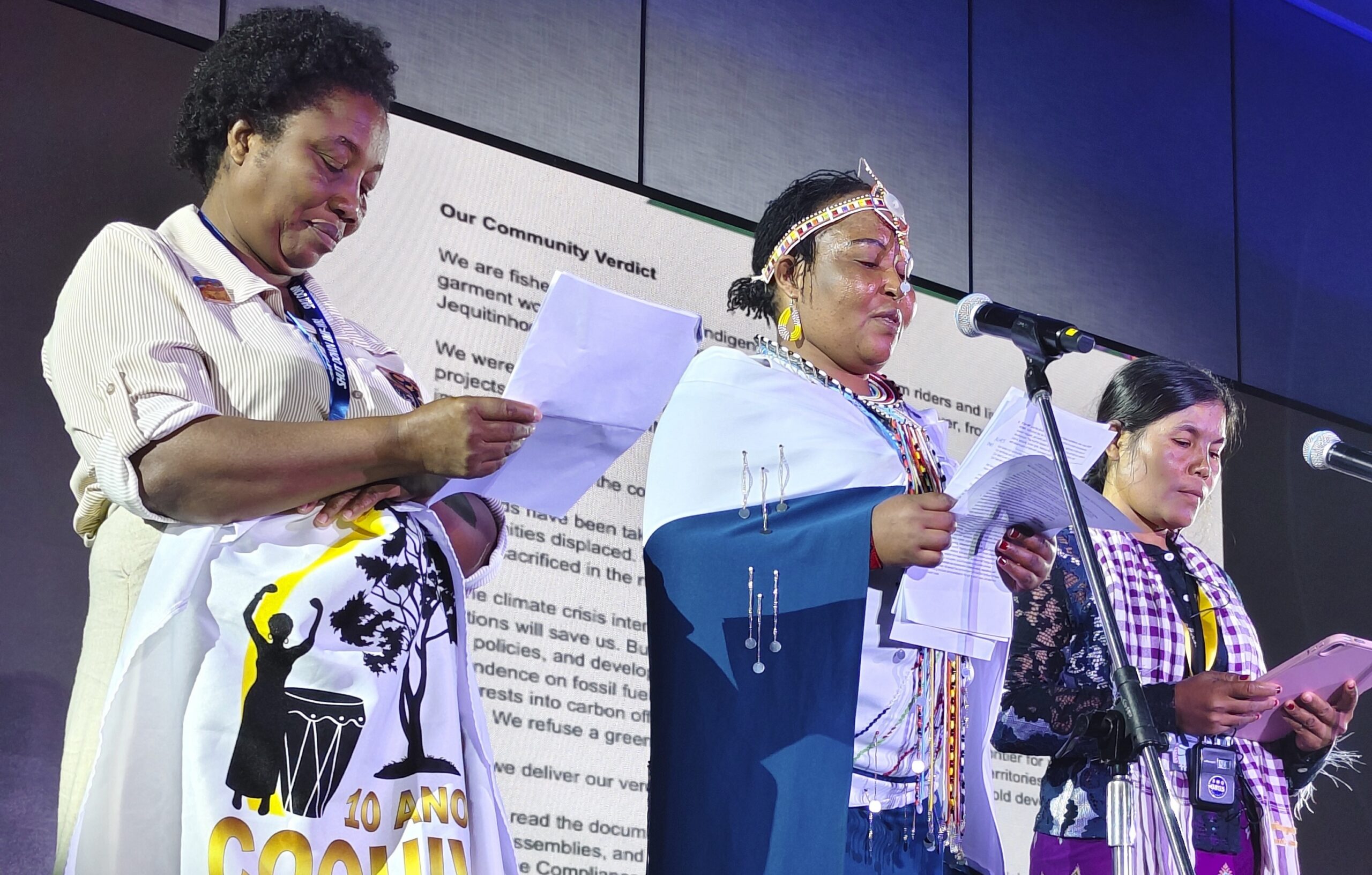
- During a recent “people’s tribunal” in Bangkok, women from across Asia spoke about their experiences as leaders of movements seeking justice for communities affected by World Bank-funded development projects.
- The women are from communities affected by a variety of projects across the continent, including dams and land redistribution programs.
- Several themes emerged from the discussions, including the importance of maintaining resistance for decades, the obstacles and dangers faced by protest leaders, and the way that documenting struggles can serve as both a tool of resistance and a means of survival.
BANGKOK — Now in her mid-70s, Sompong Viengchan has seen 16 prime ministers and 26 cabinets come and go during her fight against a dam upstream of her village.
Governments change; her demand for justice remains.
Since 1990, Sompong and her neighbors along the Mun and Mekong rivers have fought relentlessly to prove that the 136 MW multipurpose Pak Mun Dam, co-funded by the World Bank Group and built to deliver promised prosperity, instead took their livelihoods.
At a people’s tribunal in Bangkok in October, aimed at highlighting the social and environmental impacts of IMF and World Bank-funded projects, Sompong told the story of the women-led Pak Mun Dam movement to 400 women land defenders from more than 30 nations.
“Living in the village downstream with no agricultural land, we rely primarily on fishing,” Sompong said. “Blasting rock for dam construction wiped out local fish. We faced financial ruin — investments vanished and were replaced by debt; livelihoods became impossible to sustain. Families were forced to send their children to big cities to work, and when the area flooded, the entire community had to relocate.”
In 2000, the World Commission on Dams, a body established by the World Bank and IUCN, determined the dam took houses and land, or both, from around 1,700 households and that fish catches in the reservoir and directly upstream declined by 60-80%.
“Building a dam is the same as burying a person alive,” Sompong said. “It doesn’t kill you right away, but it ruins your life. We used to catch and sell fish, but now we are compelled to buy fish to eat.”
In 2026, after 36 years of protest marches and encampments, communities have successfully pushed authorities to reconsider if the dam’s electricity justifies its social and ecological costs. The Electricity Generating Authority of Thailand lists Pak Mun Dam’s average annual generation as roughly equivalent to a fully optimized 32 MW dam — a figure far short of its 136 MW capacity.
Their persistence has also secured periodic openings of the dam’s gates, allowing migratory fish to move upstream.
Common experiences
Sompong ’s story was echoed at the tribunal by the experiences of speakers and attendees from across Asia.
Manju, a farmer born and raised in the Rai indigenous community along Nepal’s Dudh Koshi River, now lives within the footprint of the Dudh Koshi Storage Hydroelectric Project , a 670 MW dam, planned with support from the World Bank and Asian Development Bank.
Since 2023, land-use restrictions in the project area have frozen daily life, Manju told Mongabay: “We cannot buy or sell our lands under the freeze order by the government. A freeze blocked us from financing our children’s education.”
Construction has yet to begin, but Manju said local residents already feel its impact. One of the greatest stresses, she said, is uncertainty. Villagers don’t know how much of their ancestral land will be lost or what the ultimate toll will be on the natural riches once tended by their ancestors.
In Indonesia’s Central Java, Risma Umar, a social activist with Aksi for Gender, Social and Ecological Justice, helped lead the campaign for justice for people displaced by the Kedung Ombo Dam, for which the World Bank provided $156 million in 1985. Part of her role, she said, was documenting suffering that persisted well after the reservoir began to fill in 1989, and through a decades-long fight for just compensation.
“This isn’t just an issue of poverty or environment, but one of prolonged, intergenerational trauma faced by women,” she said.

Risma recounts how residents, intimidated by the military and falsely branded communist sympathizers for resisting relocation, fled into hiding. One woman, she said, “will until now hid under her own bed … or fled up the mountain when she sees men in uniform.”
Yokbeth Felle, a West Papuan activist, also emphasized the importance of documentation. Home to the world’s largest gold mine and vast copper reserves, Yokbeth’s corner of the world’s largest archipelagic nation paradoxically remains among Indonesia’s most disadvantaged regions for health, education and living standards. For years, Yokbeth has used independent media, online platforms and community-led documentation to bring Papuan voices to the world. “Within a system that marginalizes us in our own land, documentation is both a tool of resistance and a means of survival,” she said.

Cathy Estavillo, secretary general of the Philippines’ Amihan National Federation of Peasant Women, has spent years seeking justice for communities affected by the SPLIT program: A World Bank-financed effort to convert collectively held agrarian reform lands into individual titles in roughly 1.4 million hectares (3.5 million acres) and 77 provinces across the Philippines. “This individualization has exposed vulnerable households to severe economic risks, with poor farmers forced to pawn or sell their land titles to outside investors,” she said.
For Estavillo, leading a peasant women’s movement has meant confronting efforts to cut off resources, and her family’s fears for her safety. In 2021, Philippine authorities froze Amihan’s bank accounts, alleging that the organization financed communist rebels. Estavillo says the freeze halted a project supporting women farmers.
The dangers can be far greater: Global Witness identifies the Philippines as Asia’s deadliest country for land and environmental defenders, with 12 documented killings in 2025 and military involvement suspected in five of those deaths.
At the tribunal, Estavillo publicly condemned the intimidation and demanded accountability from both the government and the funders like the World Bank.
“Women and farmers will not be cowed in raising awareness, organizing, and mobilizing to advance the fundamental rights of the people,” she said.
Pak Mun’s gates are open again, but lost livelihoods and scattered families cannot be easily put back together. From Thailand to Nepal, from the Philippines to Indonesia, these women are fighting to ensure the damage isn’t forgotten — or repeated.
Banner image: Representatives of 400 women’s rights defenders who joined “Our Voices Count! Counter Docket” read their demands in Bangkok, Thailand in October 2026. Image by the Asia Pacific Forum on Women, Law and Development.
The long struggle of women farmers to halt a zinc mine in North Sumatra
Across Southeast Asia, Indigenous women challenge extraction and erasure
FEEDBACK: Use this form to send a message to the editor responsible for this story. If you want to post a public comment, you can do that at the bottom of the page.
Cite this article
Kannikar Petchkaew (2026). The women who won’t let go: Female-led resistance to development harms across Asia. Mongabay Conservation news. DOI: https://doi.org/10.66709/news-334537

