


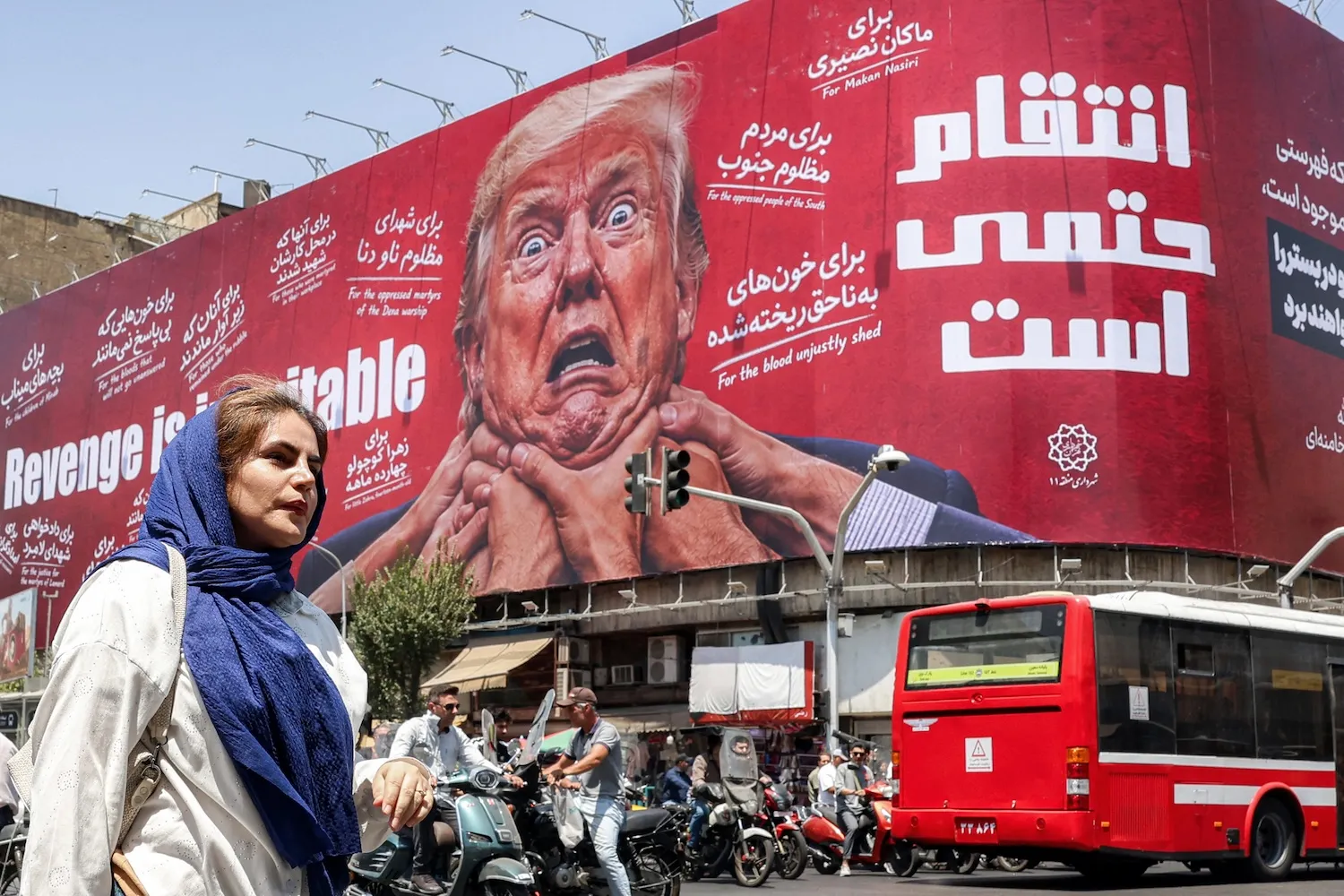
If there’s one thing that’s clear in the aftermath of the Israeli election, it is that Benjamin Netanyahu will remain prime minister—for at least a few weeks and probably several months—while the political haggling is underway. And that means that the prospects of another U.S.-Israeli war with Iran are high. Netanyahu has been pushing for a new round for weeks, and the Trump administration has reportedly advised allies to expect a military campaign after the U.S. midterm elections on Nov. 3. That campaign might be meant to force Iran back to the bargaining table—or to topple the regime. Either way, another war is unlikely to achieve even the most minimal U.S. and Israeli goals.
The United States is now locked in exactly the kind of protracted war scape in which decisive victory is close to impossible. Iran has long thrived in these environments. The U.S. blockade and episodic violence hurt Iran, to be sure, but the pain is not evenly distributed. It tends to reinforce rather than degrade regime control, strengthen the hand of hard-liners over any remaining moderates, and provide a ready-made excuse for collective suffering that might otherwise be blamed on the country’s leaders.
Such a conflict will, by its nature, defy U.S. and Israeli hopes for a decisive blow. After the initial kinetic period, the hostilities will likely continue whether or not there is active shooting, forcing every affected actor to prepare as if violence could return at any moment. Talk of victory or defeat—whether for U.S. domestic political consumption or, worse, for the Pentagon’s actual war planning—has little meaning in a conflict that Iranians rightly expect to continue for many years to come. America’s regional allies that have to live in this environment can see this clearly and want none of it. That constant risk of a sudden eruption would deny the Gulf states the kind of stability and security they desperately need to get their economic projects back on track. And it would leave the door open to flare-ups elsewhere, such as the Houthi sweep down the Red Sea coast and seizure of the Bab el-Mandeb chokepoint in September.
The suggestion to launch a renewed, intense military campaign represents a tacit recognition of U.S. failure. No amount of happy talk about the increased volume of oil flowing through the Strait of Hormuz and the mounting economic costs of the blockade on Iran can mask the new strategic reality. Iran has proved that it retains the capacity to close the strait when it wishes, and the Houthi advances in the Red Sea and effective targeting of Saudi Arabia have expanded Iran’s range of options. A diplomatic solution has been rendered largely impossible by the Trump administration’s constantly changing positions and incoherent messaging, which give Iran no reason to even consider a deal. From Tehran’s vantage point, any agreement would likely be broken before the ink was dry. Trump’s signature, as Canadian Prime Minister Mark Carney has quipped, is written in pencil.
But if Iran can live with the state of potential war and episodic eruptions of violence, the Arab Gulf states cannot. Bahrain, Kuwait, and Qatar have no alternative shipping routes other than the Strait of Hormuz. Saudi Arabia, which for a time thought it could adapt by shifting its oil exports to the Red Sea, learned the hard way that it could not count on that option in the rapidly mutating conflict. The Houthi seizure of Yemen’s Red Sea coast and control over the Bab el-Mandeb and an Iraqi militia drone strike temporarily disabling the East-West pipeline put an end to that fantasy.
The escalating Houthi attacks on Saudi airports, oil facilities, and other targets, along with the Saudi inability to mount an effective military challenge to the new Houthi positions, have caught Riyadh in an untenable bind. The United States rather shockingly declined to come Riyadh’s assistance against the Houthis. That may be for the best. The large-scale international intervention against the Houthis proposed by the Saudi ambassador to the United States this week would simply pull the world deeper into an unwinnable war scape. Nor is the Mecca Pact between Saudi Arabia, Turkey, and Pakistan going to ride to a military rescue in Yemen. The three countries may have ratified the defense pact and floated intervention possibilities, but neither country is likely to provide the ground troops that would be needed.
Read More
-
An explosion in Tehran after a missile strike An explosion in Tehran after a missile strike America’s Least Bad Option in Iran
Why staying the course is the most prudent of Washington’s three unsavory choices.

-

Three people rest on a sandy beach while a large, partially submerged and tilted ship sits out in the water in the background. The sky above is a hazy gray with cloud cover. Three people rest on a sandy beach while a large, partially submerged and tilted ship sits out in the water in the background. The sky above is a hazy gray with cloud cover. The Iran War Has Changed the World Forever
Some dramatic long-term consequences are just beginning to come into view.
-

A street scene featuring a large billboard displaying military-themed artwork in an urban environment. In the foreground, a woman wearing a light-colored coat, headscarf, and dark trousers walks across the foreground from right to left. Behind her, a white hatchback car is parked along the street in front of a shaded structure. In the background, a massive billboard mounted on the side of a tall building depicts a figure in uniform standing over a large aquatic object or piece of military hardware wrapped in nets. Persian text is printed in large bold lettering on the right side of the billboard. Clear blue skies frame the background above the city skyline. A street scene featuring a large billboard displaying military-themed artwork in an urban environment. In the foreground, a woman wearing a light-colored coat, headscarf, and dark trousers walks across the foreground from right to left. Behind her, a white hatchback car is parked along the street in front of a shaded structure. In the background, a massive billboard mounted on the side of a tall building depicts a figure in uniform standing over a large aquatic object or piece of military hardware wrapped in nets. Persian text is printed in large bold lettering on the right side of the billboard. Clear blue skies frame the background above the city skyline. Some Tout a U.S. Victory in Iran. I’m Not So Sure.
To get out of this quagmire, Washington must decide what it wants.
But there could be a silver lining in this parade of failure. With no plausible military path to victory in Yemen or over Iran, Saudi Arabia has little stomach for renewed war and strong incentives to find a diplomatic way out of its predicament. The Saudis desperately need the Strait of Hormuz and the Bab el-Mandeb reopened in a predictable and regulated way. They need an extended period of calm to reassure investors and tourists essential to economic transformation plans. That’s probably why a high-level Mecca Pact delegation visited Tehran this week and why other Gulf states have been urgently looking for a diplomatic path away from war. As Oman’s foreign minister recently noted, there is no security order in the Gulf without Iran and no alternative to a working relationship. That view seems increasingly prevalent in the Gulf—outside of Abu Dhabi—even as Washington prefers to dive deeper into its unwinnable war.
The current Iranian leadership does not think about this in terms of the resumption of war. It considers the war to be ongoing. While it would have little faith in any U.S. promises, it is conceivable that it might view Saudi-led outreach more positively, as a way to lock in its gains from the war and create a buffer against America’s more extreme options. The damage inflicted on Iran’s economy and infrastructure is real and will require massive rebuilding. There’s precedent. Following the conclusion of the horrifically destructive eight-year Iran-Iraq War and the death of Ayatollah Ruhollah Khomeini in the late 1980s, the new leadership of Akbar Hashemi Rafsanjani and Ali Khamenei chose to ratchet down revolutionary rhetoric and militant adventurism and create a period of calm to allow desperately needed economic reconstruction. Perhaps the new Revolutionary Guard-led Iran would do the same.
A de-escalatory deal between Iran and the Saudi-led bloc would pose a challenge to Israel and its allies in the region, primarily the United Arab Emirates, as well as to U.S. conceits about determining the terms of regional order. Netanyahu has been using apocalyptic language about the urgency of finishing the job. Indeed, a U.S.-Israeli attack might be motivated less by fear of Iranian escalation or nuclear progress than by fear of a new regional order consolidating in which Iran has reconciled with a Saudi coalition incorporating most of the major powers in the broadly defined region.
The Trump administration no doubt sees itself in an intractable situation from which it can still escalate to win. That is an illusion. Iran is once again perfectly capable of seeing the blow coming. It will not be taken by surprise and has already signaled its intentions to respond. The regime has strong grounds to believe that it (if not the Iranian people) will survive and prosper even under another round of intense military attack. The possible strike would simply accelerate the escalatory dynamics and reinforce emergent Arab convictions that the United States has become a destabilizing force and an unreliable partner that cannot be counted on to provide security or order. When the smoke once again clears, in Iran and in the countries that bore the costs of its retaliation, the renewed campaign may well prove to have been the final blow not to the Iranian regime but to U.S. leadership in the region.
