


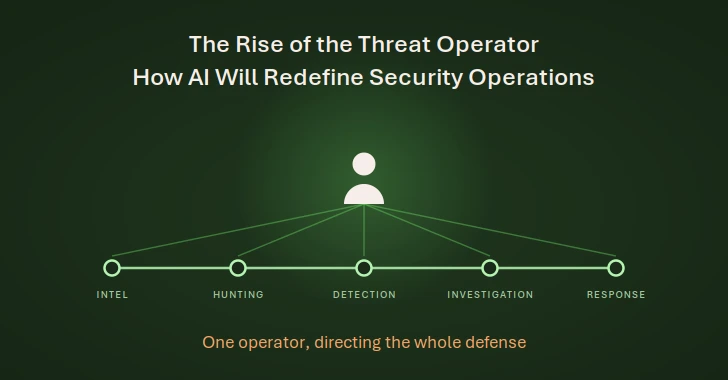
AI is beginning to take over much of the work that has traditionally defined the security analyst’s job. Investigating alerts, collecting evidence, correlating activity across tools, and executing response actions are becoming tasks that AI systems can perform on their own. As these capabilities mature, security operations centers (SOCs) will see major changes in how work is organized, how decisions are made, and what is expected of the people responsible for defending organizations.
For security professionals, this is a chance to take on a much broader role. As AI assumes more of the operational workload, analysts can move beyond individual alerts and investigations to direct the defense across the entire security lifecycle. We call this emerging role the Threat Operator: an AI-native security professional who translates business risk into defensive priorities, directs AI-driven operations, and exercises judgment over the decisions and actions taken by those systems.
The impact reaches beyond day-to-day SOC work. It will change the skills organizations need, how security professionals develop expertise, and the career paths open to people entering the field.
From Individual Tasks to Overall Defense
The traditional SOC developed around specialized functions, each supported by its own tools and workflows. Threat intelligence teams study adversaries, detection engineers create rules, threat hunters search for activity that existing controls may have missed, analysts investigate alerts, and incident responders contain confirmed threats. These functions are closely related, yet the work often moves between teams through separate systems, tickets, and manual handoffs. AI is starting to tie these activities together. For example, intelligence about a new threat can lead to a hunting hypothesis, which can reveal a detection gap and produce a new detection. That detection may identify suspicious activity requiring investigation, followed by containment and further improvements to the organization’s defenses. AI agents can coordinate and execute these workflows, carrying context and findings from one stage to the next.
That changes where security professionals add the most value. A Threat Operator works across the defensive lifecycle, setting priorities based on the organization’s exposure, business operations, and threat landscape. They determine which risks deserve attention, what the defense should accomplish, how much autonomy AI should have, and when a decision requires human intervention. They are also responsible for judging whether the operation is actually improving security.
Consider a financial institution facing a newly identified threat targeting identity infrastructure. AI agents could assess the institution’s exposure, hunt for relevant activity, identify gaps in existing detections, and recommend defensive actions. The Threat Operator would provide the institutional context needed to guide that work, including which systems support critical business processes, what constitutes unacceptable risk, and which actions require authorization.
The result is a gradual shift from human-in-the-loop to human-on-the-loop, with security professionals supervising and governing AI-driven operations. The level of autonomy will depend on the maturity of the technology, the consequences of particular actions, and the organization’s tolerance for risk, but a human remains accountable throughout.
Rethinking How Security Professionals Gain Experience
Junior security analysts will feel some of the biggest effects. For decades, the SOC has provided an entry point into cybersecurity, with analysts developing their skills through alert triage, evidence collection, investigations, documentation, and escalation. Although much of this work is repetitive, it has also served as an apprenticeship. Over time, analysts learn how systems behave, how attackers operate, and how experienced practitioners distinguish genuine threats from benign activity. As AI absorbs more of these responsibilities, organizations will need to rethink how that experience is acquired. The traditional progression from handling simple alerts to managing complex investigations may become less relevant as AI takes on more sophisticated work. Without a deliberate approach to training, security teams may struggle to develop the experienced professionals they will need in the future.
AI can also open up a different path for professional development. Junior Threat Operators can gain supervised exposure to a much wider range of security activities, examining how intelligence informs hunting, how detections are developed, how investigations reach conclusions, and how response decisions affect the business. They can review the evidence behind AI-generated findings, challenge assumptions, identify missing context, and learn from the decisions made by more experienced colleagues. This only works if organizations invest in technical fundamentals and structured mentorship. Analysts still need to understand networks, operating systems, attacker techniques, and the security technologies underlying AI-driven workflows. Experienced practitioners will need to teach younger colleagues how to evaluate conclusions, recognize uncertainty, and exercise judgment when the available evidence is incomplete.
The Skills Needed
For the current generation of security analysts, technical proficiency has often been measured through familiarity with security tools and the ability to extract useful information from them. Query languages, detection logic, endpoint telemetry, and investigation techniques have been central to the profession. Those skills still matter. AI adds new demands on top of them: orchestration, governance, and interpreting automated decisions.
Threat Operators will need to translate business security risks into clear defensive objectives that AI systems can execute. They must understand the organization’s architecture, critical assets, operational dependencies, and relevant adversaries, and know how to communicate that context to AI agents. Their work will involve evaluating hypotheses, validating evidence, setting escalation criteria, and determining whether an automated action has achieved its intended outcome.
For example, an AI system investigating a compromised server may recommend immediate isolation. That call could be technically sound. But the server may support a critical business process where disruption carries significant consequences. A Threat Operator must understand those dependencies and determine how the response should proceed, balancing containment requirements with operational risk. This need for defined oversight and accountability is also reflected in the NIST AI Risk Management Framework.
The role will combine four areas of expertise:
- Business security risk: Understanding organizational priorities, critical assets, and the consequences of security decisions.
- Threat and adversary understanding: Interpreting intelligence and anticipating how attackers may target the environment.
- Defensive operations: Understanding detection, hunting, investigation, and response across the security lifecycle.
- AI orchestration and judgment: Directing AI workflows, evaluating their conclusions, and governing automated actions.
Building a Career Path Around Defensive Outcomes
The Threat Operator role should become a career path with increasing levels of responsibility. Early-career operators can focus on validating evidence, reviewing AI conclusions, adding environmental context, and understanding how decisions connect across the defensive lifecycle. As they gain experience, they can begin translating business risks into defensive objectives, directing agent workflows, identifying coverage gaps, and determining when operations should escalate or act.
Senior Threat Operators will take responsibility for defining autonomy boundaries, governing consequential actions, evaluating the reliability of AI-driven decisions, and measuring whether security operations are reducing organizational risk. Professionals may enter this career path from investigations, threat intelligence, detection engineering, incident response, security architecture, or risk management, bringing different areas of expertise to a role that spans the entire defensive operation.
Security leaders should start building the training, governance, and progression frameworks needed to support these responsibilities. That includes establishing which decisions require human approval, how operators validate AI-generated evidence, how autonomy expands as systems demonstrate reliability, and how individual performance is evaluated. Measures such as the quality of defensive decisions, the closure of detection gaps, and improvements in threat coverage will matter more alongside traditional operational metrics.
This will happen at different speeds in different organizations. Security professionals will have more say in how their organizations defend themselves. The old SOC trained people to operate tools. The AI-native SOC has to train them to operate the defense.
Conifers.ai’s CognitiveSOC platform uses agentic AI to connect threat intelligence, hunting, detection engineering, investigation, and response, and every agent action comes with a reasoning chain and evidence trail that analysts can review. Learn more about how Conifers helps security teams direct and govern AI-driven defense across the full SOC lifecycle.
