


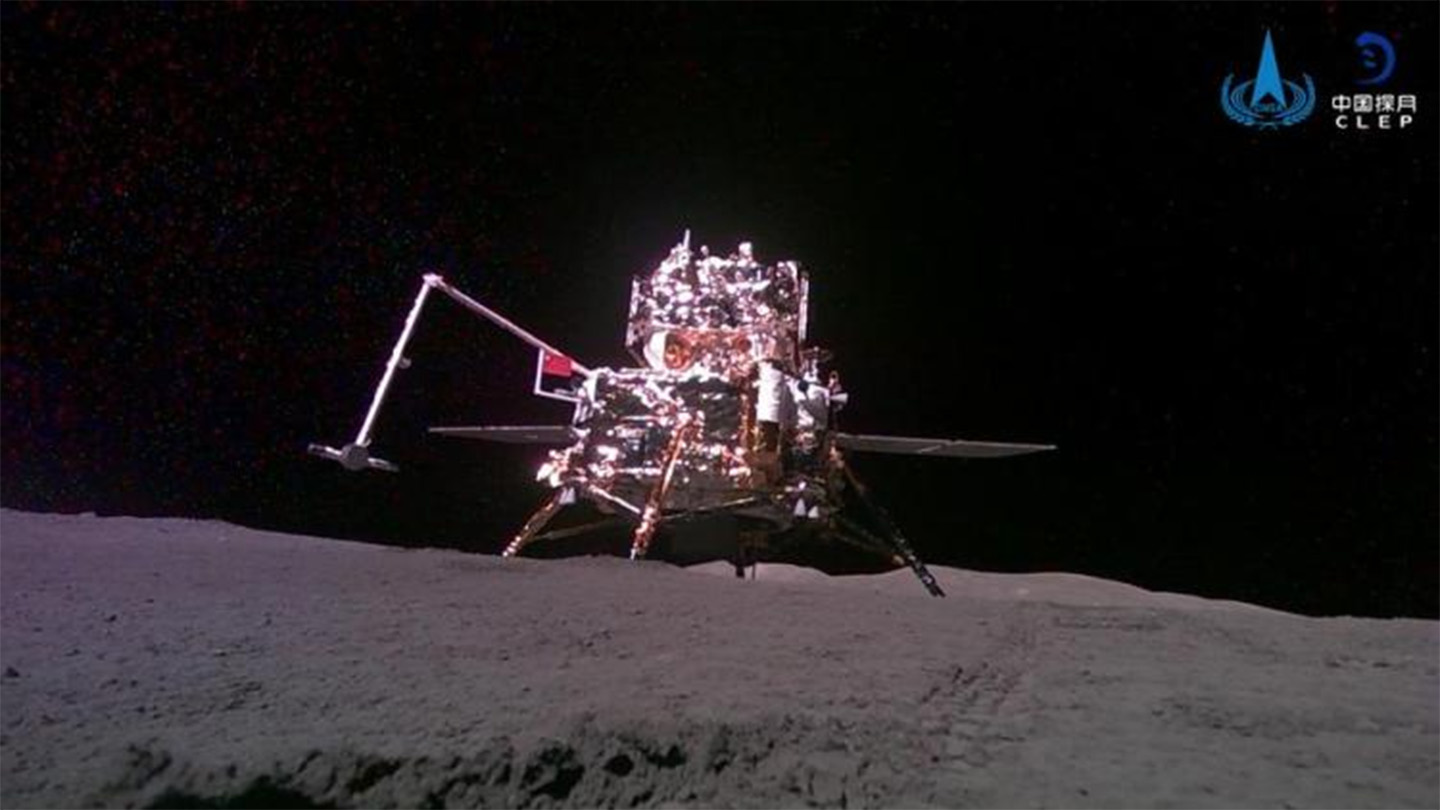
Bits of rock from the farside of the moon are adding weight to a scientific rethink about the solar system’s adolescence.
The moon’s craters and basins attest to its history of being battered by incoming space rocks. Planetary scientists long thought that these impacts spiked suddenly around 3.9 billion years ago, a period called the Late Heavy Bombardment.
But samples returned to Earth by China’s Chang’e-6 spacecraft in 2024 don’t back that idea up, scientists report July 23 in Science Advances. The rocks are the first analyzed that come from the moon’s farside, outside the range of one particularly influential nearside impact.
“The lunar farside bombardment was not dominated by a cataclysmic spike,” says Wanfeng Zhang, an engineer at the Guangzhou Institute of Geochemistry in China. Instead, the moon may have experienced a longer period of less frequent impacts.
Zhang and colleagues analyzed 28 bits of impact melt, rocks that were once liquified in the heat of a strike. The team measured the relative amounts of two isotopes of argon in the rocks to date when they last melted and resolidified, a proxy for the time a crater formed.
That technique provided the original evidence for the Late Heavy Bombardment. Many of the moon rocks from NASA’s Apollo and the Soviet Union’s Luna missions in the 1960s and ’70s appear to be around 3.9 billion years old, based on the same argon measurements.
This bombardment idea has influenced theories about the evolution of the solar system and the origins of life on Earth. But more recently, planetary scientists have started to question whether there was a single, short-lived cataclysm 3.9 billion years ago, a series of smaller spikes or something more gradual.
Part of the problem with the Apollo and Luna samples is that they all came from a part of the moon’s nearside that is covered in huge pools of solidified lava called mare. The mare make up the face of the iconic “man in the moon” (or rabbit, depending on how you look). Previous work suggested that the impact that created one of these pools, Mare Imbrium, spread debris so far across the moon’s face that a lot of the existing samples originated with that one event — which happens to have been about 3.92 billion years ago.
“As such, the lunar bombardment history is severely masked,” Zhang says. “This problem can be overcome by examining impact melt rocks from the lunar meteorites or samples [returned] from lunar farside.”
The Chang’e-6 samples come from a farside impact basin that is also named Apollo. They range from 4.33 billion to 1.13 billion years old and show no sign of a cluster around 3.9 billion years ago, Zhang and colleagues report. That suggests a long period of regular impacts, rather than one brief cataclysm.
It’s tough to draw conclusions about impact cadence with data from only one region, says planetary scientist Simone Marchi of the Southwest Research Institute in Boulder, Colo. And it’s true that prior data tend to be “plagued” by the influence of Mare Imbrium, and more samples from more parts of the moon would help, Marchi says.
Geochemist Mark Harrison of UCLA, an expert in argon dating, thinks the rock ages measured look accurate. Or at least as accurate as argon dating can be; Harrison’s previous work questioned whether argon can reliably date a single ancient impact.
But he also questions whether these rocks actually came from impacts or were just volcanic rock that cooled. The rocks in this study lack morphological features he would expect from impact melts, he says.
“The main issue is, how do we know this in any way relates to the bombardment history?” he says.
Still, if the finding holds up, it adds to a growing chorus of researchers doubting the Late Heavy Bombardment, Harrison says. “The mood in the room has changed. The paradigm is shifting, or has shifted.”
