


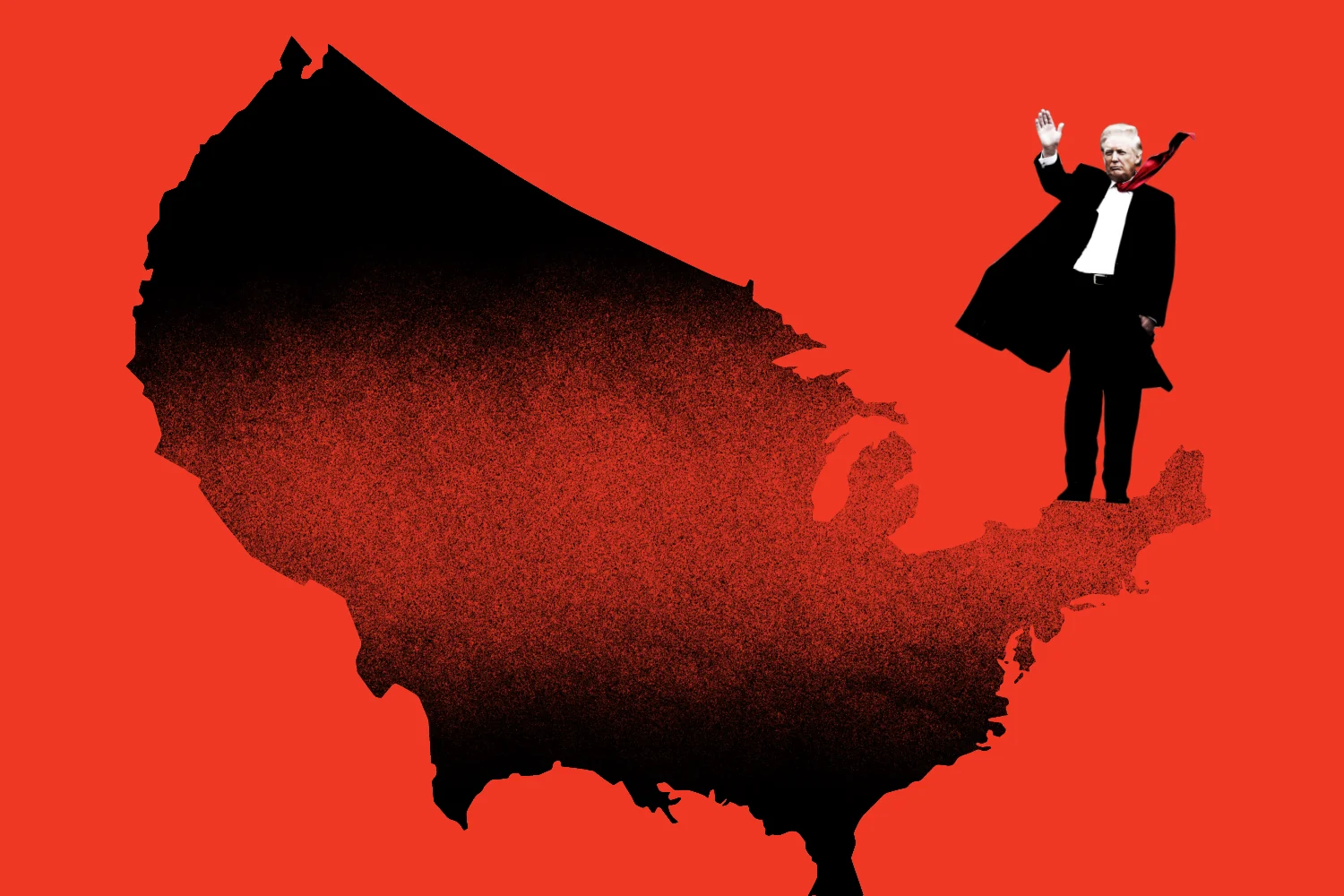
America’s geopolitical power is crumbling, and that shouldn’t be too much of a surprise. Hegemons, after all, rise and fall. Yet nobody in U.S. politics or punditry seems to actually want to talk about the consequences, especially for the American people. When it comes to decline, they either believe it won’t happen or won’t matter—in other words, that America can’t decline or that Americans will be just fine if it does.
Many in the neoconservative and traditionally conservative wings of the Republican Party believe that with the renewed application of its still considerable military and political power, America can remain the world’s dominant power for the foreseeable future. Republican restrainers, in turn, believe that if America forsakes dominance and conserves its power, global disorder can be kept at bay and the American people will be better for it. And while key figures in President Donald Trump’s orbit are all too worried about decline in racial or civilizational terms, they have their own dangerous and counterproductive ideas for how to reverse it.
On the Democratic side, many in the more traditional, liberal internationalist wing of the party maintain, with more modesty than their neoconservative counterparts, that Washington can still lead the way in renewing a global order that will broadly serve U.S. interests. Finally, the progressive wing of the party is convinced that a more restrained foreign policy will bring peace to the world and prosperity to ordinary voters, with the only negative consequences borne by the billionaire class.
But what if everyone’s right about the wrong things? The worst possible outcome would be if the restrainers prove correct about the fact that sustaining America’s global preeminence is no longer possible, and the neocons and liberal internationalists prove right about all the bad results. What if ordinary Americans really did benefit from the unique international stature of the United States, and will sorely miss it when it’s gone?
A protester holding a cardboard sign that reads “People Over Billionaires” takes part in a national day of protest in New York on March 28. Jerome Gilles/NurPhoto via Getty Images
Much as Trump’s presidency has served as a catalyst for American decline, his open disdain for the U.S. foreign-policy consensus has catalyzed the debate over what went wrong and what comes next.
Committed champions of Washington’s traditional foreign policy lament that voters no longer seem to support American global leadership. On the other side, many progressives and pro-restraint conservatives have argued that, however duplicitously, Trump channeled the public’s justified anger over Washington’s failed commitment to global hegemony.
But there’s an alternative, more worrying, story about what Americans really gained from their country’s unprecedented geopolitical power and why they concluded these gains were no longer being realized.
Over the course of the Cold War, and all the more so immediately after, U.S. foreign policy largely delivered voters the benefits of hegemony—both material and psychological—without the cost of extensive foreign wars.
In both good ways and bad, U.S. power helped underpin an extraordinary expansion of global trade and industrialization from which America and Americans grew wealthy. Washington defended democratic stability in Europe through NATO and imposed autocratic stability through friendly dictators in the Middle East. It used its economic power to help allies industrialize on America’s terms and push recalcitrant governments to open their markets, while using military force to secure the freedom of the seas and prevent other governments from industrializing on their own terms.
Meanwhile, the dynamism and independence of American education, combined with massive military spending and an apocalyptic arms race, helped drive unprecedented scientific breakthroughs.
Partially as a result of all this, America’s real GDP has grown more than tenfold since 1945. These gains have not been shared equally by the country’s population. But the period of postwar prosperity and broad-based economic growth also helped maintain public support for expanded government programs and a strong social safety net.
Meanwhile, Washington’s preponderance of power often enabled it to impose its will through pressure and proxy wars rather than direct military conflict. Other people paid the cost of American power, often in blood. While wars like Vietnam and Iraq took a violent toll on Americans, they took a far worse one on Vietnamese and Iraqis.
Now, however, that hegemony is waning—and so are the benefits. The financial gains from America’s position have increasingly accrued to a small and wealthy elite, while the prestige has accrued to a community that many Americans no longer identify with. As a result, voters now feel like they are paying the price of U.S. power without reaping its rewards.
Americans remain awkward about acknowledging the benefits of empire, and thus the price of losing it. Many neoconservatives and liberal internationalists are more comfortable discussing the freedom and prosperity American power brings the world. Trump and many others on the anti-internationalist right have taken the selfless side of this rhetoric at face value, suggesting that Americans are suckers for underwriting the world’s well-being free of charge.
Those on the left, by contrast, have been happy to highlight the material benefits of U.S. power. Progressive critiques have long reduced U.S. foreign policy to a neo-imperial bid for markets to exploit. But in this telling, the profits only ever accrued to big corporations, not ordinary Americans. Trump and the left might disagree on whether the plutocrats benefit from U.S. global hegemony, but they fundamentally agree that the rest of the country doesn’t. From this perspective, a more restrained foreign policy that accepts, even embraces, America’s smaller role in a more multipolar world brings considerable savings and no consequences.
Yet the reality may be this: During the heyday of postwar American foreign policy, the country’s role in the world really did bring widespread economic rewards to all Americans. But due to changes in the global order, there is no possible foreign policy that can bring these benefits back in the same way today. It is, at the very least, a possibility policymakers should be planning for.

U.S. President Donald Trump and Secretary of Defense Pete Hegseth step off Air Force One upon arrival at Dover Air Force Base in Delaware to attend a dignified transfer on March 18 for six U.S. military members who were killed during in the Middle East. Jim Watson/AFP via Getty Images
Mitigating the material consequences of American decline, however difficult, may still prove far easier than mitigating the psychological consequences. A lot of Americans derived a real sense of pride and security from their country’s preeminent position. Power conferred a sense of prestige, and also a sense of control over a chaotic world.
Since at least 1945, America’s national image has been wrapped up in its wealth and military might, but also, for Republicans and Democrats alike, its role as a respected leader, reliable ally, and generous benefactor. Trump rejected this tradition, but his presidency has been a continuous appeal to Americans’ deep desire for a lost feeling of power and control.
America’s victory in World War II offered the country a heady combination of both military glory and genuine respect. In the ensuing decades, ordinary Americans who traveled abroad, whether as service members, peace corps volunteers, government employees, tourists, or businesspeople—got to bathe in this. In politics, economics, and culture, Americans mattered more because America mattered. At the very least, they could safely assume that everyone in the world wanted to talk about American movies, American TV, and American music.
The country’s reputation became more controversial over time. But America, and by extension Americans abroad, still warranted a great deal of attention. Even people who never traveled saw their presidents and generals receive the world’s deference and were able to partake vicariously. But just as American power was peaking at the start of the new millennium, a mix of partisan culture war and racism changed the relationship between many Americans and their country’s international image. Unlike in the Cold War, the people representing America on TV, making foreign policy and talking about it, became both more liberal and less white than they’d been before.
This means that for Trump and his movement, responsible liberal internationalism delivered respect to the wrong people, and they no longer saw their country’s prestige as their own. Conservatives complained about President Barack Obama’s global “apology tour” while watching him receive the Nobel Peace Prize and international praise. Trump promised to fix this by, in David Frum’s words, “redistributing respect away from those who command too much (overeducated coastal elites) to those who don’t have enough (white Americans without advanced degrees who feel left behind).” Where once diplomats, aid workers, and journalists got careers that delivered a sense of stature, Trump would leave them crying outside of their offices, whether at the State Department, the U.S. Agency for International Development, or Voice of America.
To complete the redistribution, Trump’s policies would then bring a different set of psychological rewards to a different constituency. Instead of the “liberal-professional preference for restrained institutional blandness,” he offered “gilding,” “military fanfare,” and “inflated talk of seizure and possession.” This was a form of national strength Trump’s followers could partake in. Or, as the president himself said in explaining why he wanted to seize Greenland: “[W]hat I feel is psychologically needed for success.”

A U.S. flag hangs from a gas pump in Allagash, Maine, on Oct. 14. Charly Triballeau/AFP via Getty Images
Over the course of the 20th century, Americans have gotten accustomed to global power and to exercising it on the cheap. No one has a plan for what happens when this is no longer possible.
When events ranging from terrorist attacks to foreign wars threaten their sense of security, voters expect their leaders to respond in a way that restores some sense of control. Thus, while Americans may have been genuinely sick of the Iraq War, and genuinely opposed to intervening in Syria, when the Islamic State started beheading people on TV, they demanded that Obama do something.
So far, Trump has been able to meet this expectation by spending down the military, diplomatic, and economic power that the U.S. accumulated through decades of responsible, or at least less reckless, policymaking. Flouting international law to bring Venezuela’s president to New York in shackles was a true testament to American military prowess. And the photos undoubtedly brought some viewers the same satisfaction Romans felt watching enemy leaders led by in a triumphal parade. But the Iran war quickly demonstrated the limits of Trump’s approach.
Already, Iran’s ability to defy Washington for eight months has had a direct economic impact on American citizens. And the White House, recognizing it has no good military route to victory, has been left to systematically lie about the number of casualties and the status of shipping through the Strait of Hormuz in order to counteract humiliating accusations of defeat.
Iran also shows why, after playing an outsized role in world affairs over the past decade, the United States cannot simply step back and leave others to reap the whirlwind. The end of the British Empire may have left behind civil wars that killed millions in Sudan and South Asia, but the impact on life in London was minimal. After decades of rapid globalization, though, the consequences for Washington are less likely to stay so safely at bay.
There is every reason to fear that in the coming decades, the world will be more violent, and this violence will make Americans less safe. It will also be less stable, and this will eat away at the sources of America’s wealth. A host of sober-minded foreign policies, coupled with sound economic leadership, can certainly mitigate the damage, but the country will still be less secure and less prosperous. This, in turn, will leave voters feeling even more powerless and aggrieved.
To be effective, a new foreign-policy agenda needs a plan for managing this, too. The restraint camp has embraced the belief that Americans are tired of forever wars and don’t want costly adventures abroad. But anyone who remembers the aftermath of 9/11 knows how quickly this can change in a moment of national anger and humiliation.
Restrainers are undoubtedly right that Washington would do better to accept the shift to a more multipolar world gracefully, rather than rage self-destructively against it. But they seem unduly confident that this process will be a win-win for America and the world, rather than a painful adjustment for everyone—including the American people.
