


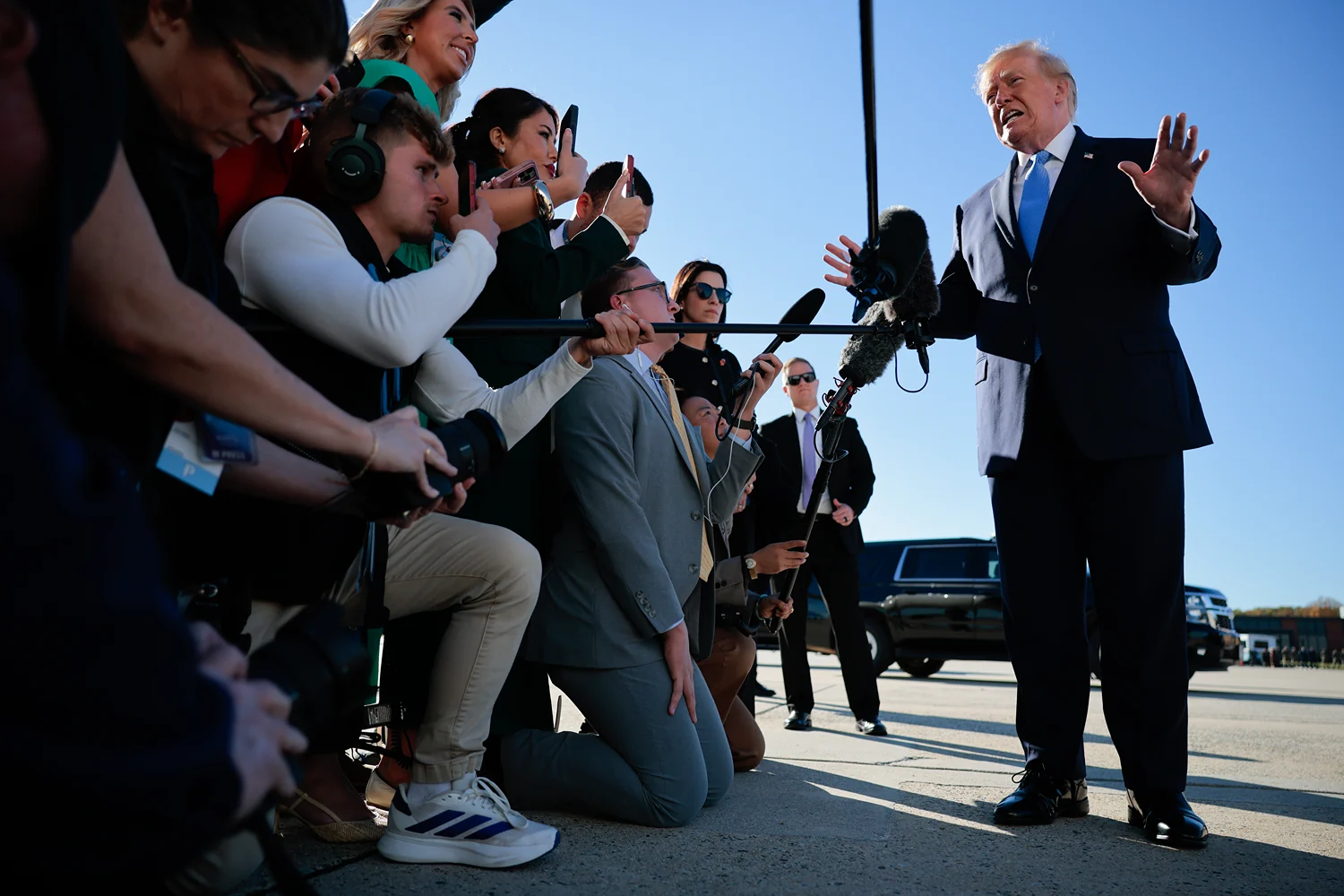
U.S. President Donald Trump’s America First agenda has transformed U.S. foreign policy. He has applied tariffs against long-standing U.S. trading partners, taken unilateral military action in Venezuela and Iran, waived new economic sanctions on Russia, questioned the U.S. commitment to the NATO alliance, retreated from U.S. participation in multilateral organizations, and ended much foreign and humanitarian assistance.
But does Trump’s foreign policy resonate with U.S. foreign-policy leaders or the public? To answer this question, we drew on unique surveys recently carried out by the Chicago Council on Global Affairs and the University of Texas at Austin. These surveys polled a nationally representative sample of the U.S. public, as well as 449 leaders in business, government, media, universities, and religious groups, among others. Respondents were asked questions on a variety of issues related to foreign affairs, including economic policy, national security, and the ongoing conflicts in Ukraine, Iran, and Israel. Of the leadership groups we surveyed, approximately one-third either currently or formerly served in government positions related to international policy. These surveys allowed us to compare the foreign-policy views of different segments of American society, as well as across political parties. The survey of the public was fielded from July 10 to July 21. The survey of leaders was fielded from July 27 to Sept. 19.
The results are not good for the president, especially before an already tricky midterm election. Many of Trump’s foreign-policy views are unpopular with U.S. foreign-policy leaders and the public. Trump has failed to sell fellow Republican foreign-policy leaders or voters on key parts of his vision. Rather than mark a turning point in America’s approach to the world, Trump’s foreign policy may not outlast Trump himself.
On international economic policy, large majorities of every leadership group believe that tariffs worsen the cost of living in the United States, including 86 percent of business leaders, 100 percent of labor leaders, and approximately 80 percent of officials in Congress and federal executive branch agencies. While Republican leaders are more supportive of his trade agenda, 65 percent of them acknowledge that tariffs are worsening the cost of living in the U.S., and 81 percent of Republican leaders said tariffs are bad for U.S. relationships with other countries.
The public has also rejected the Trump trade agenda. Eighty-one percent of the overall public believe that Trump’s tariffs do not improve the cost of living in the U.S., while 63 percent believe that they are bad for creating jobs. Even for Republicans, Trump’s tariff agenda is divisive. While approximately 56 percent of Republicans agree that tariffs help the economy, 62 percent also believe that they raise the cost of living.
At the same time, when asked to identify the most important issue in the upcoming midterm election, more Republican voters point to inflation and the cost of living than any other single issue. Although Trump has repeatedly turned to the message that the U.S. has been “ripped off on TRADE … by friend and foe, alike, for DECADES,” a bipartisan majority of the public believe that international trade benefits both the U.S. and other countries, including 62 percent of Republicans.
Trump has similarly failed to persuade leaders and the public about the wisdom of his approach to America’s traditional allies. Trump’s belief that the United States has been exploited by its security alliances has been a centerpiece of his foreign policy since entering politics in 2015. In May 2025, for example, Trump told a graduating class of West Point military officers, “We’ve been ripped off at the NATO level. We’ve been ripped off like no country has ever been ripped off.” At a campaign rally in February 2024, Trump stated that for those NATO members that did not meet defense spending targets, he would encourage Russia “to do whatever the hell they want.”
This view of U.S. security alliances is decisively opposed by leaders in every professional group surveyed and the U.S. public, including by bipartisan majorities of voters in both parties. While Republican leaders support greater burden-sharing, over 60 percent of Republican leaders and over 90 percent of Democratic leaders support either maintaining or increasing the level of U.S. commitment to NATO, while 85 percent of respondents across all leadership groups support using force if Russia invaded a NATO ally in Eastern Europe. Only 15 percent of the public supports decreasing the U.S. commitment to NATO. If Russia invaded a NATO ally like Poland, 60 percent of the public would support using military force, including majorities of Republican, Democratic, and independent voters.
The conflict in Ukraine further illustrates the gap between Trump and both foreign-policy leaders and the public. Since returning to office in 2025, Trump has ended U.S. military aid to Ukraine, told Ukrainian President Volodymyr Zelensky that he didn’t “have the cards” to reach a favorable settlement with Russia, and called for Ukrainians to replace Zelensky with a new leader.
Yet 84 percent of foreign-policy leaders, including 79 percent of Republicans, favor sending additional military aid to Ukraine. More than 92 percent of leaders, including 94 percent of Republicans, favor increasing economic and diplomatic sanctions on Russia. The public also is supportive of Ukraine. Almost 60 percent of the public supports sending additional military aid to Ukraine, 70 percent support increasing economic and diplomatic sanctions on Russia, and almost 70 percent support admitting Ukraine into NATO, including 60 percent of Republican voters.
And, in the crisis triggered by Trump’s claims over Greenland, 90 percent of the public opposes forcibly annexing Greenland, including 82 percent of Republican voters and almost 90 percent of Republican elites.
In the conflict in Iran, the public is not persuaded that the war is justified, though leaders are more divided. Fifty-eight percent of Republican leaders still believe that the Iran war was the right decision, while 98 percent of Democratic and 73 percent of independent leaders say it was the wrong decision.
After almost eight months of war, however, only a third of the public believes Trump made the right decision. Conversely, 68 percent of the U.S. public believes the war was not worth fighting, and the same percentage opposes using force to overthrow the Iranian government. A majority of Republican voters still approve of the decision to attack Iran but also believe that costs of the war have been high, including by raising the cost of living in the United States.
Perhaps most damning of all for Trump, only 20 percent of the public thinks the United States is more respected on the world stage compared to 10 years ago, including only 40 percent of Republicans.
There are genuine partisan gaps on some issues, including areas where Trump’s foreign-policy agenda retains the support of both the Republican Party leadership and its base, such as on strengthening immigration enforcement, hostility to action on climate change, and withdrawing from numerous multilateral organizations. Yet these tend to be areas where Trump has pursued more traditional Republican foreign-policy priorities, rather than his own idiosyncratic beliefs.
That foreign-policy leaders reject key aspects of the America First agenda may not be surprising. Trump himself has framed his agenda as a rejection of classic elite attitudes. But much of the public is equally hostile to his approach, suggesting that project may not be durable. These attitudes provide an opening for members of Congress and the next U.S. president to pursue a new foreign-policy vision that will resonate more with leaders and the American public, while strengthening America’s standing in the world.
