


- Environmental lawyer Rose Liza Eisma-Osorio joined a legal fight in 2007, representing the resident marine mammals in Philippines’ Tañon Strait as petitioners in a case to stop energy company JAPEX’s oil exploration.
- JAPEX withdrew from the strait before the court ruled on the petition.
- In 2015, a landmark decision by the Supreme Court set a precedent that people can represent nature as stewards and give it legal standing without proving personal injury, making it easier for citizens to file environmental cases.
- After the October 2025 ethanol spill in Bais Bay, Philippines, Oceana is working with communities and scientists to push for legal accountability — a long battle, Eisma-Osorio says, that must be fought together with the community.
CEBU CITY, Philippines — At a coffee meeting in 2007, Philippine environmental lawyer Rose Liza Eisma-Osorio and four other law professors in Cebu City sat laughing at an idea: representing marine mammals in court.
Despite their laughter, they were dead serious about their goal: Stop the oil exploration led by Japan Petroleum Exploration (JAPEX) in Tañon Strait. The protected seascape between the islands of Cebu and Negros in the central Philippines is home to 14 whale and dolphin species, as well as coral reefs and mangrove forests, according to advocacy group Oceana. In 2007, the Japanese energy company performed seismic surveys and drilled an exploration well in the strait, driving away cetaceans.
It was an ambitious plan, as animals had never been named as petitioners. Eisma-Osorio and fellow lawyer Gloria “Golly” Estenzo Ramos filed the first petition representing the resident marine mammals in December 2007. Their colleagues filed a second petition on behalf of the fishing communities who had been directly affected by the exploration activities.
The case, Resident Marine Mammals of the Protected Seascape Tañon Strait v. Secretary Angelo Reyes, went on for several years. In April 2015, the Philippine Supreme Court ruled to void the contract that allowed the exploration, development and exploitation of petroleum resources within the Tañon Strait.
Eisma-Osorio joined Oceana Philippines as a consultant in 2015, a year after the NGO was established. At 56, she now leads the campaign and legal departments as senior director of Oceana Philippines.
On Oct. 24, 2025, a major ethanol wastewater spill hit Bais Bay, part of the Tañon Strait Protected Seascape (TSPS). Oceana Philippines collaborated with marine scientists to assess the severity of the spill. Their research, published in July, found that Universal Robina Corporation’s (URC) ethanol plant continued to leak wastewater, killing fish, corals and seagrass. The NGO is also consulting with fishing communities to build a court case against the company.
With more than 25 years of experience in natural resources law and policy, Eisma-Osorio says she believes it’s her personal responsibility to ensure there is legal accountability. In an interview with Mongabay via video call, she talked about representing marine mammals, the reaction from the community and her current legal fight.
This interview has been edited for length and clarity.
Mongabay: What was your thought process in deciding to represent the marine mammals in such a landmark case?
Rose Liza Eisma-Osorio: It was an ambitious undertaking. We wanted to challenge the thinking that only humans can file cases in court, and we knew there were two ways it could go: The court would throw out the case or decide to hear it. So we wanted to be sure and we had Attorney Ramos and myself act as stewards representing the marine mammals.
If you look at the case caption, the marine mammals were joined and represented by us, meaning they were also signing as individuals while being represented by us, because if the court did not allow them to join as litigants, it could still allow us to represent the dolphins and whales.


Mongabay: How was the case received back then, by communities, environmental groups and the court?
Rose Liza Eisma-Osorio: Around that time, what was refreshing about the campaign was that there was already an organic movement, especially the Save Tañon Strait Movement. There were very active Cebuanos, individuals and students who helped raise awareness. The fisherfolk we represented were part of it too, so there was community engagement, because we knew they were the injured party in a way.
That was also the strategy behind two petitions. In the Philippines, you have to suffer an injury for the court to say you’re entitled to the remedy. We wanted the fisherfolk to prove their reduced catch and be heard, in the event that the court did not listen to the resident marine mammals case, since proof of injury was still a big question mark at that time.
Mongabay: At what point did you say, ‘This case is winnable?’ What was the turning point in lobbying to represent the resident marine mammals, especially with court updates?
Rose Liza Eisma-Osorio: We didn’t expect it to be in our favor. When we filed it in December 2007, the turning point was that even before the court decided, JAPEX pulled out. That was our early victory.
Then in 2015, the court decided in our favor, which was an added bonus. What the court zeroed in on — and what made it a landmark case — is that you don’t have to show proof of personal injury to represent nature as stewards and give nature legal standing in court. Only that you are here representing nature and this is the damage that was done.
We were surprised, and we said, ‘OK, we’ve set a precedent in Philippine jurisprudence. This makes it easier for our citizens to file environmental cases now.’


Mongabay: What immediate effect did you see after the Supreme Court decision?
Rose Liza Eisma-Osorio: After we won the case, I became Oceana’s consultant, and we decided to work on the management plan for Tañon Strait, because even if it was established as a protected seascape in 1998, there was no management plan [for it] at all.
Our contribution went beyond the case, [we got] into managing the area well and enforcing the laws and rules there. We left a living document that allows the agencies and local governments to work together to manage Tañon Strait in a better way.
Mongabay: Nine months after the October 2025 ethanol spill in Bais Bay, Silliman University marine scientists found the pollution killed up to 69% of coral cover in the assessed reef areas. What does it mean for Oceana to lobby again for the community?
Rose Liza Eisma-Osorio: Tañon Strait will always be our legacy campaign. When there are challenges like the ethanol spill, we need to go back and do our part.
We worked with the scientists from Silliman University to elevate the issue into a national concern and were pleasantly surprised by how our [press release] became viral. The communications tool is always useful and it helped move the Department of Environment and Natural Resources. The department has filed a criminal action against the responsible officers of URC [Universal Robina Corporation], and I think the case is now ongoing.
But there’s still the matter of the ongoing leakage that continues to affect the fishing communities. If it’s not stopped, then it might become worse and turn the bay into a wasteland.
We’re not entirely satisfied, because there are legal tools like the Writ of Kalikasan that could ensure the bay is restored and responsible actors are held accountable.
It’s early days, but there is an opportunity to ensure the community gets the justice it deserves for the damage to its resources and livelihood. Bais Bay is small compared to the entire stretch of Tañon Strait, but it’s ground zero for some because it’s where you do the dolphin and whale watching. If livelihoods are thriving there, you’ve protected Tañon Strait. That’s why it’s my personal quest to ensure environmental justice for what happened in Bais Bay.
Mongabay: Do you think it’s going to be a long battle ahead?
Rose Liza Eisma-Osorio: Yes, it will be a long battle ahead. We will be battling this together with the community. Nothing about them should be without them.


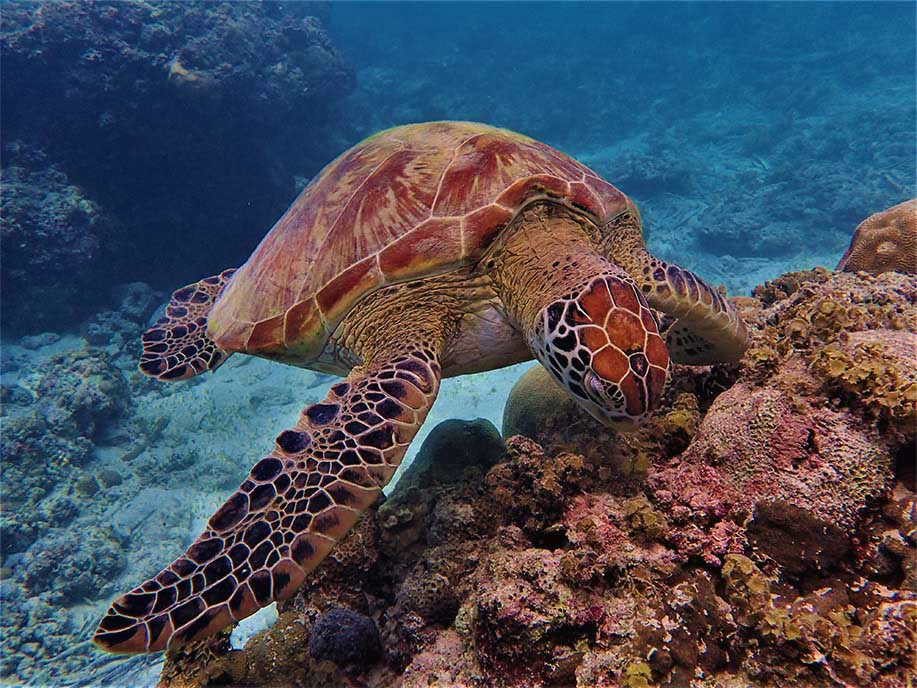
Banner image: A green sea turtle on a coral reef in Tañon Strait, a protected seascape between the Philippine islands of Negros and Cebu. Image courtesy of Tañon Strait Philippines.
Philippine fishing and Indigenous communities wary of clean energy boom in Marcos stronghold

