


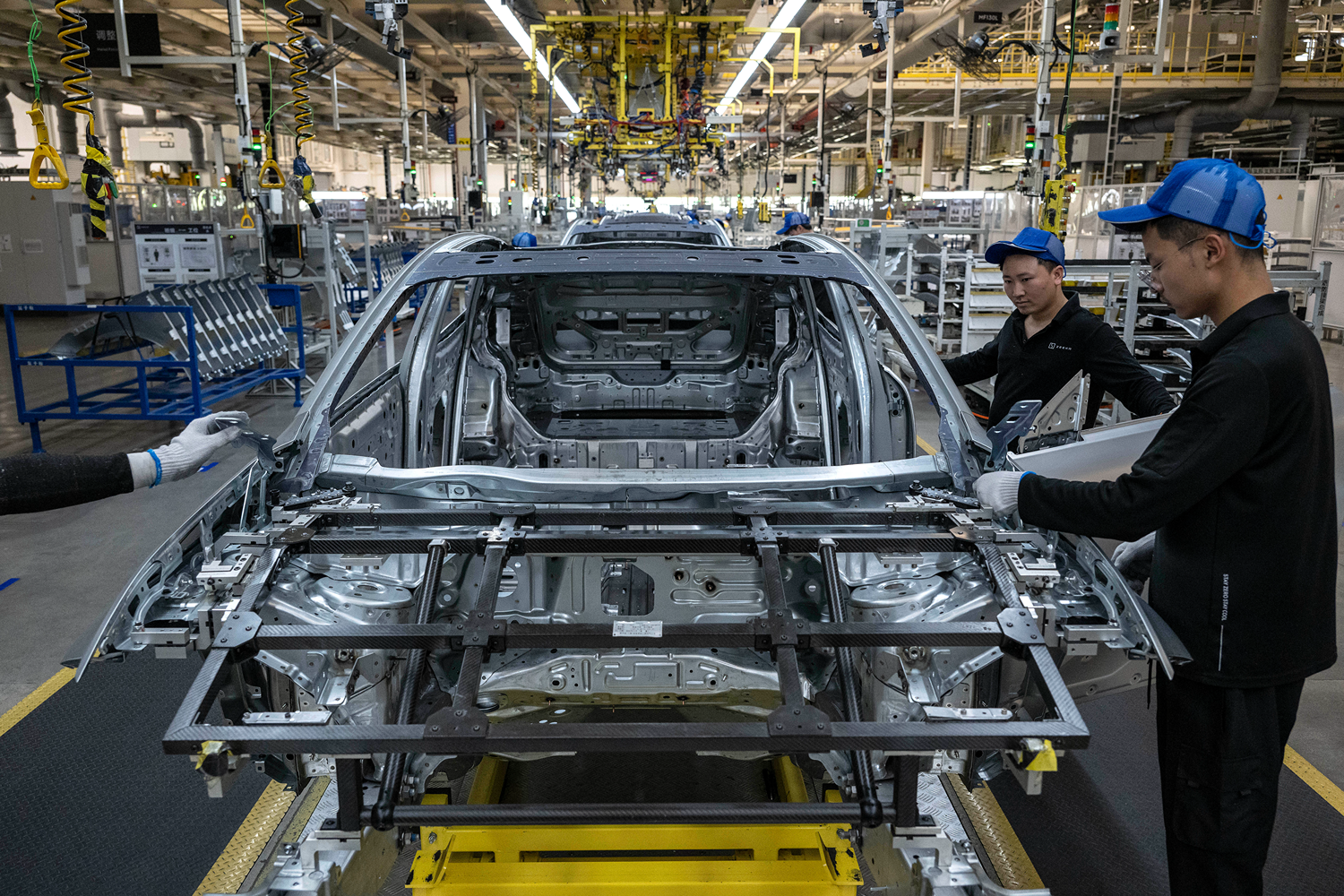
There is no sign that China’s export juggernaut is slowing down. China’s auto exports, for example, have grown more than tenfold since 2020 and are estimated to reach 10 million vehicles this year. The country posted a record trade surplus of $119.1 billion in August alone, putting it on track to surpass the $1.2 trillion surplus of 2025. The “China shock” is now an everyday reality in multiple sectors, from electric vehicles to power generation.
Accusations that China is exporting excess capacity have echoed across the United States, the European Union, and Southeast Asia, though China has vehemently rejected this. The concerns are understandable: It is hard to compete with Chinese industrial might, and local industry stakeholders worry about everything from job losses to dependence on Chinese suppliers.
But the conventional view that China’s dominant position in the global market is the result of the central government’s long-term strategic planning and top-down industrial policy tells only half the story. Beijing is not fully in control of the bulldozer of Chinese manufacturing, and the results have sometimes been far beyond what the government wanted or planned for.
In 2004, for instance, when the State Council, China’s central government, announced the launch of the high-speed railway program, its original plan was to build 12,000 kilometers of track by 2020. China ended up with nearly 38,000 kilometers by the end of that year.
The explanation lies at the local level. Once the policy initiative was launched, persistent, intensive lobbying by provinces, cities, and counties ensued, driven by their own interests in securing railway lines within their jurisdictions. The central government subsequently revised its railway construction plans several times, effectively accommodating local demands.
Beijing’s original ambitions for its domestic auto industry differed markedly from what emerged in practice. The original plan was to consolidate the market around a small number of large state-owned enterprises, such as First Automotive Works (FAW), and their joint ventures with foreign partners, positioning them as industry leaders. The superstars of China’s auto industry today, particularly in the new energy vehicle market, are mostly private firms like Geely, BYD, and Nio, each backed by a local government.
If anything, the original plan to strengthen state-owned automakers was a debacle. Leaders in Changchun, FAW’s home city, acknowledged in July that the city faced “unprecedented difficulties”: Citywide industrial profits had fallen 20 percent in 2025, while the traditional auto industry faced mounting pressure to modernize.
As much as Beijing might want to control everything from the top, implementation of its plans depends on officials whose incentives, in practice, can differ wildly from what the center wants. Local bureaucrats are appointed from above, rather than elected by constituents, with promotions tied to tournament-style evaluations. This competition is built into the system: Leaders at each level pit officials below them against one another and promote those believed to be doing a good job, based on a specific set of key performance indicators, whether explicitly stated or tacitly understood.
This gives Chinese localities strong incentives to stand out among their peers. For a long time, economic growth was the primary metric in the Chinese Communist Party’s evaluation system, so localities competed fiercely over key indicators such as GDP, investment, foreign direct investment, and revenue growth. Over the past decade, the criteria for official evaluation have expanded, as the party now prioritizes a broader range of issues, including environmental protection, industrial upgrading, social welfare, and poverty alleviation. GDP growth is no longer a guaranteed path to career advancement. Localities have had to impress their superiors—in one way or another.
The attention of senior leaders, however, is scarce. The country has more than 30 provincial-level units, over 330 cities, nearly 2,800 county-level units, and numerous bureaucratic agencies. Local governments accounted for 85 percent of China’s general budget spending in 2025. The central government still holds significant regulatory power and resources that can make or break local development.
Local governments have very few formal ways to advance their interests all the way to the top. They need to get creative to draw the attention of senior leaders to their localities. There are multiple ways to do this. Some rely on influential retired officials with hometown ties to bring their requests before top party leaders. Others compete to host high-profile mega-events like the Asia-Pacific Economic Cooperation summit or the Asian Games so that national leaders will pay a personal visit to the locality in question—creating a camera-ready photo opportunity for both the leader and the locality.
This all sounds absurdly superficial, but within the Chinese system, a single line of special written instructions from a top leader, or a favorable verbal comment made during a local inspection tour and propagated across the domestic media ecosystem, can mean real money is on the table—sometimes helping a locality secure billions of dollars in investment projects or fiscal transfers.
This “attention economy” reflects the severe information deficit in any multilayered bureaucracy with numerous subdivisions. Ideally, top leaders should promote those who actually solve real problems and contribute to national initiatives. Actual performance, however, is difficult to measure and verify from the top. It is a classic principal-agent problem.
With performance measures that are easy to game, local bureaucrats find that making a good impression on superiors becomes more important than actually solving problems. The surest way to impress Beijing, obviously, is to invest in whatever the center has signaled as a priority—especially projects that are visible, look good on camera, and are low-risk. EVs, robotics, and AI all fit the bill.
When each locality comes up with its own strategy for standing out, it is more concerned with outbidding, outspending, and outshining its peers than with the long-term health of the industry—or, for that matter, whether the national or global market can absorb the resulting output. Rational individual behavior thus adds up to a market coordination failure that produces overcapacity.
Interestingly, the central government is aware of the problem. Chinese President Xi Jinping himself has repeatedly warned against disorderly local development drives in areas such as EVs and AI, including in a public speech in 2025. But the problem is structural. And the leader’s warning, unlike his praise or a photo opportunity, bears little meaning when no consequences are attached to the actions of specific localities.
Another critical and often overlooked aspect is that the bureaucratic appointment system is structured as a series of relatively short tenures. Provincial and city leaders (party secretaries and government executives) serve an average of only three and a half years in a position. This means most officials need to demonstrate results within that window. They have to act quickly once they take office, and tunnel vision and the pursuit of quick, short-term gains take precedence over the consideration of long-term consequences.
It is not surprising that many rush to launch large investment projects to boost local economic figures, even if the projects are a poor fit in the long term or financially unsustainable. Their successors, in turn, repeat the dynamic, with one extra layer: They have every incentive to launch new projects to distinguish themselves from their predecessors, showing that they are not simply riding on the shoulders of the previous leader. This leads to further duplicative construction.
This goes beyond industrial policy and seeps into every aspect of China’s chronic economic ailments. China’s mounting local government debt—a long-standing problem that has proven extremely thorny to unwind—is, in effect, not only a result of the mismatch between revenue and expenditure (local governments are responsible for about 80 percent of spending but collect only about 50 percent of revenue), as analysts correctly point out. It is also exacerbated by cycles of ever-greater overinvestment that accompany each leadership turnover and compound over time. The perverse consequence of short tenure is that the costs of failed investment decisions, such as debt and bankruptcies, often emerge long after an official has left office, making it effectively impossible to hold anyone accountable. And if officials cannot be held accountable for these wasteful decisions, bad behavior persists—moral hazard becomes rampant.
It’s true that China’s overcapacity could be addressed by strengthening the domestic market, and the central government has indeed sought to boost consumption in recent years. Yet proponents of consumption-led rebalancing overlook the fact that China’s weak consumption may have the same root cause as its manufacturing glut. Pro-consumption policies, such as subsidies to households, are slow to take effect, and their effectiveness is difficult to measure—how do you assess how financially secure households feel and whether they are ready to open their purses and spend?
And even if the “investment in people” measures make people feel more secure, consumption is slow-moving. It takes months, if not years, for these effects to show up in actual consumption data. Further, unlike building infrastructure or investing in manufacturing, consumption is hard to tie to a particular locality (consumers receiving a subsidy may well spend it elsewhere), which means local leaders cannot easily claim credit for it even as they commit scarce resources.
Naturally, consumption does not make the list of priorities for local leaders facing fierce competition—despite their public statements echoing Beijing’s calls to promote consumption, exactly as instructed. On the ground, investment takes clear priority, while consumption is put on the back burner, especially under local financing constraints.
At the heart of the issue is a structural problem in China’s central-local relations: The central government relies on local competition to advance its policy goals yet has struggled to rein in the very incentives that drive excessive investment. Washington and Brussels might call out Beijing for not doing enough to rein in excess capacity. But even when Beijing is fully aware of the problem, and arguably willing to address some aspects of it, it still runs up against the same local incentives that created the problem in the first place.
Restructuring these incentives, much like changing corporate culture, is as much an organizational challenge as a political one. Half a century ago, organizational theorist Steven Kerr described precisely this problem as “the folly of rewarding A, while hoping for B.” Beijing is still grappling with it today.
