


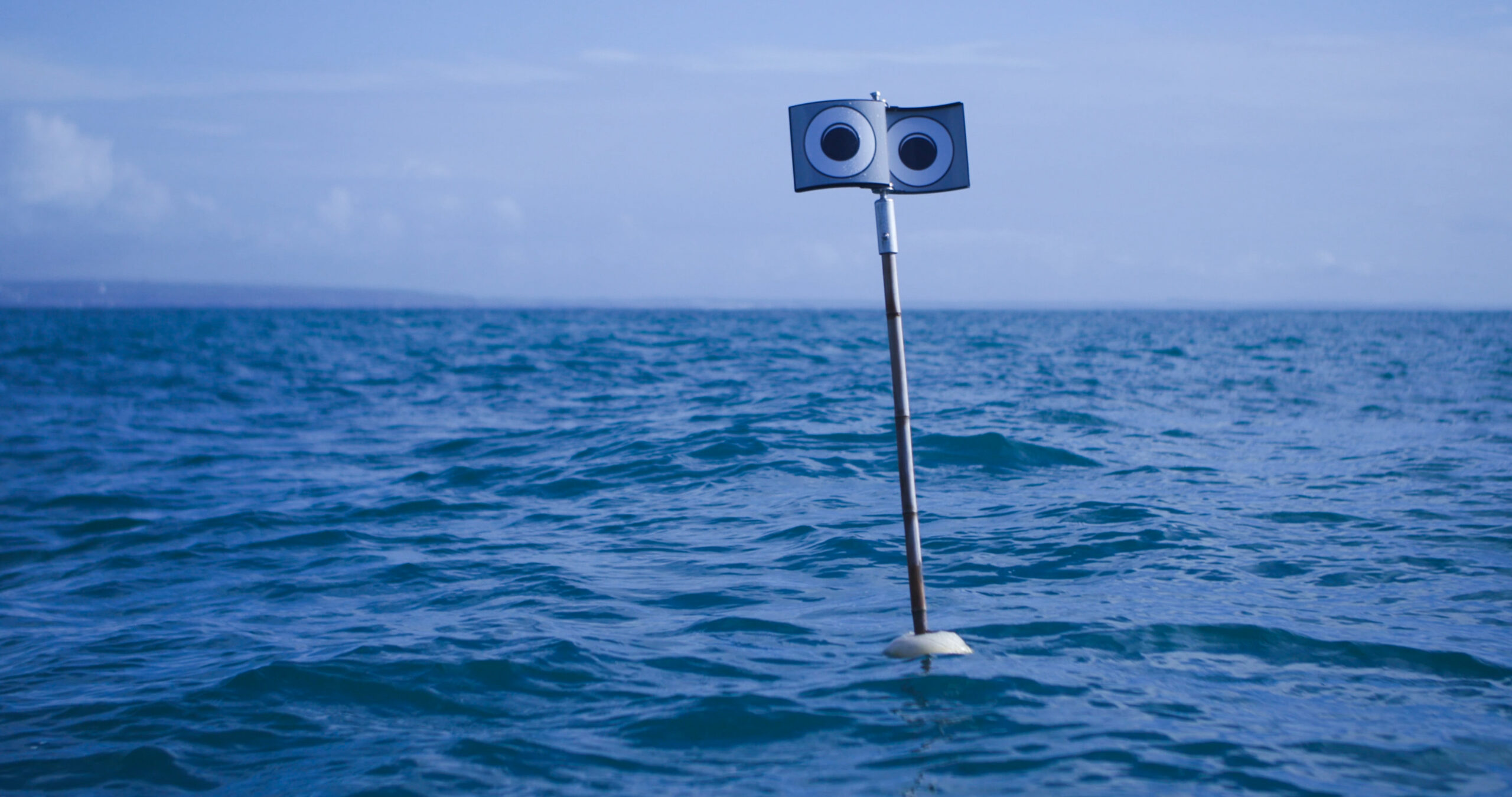
- A study off Cornwall, England, found that nets fitted with bird-of-prey kites had 71% lower odds of catching guillemots and razorbills, and nets with spinning “looming-eye” buoys had 59% lower odds.
- Ten fishers set more than 1,000 camera-monitored nets over about 17 months, and the nets caught 191 non-fish animals, most of them seabirds that drowned.
- Bycatch peaked in January and February in sea bass and mackerel nets, which suggests short, targeted winter deployments could protect birds without year-round rules.
- The devices have limits: kites struggled in light and strong winds, the buoys may have attracted seals, and a separate Danish study found the buoys stopped deterring birds after about a month.
Off the coast of Cornwall in southwest England, a pole rises from a buoy with a pair of big eyes on top. The head spins, creating what researchers call an “animated eye effect.” Its job is to scare away seabirds away before they dive into the fishing net below. On other nets, a kite shaped like a bird of prey flies from a pole.
According to a new study in Conservation Letters, both devices reduced the chance that diving seabirds would drown in gillnets. Nets fitted with the kites had 71% lower odds of catching an auk, the bird family that includes guillemots and razorbills. Nets fitted with the buoys had 59% lower odds.
“People may enjoy seeing seabirds around our coasts, but very few witness the moment when a diving bird encounters fishing gear,” lead author Tom Horton, a research fellow at the University of Exeter, told Mongabay.
Gillnets are a major threat to diving birds because the birds forage underwater, where they can get tangled in the mesh, the authors write. Gillnets in the Baltic Sea and Northeast Atlantic kill more than 95,000 seabirds a year, according to a 2024 review. Across all European fisheries, about 31,000 common guillemots (Uria aalge) die as bycatch each year, the same review found.
Fixes have been hard to find. An earlier trial of the eye buoys in Iceland’s lumpfish fishery found they didn’t reduce bycatch.
“Gillnets have proved a real challenge to develop mitigation methods for and pose a significant threat to seabirds in the UK,” Yann Rouxel, bycatch program manager at the U.K.’s Royal Society for the Protection of Birds (RSPB) and a study co-author, said in a press release.

For the new study, researchers paid 10 Cornish fishers to take participate between October 2023 and March 2025. Cameras and GPS units on their boats recorded every haul, with the fishers setting nets in pairs: one with the deterrents and one without, at least 200 meters (660 feet) apart. In total, they set 1,057 nets with a combined length of about 129 kilometers (80 miles), the study reports.
The nets caught 191 non-fish animals: 153 birds, 25 seals, and 13 cetaceans, such as dolphins and porpoises. Guillemots and razorbills made up nearly three-quarters of the total. Almost all were dead when hauled aboard.
“The biggest surprise was how clear and consistent the results were,” Horton said. “Conservation interventions often show mixed results when they’re tested under real-world commercial conditions, so seeing both deterrent types perform well across such a large-scale trial was genuinely encouraging.”

Distance affected the devices’ performance. Within 30 m (100 ft) of a device, the kites outperformed the buoys. The buoys were moderately effective over a wider range. The authors suggest that improved kites, spaced every 60-80 m (200-260 ft), could be a practical option for coastal gillnet fisheries.
Each device had drawbacks, however. Fishers reported that the kites performed poorly in very light winds and were harder to handle in strong winds. The buoys were easier to handle and store. The data also hinted that the buoys may attract seals: 15 seals were caught in buoy nets, compared with six in nets without devices and four in kite nets. The authors say more testing is needed to confirm that.
Birds may also learn to ignore the buoys. In a separate 2026 study in Denmark, researchers placed two of the buoys near a stationary fish trap. For the first few weeks, fewer cormorants and gulls gathered there than at a nearby trap without buoys. But the effect faded and was gone after about a month, the researchers report. The Cornwall team didn’t test for this, but they note in their paper that birds getting used to deterrents can weaken them over time.
Fishers also suggested design changes, and some have already shaped newer prototypes, the authors write.
“The fishermen who participated weren’t simply providing access to vessels,” Horton said. “They were actively helping to test ideas, providing feedback on what worked in practice, and suggesting ways the devices could be improved.”

Fisher Micky Bacon, from the village of Mousehole, joined the trial because “the sea is my workplace,” he said in the press release. “It is also a good opportunity to publicise to people outside the industry that fishermen don’t just want to go and catch fish, we also want to be part and parcel of improving the environment.”
The study also showed when birds were most at risk. Bycatch rates peaked in January and February, and were highest in nets targeting sea bass and mackerel with mesh sizes of 100 to 110 millimeters (about 4 inches). That points to short, targeted winter deployments rather than year-round rules, the authors write.
“This means that deterrent efforts can be directed and efficient,” co-author Tom Hooper, senior fisheries scientist at Fishtek Marine, a U.K.-based conservation engineering firm, said in the press release.
Fishtek Marine developed the buoy with the RSPB over eight years. Three of the study’s authors work for Fishtek, which manufactures the buoys, according to the paper’s conflict-of-interest statement. The U.K. government’s Department for Environment, Food and Rural Affairs funded most of the work, with the rest coming from oil and gas company Equinor. U.S.-based Schmidt Marine Technology Partners separately funded three of the University of Exeter authors, including Horton.
“One of the key messages from the study is that bycatch is not an inevitable consequence of fishing,” Horton said.

Banner image:A fbouy deters seabirds from getting caught in fishing nets. Photo courtesy of Nina Constable.
Liz Kimbrough is a staff writer for Mongabay and holds a Ph.D. in ecology and evolutionary biology from Tulane University, where she studied the microbiomes of trees. View more of her reporting here.
Citations:
Horton, T. W., Enever, R., Course, G., Hooper, T., Horton, M. C., Kibel, P., … Doherty, P. D. (2026). Above water deterrents reduce auk bycatch in gillnet fisheries off the United Kingdom. Conservation Letters, 19(5), e70082. doi:10.1111/con4.70082
Ramírez, I., Mitchell, D., Vulcano, A., Rouxel, Y., Marchowski, D., Almeida, A., … Paiva, V. H. (2024). Seabird bycatch in European waters. Animal Conservation, 27(6), 737-752. doi:10.1111/acv.12948
Rouxel, Y., Arnardóttir, H., & Oppel, S. (2023). Looming-eyes buoys fail to reduce seabird bycatch in the Icelandic lumpfish fishery: Depth-based fishing restrictions are an alternative. Royal Society Open Science, 10(10). doi:10.1098/rsos.230783
FEEDBACK: Use this form to send a message directly to the author of this post. If you want to post a public comment, you can do that at the bottom of the page.
Cite this article
Liz Kimbrough (2026). Googly-eyed buoys and kites help keep seabirds out of fishing nets, study finds. Mongabay Conservation news. DOI: https://doi.org/10.66709/news-333625

