


In the final two years of a US presidency, when Congress has been lost, approval ratings have sunk like a stone and their party has started to think about who’s coming next, the person occupying the Oval Office can feel their power draining away. Domestic legislation, particularly in an era where bipartisan cooperation is almost nonexistent, grinds to a halt. But as the days tick by until the end, and as presidents begin to think about their legacy, there is one part of the job where they still have power: the rest of the world.
In the final weeks of his presidency in 1992 George HW Bush sent 28,000 American troops to Somalia to help end a famine. For Bill Clinton, it was a quixotic attempt to bring peace to the Middle East by ending the Israeli-Palestinian conflict. Barack Obama restored diplomatic ties with Cuba, making a historic visit to Havana, as well as a final, successful push on the Iran nuclear deal.
In 10 days, Donald Trump will enter his own twilight zone. He is almost certain to lose control of the House and it’s not impossible he will face a Democratic Senate too. Any hopes of passing domestic policy – not that he’s bothered with that much during his first two years – will disappear. Instead, he will face a series of investigations that could lead, once again, to impeachment.
On the world stage, however, it will be a different story. And unlike Bush senior, Clinton and Obama, his ambitions won’t be peaceful. The first two years of his second term have been catastrophic; the final two could be even worse.
Once the midterms are over, the US is understood to be planning to restart its unwinnable war with Iran, already carrying out exercises with the Israeli military and withdrawing diplomats from the region. Trump’s sellout of Ukraine is well under way. In the past week he has argued that “Russia, frankly, has been fine on Ukraine”, while his envoy Steve Witkoff met with Vladimir Putin in Moscow, praising him in a televised meeting as a “humanitarian…and I salute that, I commend you and I thank you again.”
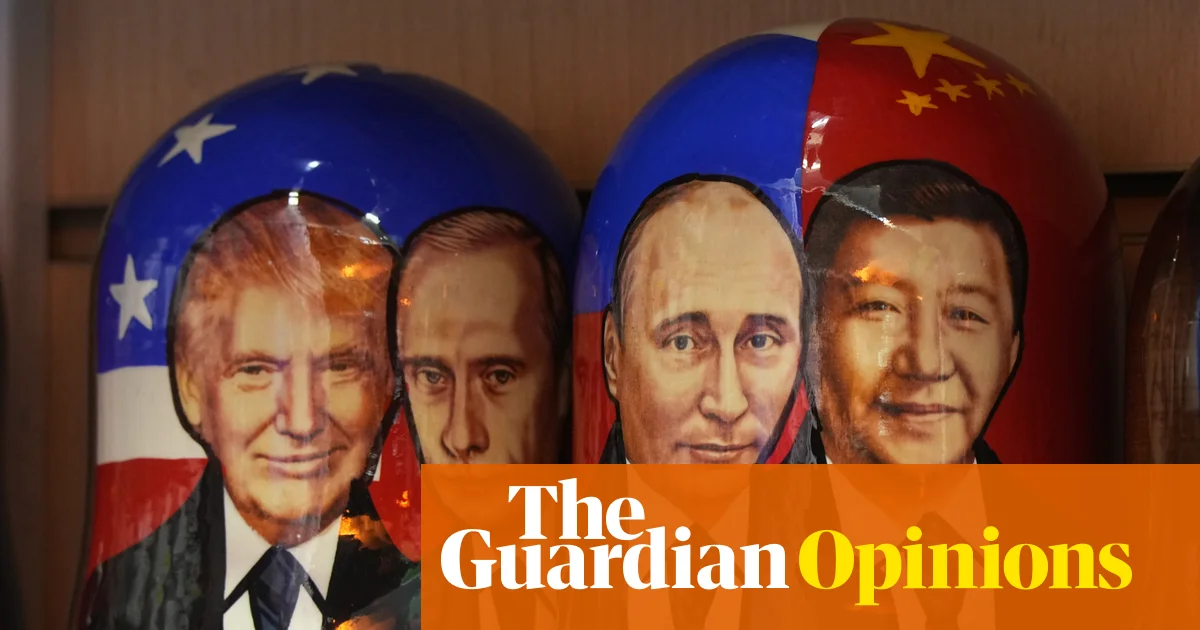
On top of a reckless war in the Middle East and appeasement in Europe, the shadow of a new world order is emerging, which Trump will relentlessly pursue in his final years. Putin has proposed a summit between himself, Trump and China’s Xi Jinping, to be held in China next month.
Such an unprecedented meeting, were it to take place, would have potentially devastating consequences for the rest of us. The three leaders have ambitions to transform the way the world is governed, essentially dividing it into spheres of influence. One summit wouldn’t turn an idea into reality, but it would send us down a very dangerous path. In Europe, it would have an impact beyond Ukraine if the US refused to help protect nations threatened by Russia. In east Asia, the withdrawal of the American security blanket would cause enormous problems for Taiwan, South Korea and Japan, as well as Australia.
We’ve talked a lot about the end of the west over the past two years – this feels like a moment when many of those fears will crystalise.
The Trump administration’s ambition to divide the world into spheres and side with dictators over democrats has long been evident. Last year’s National Security Strategy was deeply critical of the US’s traditional allies in Europe and east Asia. But it was what it didn’t say that was most shocking. Both Russia and China avoided direct criticism. In six paragraphs describing the threat to Taiwan, China was not mentioned once. Elsewhere in the document, China was actually praised as “rich and powerful … us[ing] its wealth and power to its considerable advantage.” The section on Russia’s war in Ukraine failed to mention how it started and did not suggest that Putin should be defeated; instead it focused on how the US could help Europe and Russia mend their relationship. The 33-page document discussed the importance of the US controlling the western hemisphere, but made clear that so long as the US still had economic dominance, it cared little whether other parts of the world are protected. “The affairs of other countries,” it stated, “are our concern only if their activities directly threaten our interests.” For too long, it argued, America’s allies had “suck[ed] us into conflicts and controversies central to their interests but peripheral or irrelevant to our own”.
For Putin, this is a success almost three decades in the making. He has long viewed American support for democracy in eastern Europe and central Asia as “interference” in Russia’s backyard. Now he has a US president who agrees. Trump has also placed Putin on a far higher pedestal than Russia’s economy and its technological prowess deserves.
Xi, too, has welcomed the US’s rhetorical retreat from east Asia, particularly if it allows China greater maritime control in the East China Sea and South China Sea. World opinion on China has dramatically improved as that of the US has slid. As Chrystia Freeland, a former Canadian foreign minister, put it this week, “there has not been a president who has been more beneficial for China than Donald Trump”.
At stake is not merely territorial control. All three governments see the possibility of increasing economic ties. For the US and China, the bigger issues are future control of economic supply chains and technology platforms, while Russia’s fossil fuel resources are also a factor. All three are key players in the next space race, both in terms of commercial and military control. If these three nations begin to work together, at the expense of Europe and the rest of the world, it will fundamentally change the nature of geopolitics. A decade ago, talk of a multipolar world was based around the idea of the US, China and the European Union as the three most powerful blocs. Somehow, Brussels has been replaced by Moscow.
after newsletter promotion
Until now, the rest of the west has – on the whole – tried to muddle through. Nato still exists on paper, G7 and G20 summits may be chaotic but they still take place. Optimists in the Foreign Office point out that Trump turned up to the UN general assembly and his administration is still deeply involved in the UN’s day to day activities.
Mark Carney spoke of a “rupture” and warned the old post-cold war world was not coming back, but despite warm words from Emmanuel Macron, and renewed discussion about how Europe can protect itself without the US, there is still a sense that everyone is waiting for Trump’s time in office to end. A Great Powers summit makes this harder to ignore.
While US presidents seek foreign policy success in their final months, history suggests they rarely find it. Clinton’s Camp David talks collapsed after Ehud Barak and Yasser Arafat were unable to reach an agreement. Bush would argue that his initial intervention in Somalia eased a famine, but it ended in humiliation. A botched raid on a warlord led to the deaths of 18 US soldiers and several hundred Somalis. Obama’s diplomacy in Cuba and Iran succeeded, but were both promptly ripped up by Donald Trump.
Trump will get his photoshoot – and maybe that’s all he wants – but there is no guarantee that this unsavoury troika becomes a permanent geopolitical fixture. Trump’s foreign policy has divided his Maga movement and has shocked traditional conservatives. The Wall Street Journal editorial board described the proposed summit as “arguably the worst idea of the second Trump term”. A President Vance or Rubio might be less willing to throw in their lot with dictators; a President Ossoff or Ocasio-Cortez certainly won’t.
But just because Trump won’t win, doesn’t mean that the US won’t lose. He will be arriving in Shenzhen at the weakest moment in his presidency. An 80-year-old lame duck leader fated to limp towards the finish line unable to pass any legislation and threatened by two chaotic years of investigations into his alleged corruption. Opposite him will be two authoritarian leaders in their early 70s who believe the only thing preventing them from ruling their nations for another two decades is death. Indeed, given their “hot mic” discussions about longevity drugs last year, perhaps they both believe they can rule for even longer.
If it goes ahead, this summit will bring Putin back in from the cold and reiterate Xi’s position as a global leader who cannot be ignored. The image of the three leaders will come to define this era when the rules-based international order was torn apart and a new, uncertain period began to form.
