


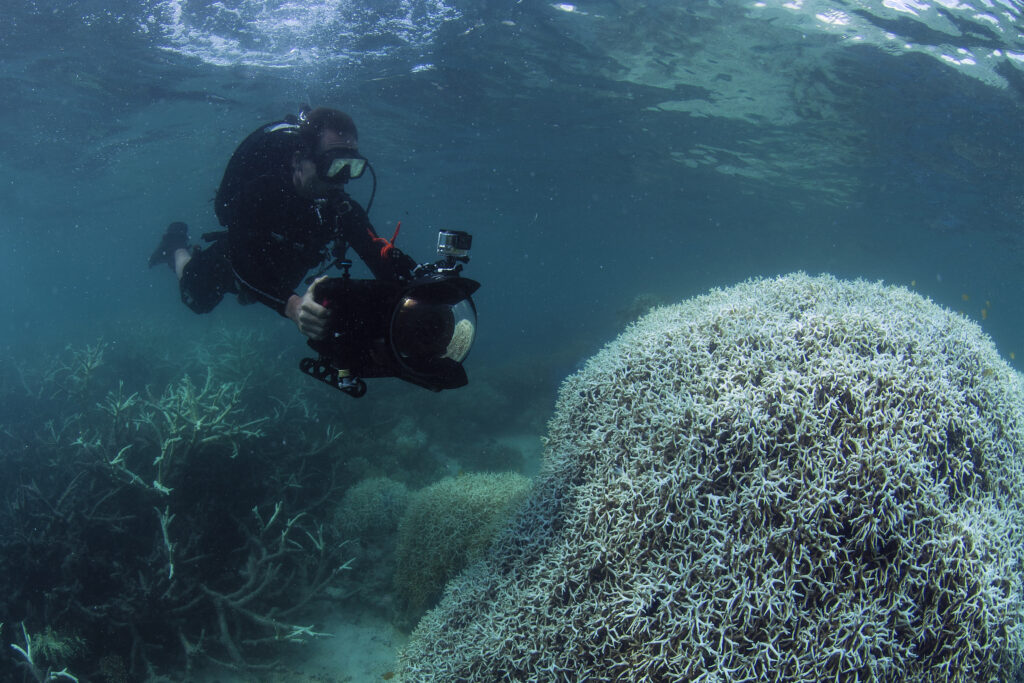
By 2075, the vast majority of the world’s shallow coral reefs could cease to function as both critical habitat for marine life and a lifeline for hundreds of millions of people who rely on them.
According to a new assessment by the International Union for Conservation of Nature, 96 percent of the planet’s 127 major warm-water reefs are now classified as critically endangered, primarily due to heat stress induced by climate change. These ecosystems—which people depend on for food, livelihoods and protection from storms and flooding—include the Great Barrier Reef in Australia, the Mesoamerican Barrier Reef System in the Caribbean and the Coral Triangle in the western Pacific Ocean.
“They are at extremely high risk of collapse in the next 50 years,” said Mishal Gudka, the assessment’s lead scientist. He is also a research director at CORDIO East Africa—a marine conservation nonprofit based in Kenya—and a research fellow at the University of Melbourne in Australia.
For coral reefs, collapse means losing most, if not all, of their living hard corals that build and maintain their defining three-dimensional structure. As vibrant coral communities disappear, so do the fish and other marine life that live amidst them. Eventually, the reef becomes rubble covered in algae. “It’s effectively degraded into a different type of ecosystem,” Gudka said.
This is the first time the International Union for Conservation of Nature has produced a global assessment of coral reefs as part of its Red List of Ecosystems initiative, designed to guide and encourage conservation efforts before irreparable loss occurs. And its findings are “alarming,” said Susanne Pedersen, the International Union for Conservation of Nature’s director of the Centre for Science and Knowledge.
“It must serve as a renewed call to action on climate change and other drivers of biodiversity loss to save the world’s coral reef ecosystems,” she said during a news conference Thursday at the United Nations biodiversity summit known as COP17.
The two-week conference is being held in Yerevan, Armenia, where representatives from nearly 200 countries are taking stock of their progress toward achieving a set of 23 targets outlined in the Kunming-Montreal Global Biodiversity Framework. The landmark international agreement, adopted in 2022, is aimed at halting and reversing biodiversity loss through commitments such as conserving 30 percent of the world’s land, inland waters and marine areas by 2030, restoring degraded ecosystems and reducing pollution.
But several recent reports indicate countries are falling behind on their commitments, especially when it comes to conserving marine ecosystems. More than 90 percent of ecosystem restoration efforts are occurring on land in comparison to just 2 percent in coastal and marine areas, according to a joint report, released Friday, by the Society for Ecological Restoration and the Secretariat of the Convention on Biological Diversity.
Changing the trajectory for coral reefs outlined in the latest Red List assessment is vital. At least a quarter of all marine species, including thousands of species of fish, live and feed on coral reefs.
“The actions we take over the next few years will determine what these ecosystems look like at the end of the century, whether they persist as we have known them, or whether they transform into a different ecosystem, which is worth less to both nature and people,” Gudka said at the press conference in Yerevan.
As global temperatures rise, the intervals between marine heat waves are shrinking, leaving reefs less time to recover in between. Even under a moderate warming scenario, the new global Red List assessment for coral ecosystems projects that within the next 50 years, these events will occur too frequently for most reefs to withstand.
Read More
As Global Warming Threatens Corals Worldwide, Woods Hole Scientists Search for ‘Super Reefs’ That Can Take the Heat
By Teresa Tomassoni
When corals become too hot, they expel the algae living within their tissue that provides them with much of their food and color. The invertebrates then turn white in a process called bleaching. If water temperatures cool down fast enough, corals can recover. But if not, they eventually die. Already, that trend is accelerating and taking a toll.
From January 2023 to September 2025, during the world’s fourth global bleaching event, more than 80 percent of the world’s coral reefs in at least 83 countries and territories were impacted.
In Florida, a record-breaking marine heat wave in 2023 wiped out most colonies of two important reef-building species: staghorn and elkhorn corals. Both have since been deemed functionally extinct there, meaning there are too few left in the wild to reproduce naturally and they can no longer help build or sustain reef ecosystems.
In many places, including the Caribbean, climate change and other local pressures exacerbate one another.
“Rising sea temperatures are adding to the damage caused by overfishing, pollution and poorly planned coastal development, making it harder for reefs to recover after each disturbance,” said Tadzio Bervoets, from Sint Maarten, who was not involved in the assessment. He is a Caribbean coral researcher for the Coral Restoration Consortium and the executive director of a marine conservation organization in Jamaica, the Alligator Head Foundation.
This story is funded by readers like you.
Our nonprofit newsroom provides award-winning climate coverage free of charge and advertising. We rely on donations from readers like you to keep going. Please donate now to support our work.
Warmer waters, for instance, can make corals more susceptible to disease, which can be more common in polluted areas. Overfishing—which threatens at least 63 percent of coral reef ecosystems, according to the Red List assessment—also undermines their ability to recover from heat stress. Without herbivorous species like parrot fish that graze on the reef, aggressive algae can smother weakened or recovering corals and take over space on the reef needed for new coral growth.
To give reefs the best chance at surviving the years ahead, scientists say efforts to reduce local pressures must go hand in hand with action to curb climate change.
“We need rapid cuts in emissions alongside sustained investment in reef monitoring, emergency response, effective marine protection, fisheries recovery, cleaner coastal waters and restoration,” Bervoets said in an email. “We can still protect the Caribbean’s most resilient reefs, but that requires funding and political commitment now.”
About This Story
Perhaps you noticed: This story, like all the news we publish, is free to read. That’s because Inside Climate News is a 501c3 nonprofit organization. We do not charge a subscription fee, lock our news behind a paywall, or clutter our website with ads. We make our news on climate and the environment freely available to you and anyone who wants it.
That’s not all. We also share our news for free with scores of other media organizations around the country. Many of them can’t afford to do environmental journalism of their own. We’ve built bureaus from coast to coast to report local stories, collaborate with local newsrooms and co-publish articles so that this vital work is shared as widely as possible.
Two of us launched ICN in 2007. Six years later we earned a Pulitzer Prize for National Reporting, and now we run the oldest and largest dedicated climate newsroom in the nation. We tell the story in all its complexity. We hold polluters accountable. We expose environmental injustice. We debunk misinformation. We scrutinize solutions and inspire action.
Donations from readers like you fund every aspect of what we do. If you don’t already, will you support our ongoing work, our reporting on the biggest crisis facing our planet, and help us reach even more readers in more places?
Please take a moment to make a tax-deductible donation. Every one of them makes a difference.
Thank you,

Oceans Correspondent
Teresa Tomassoni is an environmental journalist covering the intersections between oceans, climate change, coastal communities and wildlife for Inside Climate News. Her previous work has appeared in The Washington Post, NPR, NBC Latino and the Smithsonian American Indian Magazine. Teresa holds a master’s degree in Journalism from the Craig Newmark Graduate School of Journalism at CUNY. She is also a recipient of the Stone & Holt Weeks Social Justice Reporting Fellowship. She has taught journalism for Long Island University and the School of the New York Times. She is an avid scuba diver and spends much of her free time underwater.
