


- If Flávio Bolonaro wins Brazil’s 25 October runoff election the consequences for the environment will be enormous, especially in the Amazon but also for the world.
- Flávio, son of Brazil’s anti-environmental former president Jair Bolsonaro, is slightly ahead of incumbent President Lula in the polls, but the difference is within the margin of error.
- Flávio, who denies anthropogenic climate change and has supported a series of anti-environmental bills as senator, plans to follow in his father’s footsteps.
- The Amazon rainforest is near a series of tipping points, beyond which risk of the forest collapsing rises sharply. If the forest collapses, the emission of greenhouse gases would push global climate past the point where warming escapes from human control. Flávio’s policies would increase this risk.
Fear and disbelief prevail among those in Brazil who are concerned about the environment. A climate denier and voluble supporter of dismantling Brazil’s environmental agencies may well be the country`s next president. Brazil’s current president, Luiz Inácio Lula da Silva (known simply as “Lula”) faces Flávio Bolsonaro, one of former president Jair Bolsonaro’s sons. In the first round of the election on October 4th neither reached the required 50% plus one vote needed, and they face each other in a runoff on October 25th. Flávio was two percentage points ahead for valid votes in a poll released on October 21st, although one poll released on October 18th showed Lula ahead by two points.
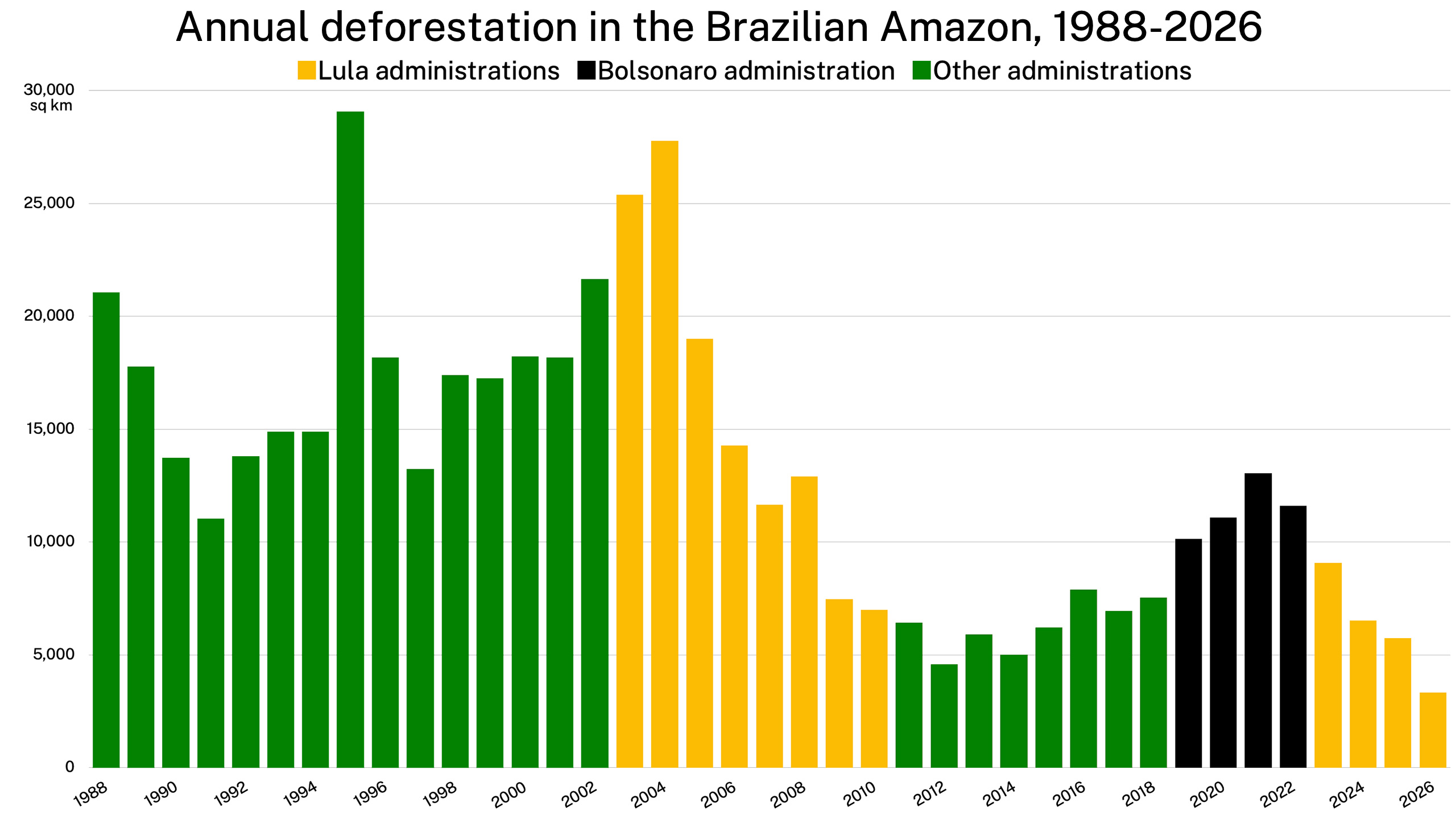
Flávio’s father Jair Bolsonaro’s 2019-2022 term was an environmental disaster, and Flávio frequently claims that his father was the best president Brazil has ever had and that, if elected, he will bring back his father’s policies. Under Jair Bolsonaro the annual deforestation rate in the Amazon rose sharply, peaking in 2021. He made good on his promise not to demarcate “a single centimeter” of Indigenous land. He appointed openly anti-environmental figures to head the Ministry of the Environment and IBAMA (the Brazilian Institute for the Environment and Renewable Natural Resources), who largely dismantled these agencies and blocked enforcement of environmental laws. Jair Bolsonaro’s constant rhetoric supporting illegal loggers, goldminers and deforesters resulted in surges of these activities, including in Indigenous areas. Most notorious was the invasion of the Yanomami Indigenous Land by over 20,000 goldminers who converted the area`s watercourses into rivers of mud, killing the fish that sustained the Indigenous population and resulted in starvation and images of emaciated Yanomami children that shocked the world. Flávio’s plans put almost 300 Indigenous Lands at risk.
Flávio owes much to his father, including his political career and the current candidacy. His father is serving a 27-year sentence for leading an attempted coup, and Flávio says he will get the sentence annulled as his first priority. He would likely be able to do this either through the four supreme court justices that the next president will nominate or through the supermajority he will enjoy in Brazil’s National Congress. In any case, advice from Flávio’s father is likely to be decisive in many decisions, including those impacting the environment.
Flávio’s brother Eduardo is also likely to have a key role. Eduardo, who is currently in exile in the US, where he fled to escape judgement for a variety of crimes, has stated that he will be Brazil’s foreign minister if Flávio is elected. However, after dodging the question in previous interviews, on October 16th Flávio said Eduardo would not receive this appointment. However, he left open the question of whether Eduardo would have some other post in the administration.
Flávio, like his father, denies the existence of anthropogenic climate change, but the leading influence in the Bolsonaro clan’s embracing climate denialism as a banner was Eduardo, under the influence of his friend Steve Bannon. Eduardo often brags about his friendship with US president Donald Trump (who was also influenced by Bannon on this issue), increasing the likelihood of following Trump’s example of withdrawing from the Paris Agreement. Jair Bolsonaro initially planned to withdraw Brazil from the Paris Agreement, but the withdrawal failed to occur due to pressure from Brazil’s largest soy exporter, who explained the impact such a move could have on Brazil’s soy exports to Europe. Currently Europe’s importance has declined, with China being by far the largest importer.

Flávio’s platform doesn’t mention climate change, although it does state that Brazil will “sell carbon credit to the world.” Lula’s platform makes various mentions of climate and affirms the intention of honoring Brazil’s commitments under the Paris Agreement. However, neither candidate has made climate an issue during the campaign. This is not surprising, given that a survey of what voters consider to be the top issues in the election indicated that no issue involving the environment, including climate change, was among the 15 issues named by at least 1% of the interviewees.
Flávio’s campaign rhetoric and his platform, known in Brazil as a “plan for government,” indicates that he intends to reduce environmental restrictions of all types. Flávio says he plans to wield a “tesouraço” (big pair of scissors) to cut government expenditures. This is similar to Argentinean President Javier Milei’s chainsaw and to the version brandished by Elon Musk in the US. Environment, science and Indigenous protection are expected to be major targets.
Brazil’s National Congress already strongly anti-environmental, having passed such laws as the “General Law of Environmental Licensing,” better known as the “law of devastation” (Law 15,190/2025), the “marco temporal” (timestamp) (Law 14,701/2023) (ruled unconstitutional by the Federal Supreme Court in December 2025, but now under appeal) that would revoke the rights of many Indigenous peoples to their territories. Flávio voted for both of these measures as a senator. As of January 2027, the newly elected members will greatly strengthen this, with voting power sufficient to amend the constitution, which Flávio claims he wants to do. Brazil’s constitution is easily amended, requiring 60% in two votes in each chamber of the congress and no requirement for ratification by the states. The current constitution has been amended 141 times since it came into effect in October 1988.

One of the most frequent terms in Flávio’s platform and discourse is “legal security” (segurança jurídica), one of the euphemisms for legalizing illegal land claims in government land. This is a major driver of Amazon deforestation, as granting land titles to illegal claimants stimulates ever more land invasion and land grabbing (grilagem). Note that the English-language term “land grabbing” in Amazonia refers to large Brazilian actors who claim areas in government forest land and who normally later subdivide and sell the land to cattle ranchers – different from the same term in Africa and Asia where it refers to foreign companies purchasing agricultural land and converting it to export crops. Brazil is one of the only countries in the world where people can invade government land and expect to get a land title. Deforestation is a means of showing “productive use” of the land, helping to justify titling and also helping to prevent the claim being usurped by either small squatters or large landgrabbers. However, the net effect of granting titles is to increase deforestation within the titled properties, as shown by a study of the Terra Legal (legal land) titling program under Lula in his second administration. This is in addition to the titling stimulating additional invasions and land grabbing.
Flávio’s advocacy of titling illegal land claims and relaxing environmental restrictions is popular on Amazonian frontiers. In the first round of the 2026 election, the Amazonian municipality with the highest percentage of votes for Flávio (84%) was Novo Progresso, Pará – the place on the BR-163 highway from which the “day of fire” was organized in August 2019, when ranchers across the Amazon set fire on the same day to show support for Jair Bolsonaro’s antienvironmental policies. The political movement in favor of relaxing environmental restrictions has adopted the name “agrobolonarismo.”
Denial of science in general was a hallmark of Jair Bolsonaro. His denial of science in the case of COVID-19 is credited with over 400,000 additional deaths in Brazil during the pandemic, and Amazonian Indigenous peoples were especially hard hit. His denial of the validity of satellite data on Brazil’s deforestation.

Impacts of the next Brazilian president on climate change is a particularly critical issue. While both candidates support a variety of policies that increase climate change, the impact of Flávio would clearly be much greater than that of Lula. In a television interview in August 2026, Flávio denied the existence of anthropogenic climate change, saying that what we see is natural cycles and that the response is “basic sanitation” (saneamento básico), that is, building sewerage systems in Brazilian cities. This stance on climate change apparently has little impact on the electorate: although over 70% of the Brazilian population claims to be concerned with climate change, the vote for Flávio in the first round indicates this concern is not so great.
Loss of Amazon forest implies loss of biodiversity, traditional peoples, the forest’s water recycling role, and its huge carbon stock. While most attention is on the deforestation rate each year, the greatest danger lies elsewhere: the risk of the remaining forest collapsing as the combined result of climate change and direct human actions that degrade the forest through logging, fire and edge effects. These processes are increasing due to the building of roads that open previously inaccessible areas to the entry of deforesters and loggers. These processes are fed by policies that are supported by both candidates, including reconstruction of the BR-319 (Manaus-Porto Velho) highway, “regularization” (the euphemism in Brazil for legalization of illegal land claims in government land), and generous subsidies for converting cattle pasture to soy plantations – an important driver of deforestation because cattle ranchers sell their land to soy planters rather than planting soy themselves, and the ranchers then invest the proceeds of the sales in buying and deforesting much larger areas of cheap rainforest land on remote Amazon frontiers.
Brazil’s Amazon forest is nearing various tipping points that, if passed, would greatly increase the probability of forest collapsing. These tipping points include the local impacts of global average temperature passing the Paris Agreement’s limit of 1.5°C above the pre-industrial average, the percentage of the Amazon forest that has been deforested and no longer fulfills the water recycling function that maintains the rest of the forest, the lengthening of the dry season in Amazonia, and the increase in major drought events. These climate stresses are much less likely to cause collapse in a forest that is intact than in one that is reduced to fragments or cut into the notorious “fishbone” deforestation pattern typical of occupied areas and is also more likely in forests degraded by logging and fire.

If the forest collapses it would release a quantity of greenhouse gases more than sufficient to push the global climate system past a tipping point where global warming escapes from human control. Barring large-scale carbon removal that is unlikely to be achievable on a relevant time scale, the most we can do to contain global warming is to not emit any more from fossil fuels and deforestation. If what we now emit deliberately is exceeded by what is emitted indirectly as by higher temperatures causing forest fires, warming soils around the world, melting the tundra and warming the oceans, then even cutting our deliberate emissions to zero would fail to stop the vicious cycle of more warming causing more emissions and therefore still more warming. The possibility of the Amazon forest collapsing is at the center of this problem, with the tipping points in the forest being interrelated with the tipping point in the climate system: if the forest collapses first, then the climate system would follow, and if the global climate system’s tipping point is reached first because we continued to burn fossil fuels, then the forest would soon succumb.
The irreversibility of climate change once it escapes human control sets this problem apart from other great issues of our time. Wars and dictatorships, for example, have terrible impacts, but they eventually come to an end, but this is not the case for a “runaway greenhouse” leading to a “hothouse Earth.” The devastation would be worldwide. In Brazil, the remainder of the Amazon forest would be lost cutting off the supply of water vapor transported by winds known as “flying rivers” upon which most of the county’s agriculture depends, as well as major cities such as São Paulo. Currently semiarid Northeastern Brazil, where tens of millions of people there depend on agriculture, would become a desert. The dense populations along Brazil’s Atlantic coast would be exposed to sea-level rise and intense storms. “Climate surprises” not foreseen by climate models, such as the 2024 floods in Rio Grande do Sul and the 2014 Madeira River flood, would become more common. Most frightening is mass mortality in the human population, as maximum temperatures would soon exceed human tolerance.
A Portuguese-language version of this text is expected to appear on Amazônia Real
References
- Garcia, H.M. G.G.A. Feitosa, H.L. de Menezes, T.M.R. Figueiredo, R.N.P. Alves, N.N. Lima, A.O.A. Reis, J.E.B. Araújo, S.M.F. de Carvalho et al. 2022. Pandemic of hunger: The severe nutritional deficiency that kills Yanomami ethnic children. Journal of Pediatric Nursing 65: e1-e2. https://doi.org/10.1016/j.pedn.2021.11.024
- Arima, E.Y., P. Richards, R. Walker & M.M. Caldas. 2011. Statistical confirmation of indirect land use change in the Brazilian Amazon. Environmental Research Letters 6: art. 024010. https://doi.org/10.1088/1748-9326/6/2/024010
- Azevedo-Ramos, C., P. Moutinho, V.L.S. Arruda, C.C. Stabile, A. Alencar, I. Castro & J.P. Ribeiro. 2020. Lawless land in no man’s land: The undesignated public forests in the Brazilian Amazon. Land Use Policy 99: art. 104863. https://doi.org/10.1016/j.landusepol.2020.104863
- Barbosa, H.A. 2024. Understanding the rapid increase in drought stress and its connections with climate desertification since the early 1990s over the Brazilian semi-arid region. Journal of Arid Environments 222: art. 105142. https://doi.org/10.1016/j.jaridenv.2024.105142
- Brito, B., P. Barreto, A. Brandão, S. Baima & P.H. Gomes. 2019. Stimulus for land grabbing and deforestation in the Brazilian Amazon. Environmental Research Letters 14: art. 064018. https://doi.org/10.1088/1748-9326/ab1e24
- Fearnside, P.M. 1979. The development of the Amazon rain forest: Priority problems for the formulation of guidelines. Interciencia 4(6): 338‑343. http://antigo-philip.inpa.gov.br/publ_livres/1979/The%20Development%20of%20the%20Guidelines.pdf
- Fearnside, P.M. 2017. Deforestation of the Brazilian Amazon. In: H. Shugart (ed.) Oxford Research Encyclopedia of Environmental Science. Oxford University Press, New York, USA. https://doi.org/10.1093/acrefore/9780199389414.013.102
- Fearnside, P.M. 2022. Amazon environmental services: Why Brazil’s Highway BR-319 is so damaging. Ambio 51: 1367–1370. https://doi.org/10.1007/s13280-022-01718-y
- Fearnside, P.M. 2025. Desmatamento e queimadas: A degradacao da floresta. pp. 40-41; 84-86. In: Atlas da Amazônia Brasileira. J. Dolce, M. Montenegro & R. Shoenenberg (Eds.). Fundação Heinrich Böll, Rio de Janeiro, RJ, Brazil. 96 pp. https://doi.org/10.29327/5491394
- Ferrante, L. & P.M. Fearnside. 2020. Protect Brazil’s Indigenous peoples from COVID-19. Science 368: 251. https://doi.org/10.1126/science.abc0073
- Ferrante, L., L. Duczmal, W.A. Steinmetz, A.C.L. Almeida, J. Leão, R.C. Vassão, U. Tupinambás & P.M. Fearnside. 2021. How Brazil’s president turned the country into a global epicenter of COVID-19. Journal of Public Health Policy 42: 439–451. https://doi.org/10.1057/s41271-021-00302-0
- Flores, B.M., E. Montoya, B. Sakschewski, N. Nascimento, A. Staal, R.A. Betts, C. Levis, D.M. Lapola, A. Esquível-Muelbert, C. Jakovac, C.A. Nobre, R.S. Oliveira, L.S. Borma, D. Nian, N. Boers, S.B. Hecht, H. ter Steege, J. Arieira, I.L. Lucas, E. Berenguer, J.A. Marengo, L.V. Gatti, C.R.C. Mattos & M. Hirota. 2024. Critical transitions in the Amazon forest system. Nature 626: 555–564. https://doi.org/10.1038/s41586-023-06970-0
- Gramcianinov, C.B. 2018. Changes in South Atlantic cyclones due climate change. Ph.D. thesis in atmospheric sciences. Universidade de São Paulo, São Paulo, SP, Brazil. 222 pp. https://www.teses.usp.br/teses/disponiveis/14/14133/tde-03122018-151737/publico/CB_Gramcianinov_Tese_Corrigida.pdf
- Lovejoy, T.E. & C. Nobre. 2018. Amazon tipping point. Science Advances 4(2): art. eaat2340. https://doi.org/10.1126/sciadv.aat2340
- Matthews, T., E.E. Ramsay, F. Saeed, S. Sherwood, O. Jay, C. Raymond, N. Abram, J.K.W. Lee, S. Barley, S. Perkins-Kirkpatrick, M.S. Khan, K.J. Meissner, C. Roberts, D. Mavalankar, K.G.C. Smith, A. Ullah, A. Sadad, V. Turner & A. Forrest. 2025. Humid heat exceeds human tolerance limits and causes mass mortality. Nature Climate Change 15: 4–6. https://doi.org/10.1038/s41558-024-02215-8
- Price, J., R. Warren, N. Forstenhäusler, C. Wallace, R. Jenkins, T.J. Osborn & D.P. Van Vuuren. 2022. Quantification of meteorological drought risks between 1.5 °C and 4 °C of global warming in six countries. Climatic Change 174: art. 12. https://doi.org/10.1007/s10584-022-03359-2
- Probst, B., BenYishay, A., Kontoleon, A., dos Reis, T.N.P. 2020. Impacts of a large-scale titling initiative on deforestation in the Brazilian Amazon. Nature Sustainability 3: 1019–1026. https://doi.org/10.1038/s41893-020- 0537-2
- Raymond, C., T. Matthews & R.M. Horton. 2020. The emergence of heat and humidity too severe for human tolerance. Science Advances 6: art. eaaw1838. https://doi.org/10.1126/sciadv.aaw1838
- Ripple, W.J.,∙C. Wolf, J. Rockström, K. Richardson, N. Wunderling, J.W. Gregg, T. Westerhold & H.J. Schellnhuber. 2026. The risk of a hothouse Earth trajectory. One Earth 9: 2101565. https://doi.org/10.1016/j.oneear.2025.101565
- Sampaio, G., L.S. Borma, M. Cardoso, L.M. Alves, C. von Randow, D.A. Rodriguez, C.A. Nobre & F.F. Alexandre. 2019. Assessing the possible impacts of a 4 °c or higher warming in Amazonia. In: C.A. Nobre et al. (eds.). Climate Change Risks in Brazil. Springer, Amsterdam, The Netherlands. pp. 201-218. https://doi.org/10.1007/978-3-319-92881-4_8
- Trisos, C.H., C. Merow & A.L. Pigot. 2020. The projected timing of abrupt ecological disruption from climate change. Nature 580: 496–501. https://doi.org/10.1038/s41586-020-2189-9
- Wunderling, N., Sakschewski, B., Rockström, J. et al. 2026. Deforestation-induced drying lowers Amazon climate threshold. Nature 654: 114–120. https://doi.org/10.1038/s41586-026-10456-0
- Zemp, D.C., C.F. Schleussner, H.M.J. Barbosa, R.J. van der Ent, J.F. Donges, J. Heinke, G. Sampaio & A. Rammig. 2014. On the importance of cascading moisture recycling in South America. Atmospheric Chemistry and Physics 14: 13337–13359. https://doi.org/10.5194/acp-14-13337-2014
Cite this article
Philip M. Fearnside (2026). What if Flávio Bolsonaro wins? High stakes for the environment in Brazil’s 2026 elections (commentary). Mongabay Conservation news. DOI: https://doi.org/10.66709/news-333723

