


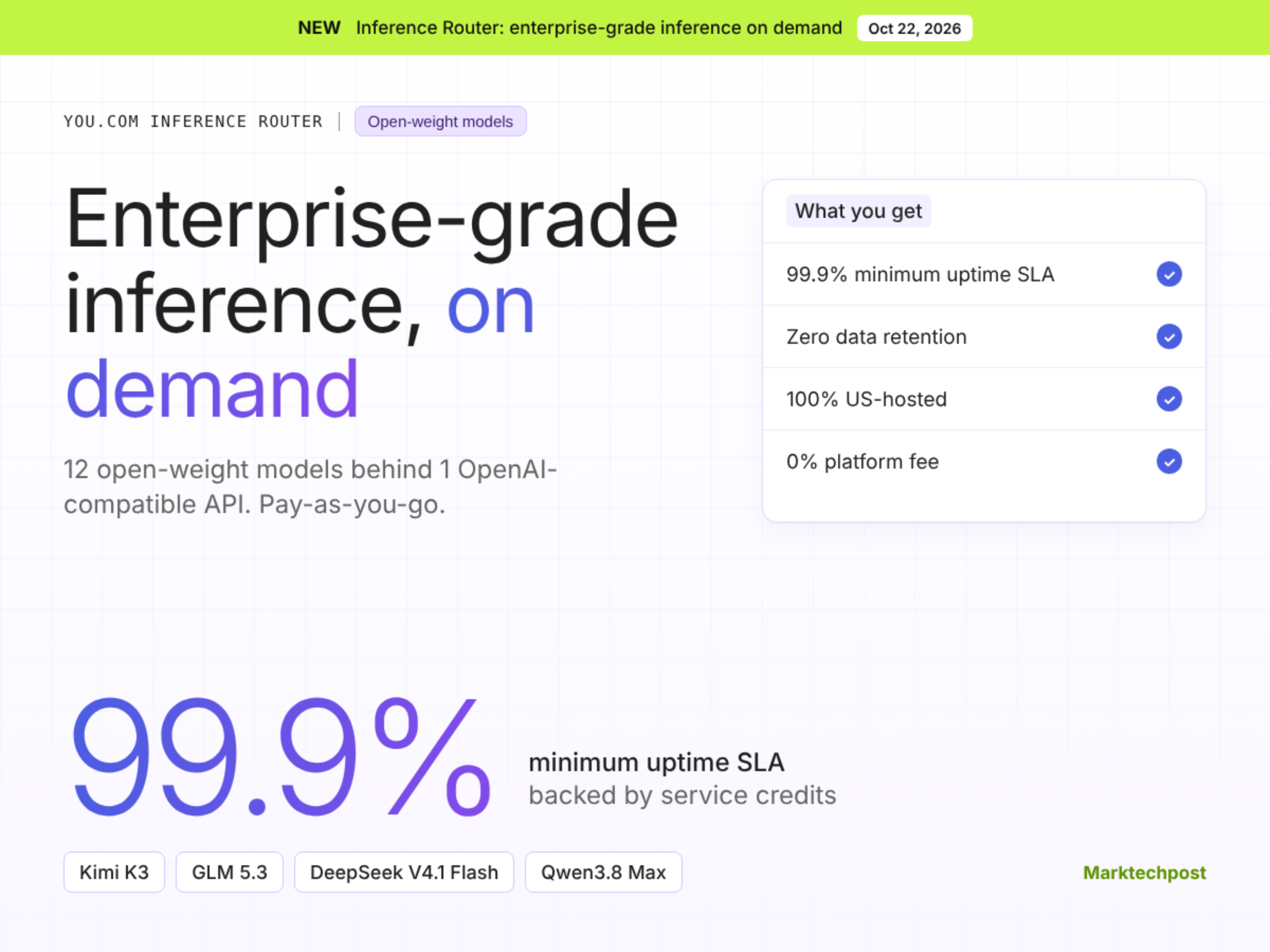
You.com has launched Inference Router, a managed API for running open-weight models in production. The You.com Inference Router is an OpenAI-compatible service that routes requests across 12 live models. It bundles a 99.9% minimum uptime SLA and zero data retention (ZDR). It adds 100% US hosting and server-side web search. It is pay-as-you-go, with no platform fee.
TL;DR
- Size: 12 live models, from GPT-OSS 120B (125K context) to Kimi K3 and Qwen3.8 Max (1M context). Kimi K3 is a 2.8T-parameter model; Qwen3.8 Max is a 2.4T MoE.
- Runs on: Fully managed. Requests hit You.com Inference Direct first, then fail over to US-hosted partners. No GPUs to manage.
- Performance: On You.com’s LiveNewsBench run, open-weight models plus You.com search matched frontier models at lower cost.
- Best: GLM-5.3 with You.com search scored 86.53%, at $0.0485 per question versus $0.0920 for Claude Sonnet 5.5 (self-reported).
- Worst: Per-token prices sit near market. Kimi K3 is $2.85/$14.25, only 5% below Together AI’s $3.00/$15.00.
It is one API for many open-weight models. The endpoint is https://api.you.com, with OpenAI-compatible and Anthropic-compatible routes. Existing SDK code moves over by changing the base URL and key.
You.com team frames the problem around stalled migrations. Dev teams test open-weight models on aggregators, then hit security review. Reviewers ask about ZDR, US hosting, access controls and DPAs. Dedicated providers clear those bars, but usually with a large commitment. Inference Router targets that gap.
How does the routing and failover work?
Every request goes first to You.com Inference Direct, the company’s own inference capacity. If it is down or full, the request fails over to a vetted partner. The official post names Parasail, Wafer, Alibaba Cloud, Meta and Inception, with Prime Intellect coming soon. All are 100% US-hosted and must meet ZDR rules.
Failover does not change the bill. Each model has 1 published per-token price. You.com also offers spend caps per API key and daily usage views by model, cost and provider. Accounts run on SOC 2 compliant infrastructure, with a DPA on request.
What does zero data retention cover?
The ZDR policy states that prompts and outputs are processed in memory and not stored. It covers both model calls and web search requests. You.com keeps only operational metadata, such as token counts, timestamps and account IDs. Prompt hashes, de-identified text and disk-backed prompt caches are explicitly excluded.
Which models are available, and what do they cost?
The models page lists 12 live models, all US-hosted. Prices are per 1M tokens (input / output):
- Kimi K3 (Moonshot AI): $2.85 / $14.25, 1M context
- Qwen3.8 Max (Alibaba): $1.85 / $5.55, 1M context
- GLM 5.3 (Z.ai): $1.35 / $4.25, 1M context
- DeepSeek V4 Pro: $1.65 / $3.65, 1M context
- DeepSeek V4.1 Flash: $0.30 / $1.20, 1M context
- Mercury 3 (Inception): $0.10 / $0.35, 1M context
- GPT-OSS 120B (OpenAI): $0.097 / $0.73, 125K context
Muse Wonder, Muse Spark 1.3, GLM 5.3 Flash, Qwen3.8 Flash and MiniMax M3 round out the list.
How does built-in web search work?
Developers declare a web_search or web_extract tool, and the router runs searches for the model. The docs show up to 20 results per search and a default of 30 search rounds. Responses return a web_results object with citations.
Search runs on the same server as the model. You.com says internal tests show up to 15% lower latency.
‘}).join(”);
requestAnimationFrame(function(){MB.querySelectorAll(‘i’).forEach(function(x){x.style.width=x.dataset.w+’%’})});post()}
R.querySelectorAll(‘#ydcSeg button’).forEach(function(b){b.onclick=function(){R.querySelectorAll(‘#ydcSeg button’).forEach(function(x){x.classList.remove(‘on’)});b.classList.add(‘on’);mode=b.dataset.m;drawM()}});
/* bench */
var B=[[‘GPT-6.1 Sol’,’built-in search’,86.53,0.0591,0],[‘GLM-5.3′,’+ You.com search’,86.53,0.0485,1],[‘Claude Sonnet 5.5′,’built-in search’,86.38,0.0920,0],[‘DeepSeek V4.1 Flash’,’+ You.com search’,84.12,0.0215,1]];
var bm=’acc’,BB=document.getElementById(‘ydcBench’);
function drawB(){BB.innerHTML=B.map(function(r){var v=bm==’acc’?r[2]:r[3],w=bm==’acc’?(r[2]-80)/(90-80)*100:r[3]/0.0920*100;
return ‘
‘+r[0]+’‘+r[1]+’
‘+(bm==’acc’?v.toFixed(2)+’%’:’$’+v.toFixed(4))+’
‘}).join(”);
requestAnimationFrame(function(){BB.querySelectorAll(‘i’).forEach(function(x){x.style.width=x.dataset.w+’%’})});post()}
R.querySelectorAll(‘#ydcBseg button’).forEach(function(b){b.onclick=function(){R.querySelectorAll(‘#ydcBseg button’).forEach(function(x){x.classList.remove(‘on’)});b.classList.add(‘on’);bm=b.dataset.m;drawB()}});
/* quickstart */
var CODE=[
‘# Use the standard OpenAI SDKnpip install openai’,
‘from openai import OpenAInnclient = OpenAI(n base_url=“https://api.you.com/v1”, # the only line you changen api_key=“YDC_API_KEY”,n)nnresp = client.chat.completions.create(n model=“kimi-k3”,n messages=[{“role”: “user”, “content”: “Hello”}],n)’,
‘resp = client.chat.completions.create(n model=“kimi-k3”,n messages=[{“role”: “user”,n “content”: “What changed in the latest Python release?”}],n tools=[{“type”: “web_search”, “freshness”: “month”, “count”: 5}],n)n# answer + citations come back in resp.web_results‘];
var TXT=[‘Inference Router speaks the OpenAI and Anthropic API formats, so existing SDKs work.’,’Swap the base URL and key. Your existing OpenAI-compatible code now runs on Inference Router.’,’Declare a web_search tool and the router runs searches server-side, returning sources in web_results.’];
function step(i){document.getElementById(‘ydcCode’).innerHTML=CODE[i];document.getElementById(‘ydcStep’).textContent=TXT[i];
R.querySelectorAll(‘.steps .btn’).forEach(function(b){b.style.borderColor=b.dataset.s==i?’#7b6cff’:”});post()}
R.querySelectorAll(‘.steps .btn’).forEach(function(b){b.onclick=function(){step(+b.dataset.s)}});
layout();setTimeout(function(){layout();post()},300);window.addEventListener(‘load’,post);post();
})();
