


Welcome to Foreign Policy’s China Brief.
The highlights this week: Chinese exports make their biggest monthly jump in 16 years, the Chinese Communist Party prepares for an important political meeting, and the former White House press secretary’s law career in China draws scrutiny.
Welcome to Foreign Policy’s China Brief.
The highlights this week: Chinese exports make their biggest monthly jump in 16 years, the Chinese Communist Party prepares for an important political meeting, and the former White House press secretary’s law career in China draws scrutiny.
China’s Export Surge
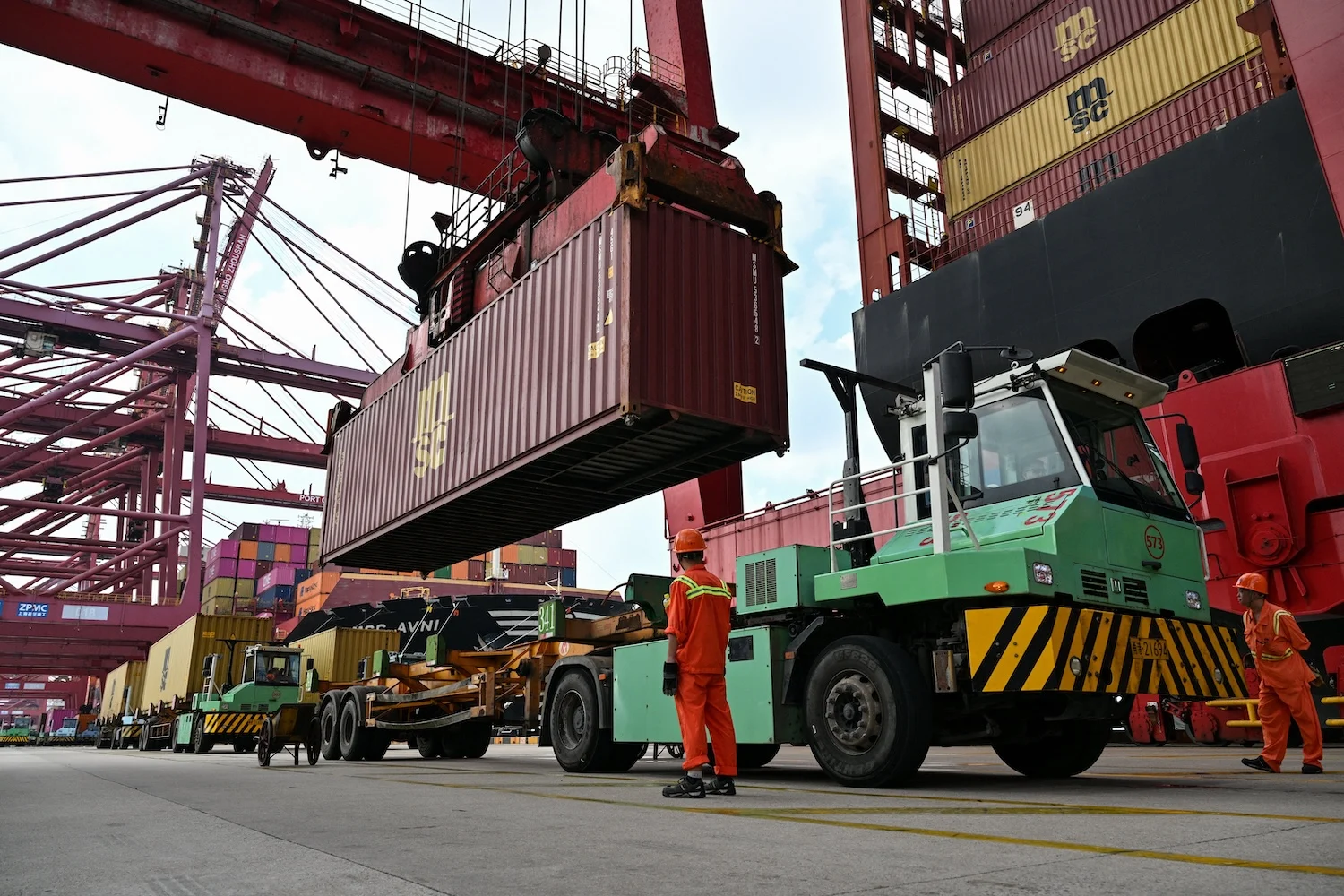
China’s exports grew by an astonishing 36.3 percent year-over-year in September, their biggest monthly jump since July 2010, thanks to the artificial intelligence industry and the easing of trade tensions with the United States.
It’s only one month, but it fits a pattern of soaring exports since the COVID-19 pandemic that cemented China’s place as the world’s factory. Exports will likely exceed $4 trillion this year. Unlike the manufacturing boom of the 2000s, this one is increasingly concentrated in high-end sectors such as electric vehicles, smartphones, and power grid management.
The paradox is that this success is partly thanks to a domestic economy still staggering from the twin blows of the pandemic and the ensuing real estate crisis. The latter has devastated household finances, while the former made people even more nervous about spending, especially given how little public support most households received during that time.
Those weaknesses fueled the manufacturing surge in several ways. Deflation at home, especially at the factory gate, made Chinese products more price-competitive. But that may be coming to an end this year; producer prices have risen for seven consecutive months as the government pushes to rebalance supply and demand.
Manufacturing has also benefited from cheaper credit as the property sector has crashed. Real estate lending once formed an unhealthy loop in which property giants borrowed from banks to buy land from local governments. That loop has broken, with land sales down 30 percent this year alone and loans flowing into manufacturing instead. A tight regulatory environment at home has also made foreign markets more tempting for Chinese firms.
Other factors are at work, too, including the growing demand for AI-related products and services and China’s heavy investment in alternative energy and EVs. But domestic weakness is what allows such astonishing export growth to coexist with relatively weak GDP growth for a developing country of China’s size.
GDP growth this quarter was stronger than expected, and based on this year’s figures so far, annual growth will probably be 4.6 percent, toward the lower end of the official target range of 4.5 to 5 percent. But those figures are still far below pre-pandemic levels, and the true figure may be lower still if the more skeptical analysts are correct.
Beijing has tried to cool the boom, conscious of both an imbalanced economy and global pushback against exporting overcapacity and deflation. But it has also benefited from the rest of the world’s failure to respond effectively.
By now it’s clear that U.S. President Donald Trump’s trade policies ended up fueling Chinese export growth rather than restricting it by making Beijing appear like a better partner than Washington. Even Canada, which had locked horns with China only a few years earlier, has shifted course in Trump’s second term.
Consumers in the developing world are happy to get cheap, high-quality goods, even as those imports swamp local industries. The only real pushback to China in this area may come from an increasingly alarmed Europe, which has both the will and leverage to extract concessions from Beijing.
What We’re Following
Proposed Ukraine summit. Russian President Vladimir Putin has proposed a trilateral summit with Trump and Chinese President Xi Jinping to decide the future of Ukraine—without Ukraine’s involvement. Though this vision of dividing the world among themselves is undoubtedly meant to play to Trump’s ego, it will not result in much.
For one, Europe—and Ukraine itself—is extremely unlikely to cooperate. But China also cannot trust any grand bargain with Trump. Beijing has always had a keen nose for political weakness, and its general mistrust of the United States has made it quicker than most to realize that Trump rarely keeps his promises.
Fifth Plenum approaches. The Chinese Communist Party will hold the Fifth Plenum of its 20th Party Congress in Beijing next week. Asia Society has a useful look-ahead, as does Deng Yuwen in FP.
Plenums are held at regular intervals between party congresses, and traditionally the fifth plenum of each cycle has concentrated on the next five-year plan. But amid Xi’s purges, the focus is likely to be on party discipline and anti-corruption efforts.
FP’s Most Read This Week
Tech and Business
Law in China. Katie Zacharia’s brief tenure as Trump’s press secretary took place almost entirely in the span since last week’s China Brief. In that time, she offered a lesson in interpreting—and overinterpreting—careers that overlap with China.
Zacharia, a lawyer, had never passed the bar exam in the United States but had worked for Zhong Lun, a major Chinese law firm, from 2011 to 2013. Foreign lawyers cannot technically practice law in China, but they can advise Chinese firms on international law.
A role like that would normally draw scrutiny in U.S. security clearance vetting, because time in China can leave people vulnerable to recruitment by foreign intelligence, but the Trump administration has ridden roughshod over that process anyway.
Moreover, Zacharia’s former job was not an impressive one, akin to the so-called white monkey jobs that proliferated in China at the time, wherein businesses hired foreigners simply to appear more international.
In general, low-level jobs in China can be useful for Americans hoping to understand how Chinese systems work. Perhaps not for Zacharia, though.
Russian satellites. China’s assistance to Russia in its war on Ukraine extends to orbit, where Chinese firms have been supplying key satellites to Russian defense-industrial start-ups.
But there’s a twist: Russian firms have been trying to pass off this technology as domestic, not to avoid foreign scrutiny but to comply with Moscow’s push to boost its own industries. Russia is slowly becoming technologically dependent on China—to an extent that even Moscow itself may not fully realize.
