


Welcome to Foreign Policy’s Southeast Asia Brief.
The highlights this week: The meth business booms in Myanmar’s Shan state while its junta representatives march on Tokyo, Indonesia’s stock market plummets, and Vietnam’s To Lam visits Europe.
Southeast Asia Breaks Bad
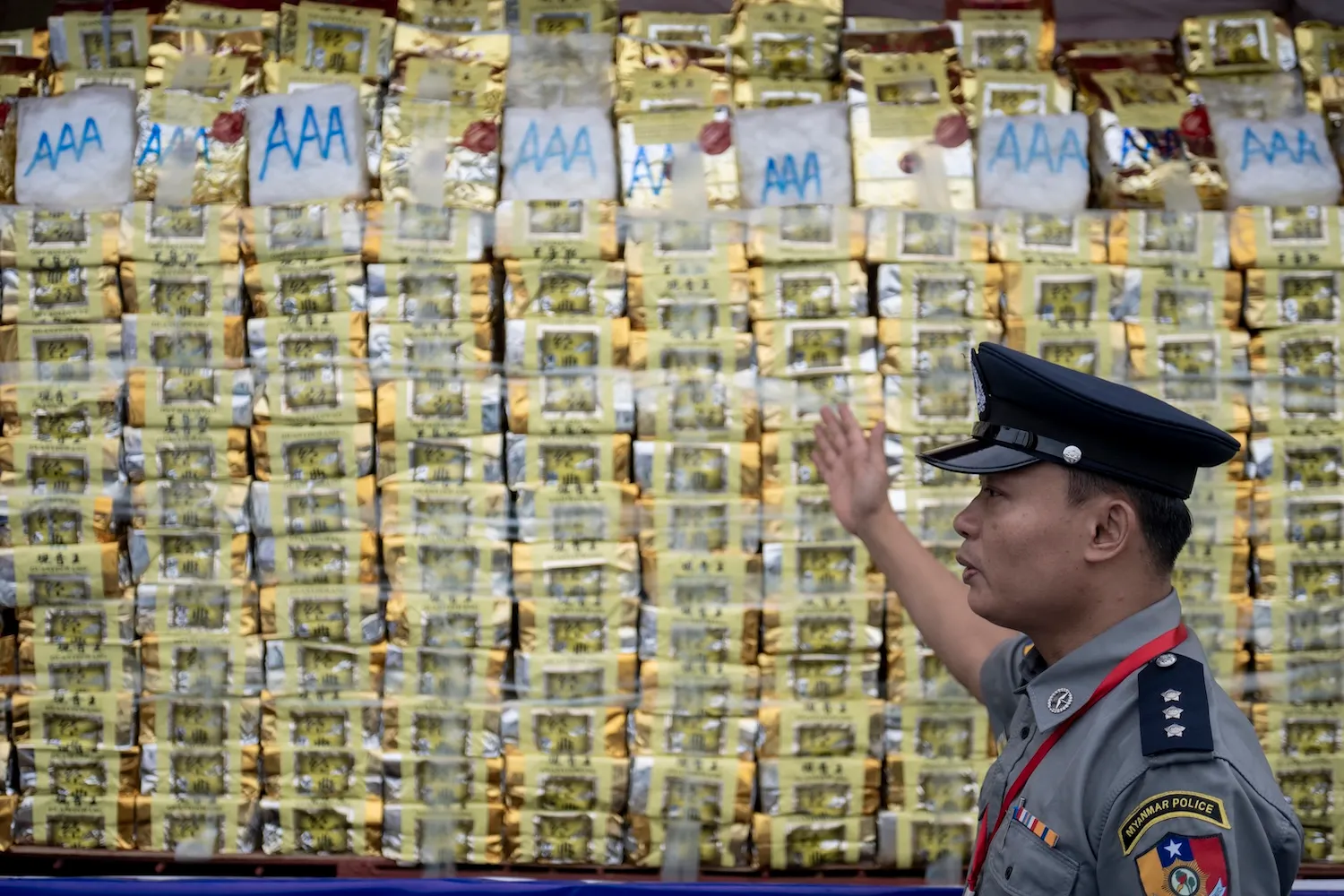
On Oct. 1, police in Laos raided a private jet that was headed for the Philippines with more than half a ton of crystal meth aboard.
The smuggling was a polyphonically international affair.
The jet was Malaysia-based, owned by a company run by two Malaysian and two Singaporeans. The man who allegedly chartered it is thought to be a politician in south Philippine city of Mindanao. Those arrested in the bust included a Singaporean, a Filipino, a Malaysian, and 10 Lao airport staff.
While scam centers now dominate headlines about crime in Southeast Asia, the region’s traditional illicit business—drugs—may well still be bigger.
For comparison, in 2023, criminal syndicates operating in the Mekong defrauded victims of some $43.8 billion worldwide, according to a conservative estimate by the U.S. Institute of Peace. Meanwhile, within Southeast Asia alone, sales of meth were worth between $48.1 billion and $74.8 billion annually, according to a report published this year by the United Nations Office on Drugs and Crime (UNODC).
The UNODC found that compared with 2019, when it published its previous report on the topic, drug markets have grown larger—as have the criminal syndicates, which operate in ever more sophisticated ways, protected by state weakness and systemic corruption. For drugs, as with many licit commodities, Southeast Asia is now a major hub for production, transit, and consumption.
Drug manufacturing is now concentrated in just one corner of the Golden Triangle: Shan state, in northern Myanmar. Control of the province is split between the Myanmar military and a number of armed rebel groups. The production and sale of drugs has long been a major source of revenue for many of these groups, including the state military.
Meth—also known as yaba or shabu, depending on its form—is the key product. The drug is often popular with those working long hours in physically demanding jobs because of its energizing qualities.
Meth sales outside the region may also be substantial. Research by Jason Eligh at the Global Initiative Against Transnational Organized Crime (GI-TOC) suggests that Myanmar meth has now gone global. He describes a sophisticated system where manufacturers have worked hard to ramp up production in industrial-scale labs and diversified their raw materials to use precursor chemicals not subject to legal controls.
Production of other synthetic drugs in Shan state is also growing, including ketamine, MDMA (aka ecstasy), etomidate (an anesthetic that is smoked recreationally), and “happy water” (cocktails of various synthetic drugs).
The drugs are then smuggled out not just into Thailand and Laos, the two other corners of the Golden Triangle, but also west into India and out of the port of Yangon—and from these places to the wider world.
However, northern routes directly into China seem to have been squeezed in recent years.
Researchers, including Eligh, accuse Beijing of tacitly tolerating foreign criminal syndicate activity so long as its own citizens are not affected. Many of the precursor chemicals for synthetic drugs seem to come from China.
China also exercises substantial influence over Shan state and key groups implicated in its booming meth industry, such as the United Wa State Army, National Democratic Alliance Army, Shan State Progress Party/Shan State Army-North, and the Myanmar military. However, groups such as the Arakan Army, the Shan State Army-South, and unaffiliated criminal syndicates all also play a role.
The drugs trade of course also entangles with other criminal enterprises. Kristina Amerhauser and Ioannis Vlassis of GI-TOC report that groups involved in the meth trade are also often connected to the scam centers. And smuggling routes, corrupt officials, and money laundering outfits can facilitate multiple different illicit activities.
A diplomatic march on Tokyo. The United States held further meetings with the Myanmar junta in Tokyo in early October, Reuters reported last Friday.
Few details were confirmed other than that talks were led on the U.S. side by Assistant Secretary of State for Intelligence and Research Michael Vance, who also led September talks in Myanmar.
Japan’s facilitating of talks reflects its ambiguous position on Myanmar and its own moves to normalize relations. Japan did condemn the 2021 coup and has yet to officially recognize the military government. However, it maintained a diplomatic presence and never joined sanctions. Japanese companies also maintained a notable presence there.
Japan is now likely moving toward full recognition of the junta. Yohei Sasakawa, Japan’s special envoy for national reconciliation in Myanmar, announced on his blog last week that he was meeting junta President Min Aung Hlaing on Monday. While I have yet to see this confirmed, it would follow a prior visit to Myanmar in August.
This also comes alongside the first public meeting, on Oct. 1, between Japan’s interim charge d’affaires in Myanmar and junta Foreign Minister Tin Maung Swe.
Analysts Hirokazu Omatsu and Kyi Sin have suggested that Japan’s past experience as a mediator to intractable conflicts in Southeast Asia, including Cambodia in the 1990s and Mindanao in the Philippines; its deep ties to the region; and its trusted status are all assets here.
However, they also point out that from the junta’s point of view, its experience with Japanese mediation is less positive. The informal cease-fire that Sasakawa helped mediate between the Myanmar junta and the Arakan Army in 2022 was used by the latter to regroup ahead of its successful renewed assault in 2023.
Crash. On Friday, Indonesia’s stock market dropped 11.57 percent. This was its worst stock market crash since 1998, when the Asian financial crisis shrunk GDP by more than 13 percent and forced the resignation of the dictator Suharto.
Things aren’t quite so dramatic this time around. The economy looks wobbly, and money has been flooding out, but the situation is much less serious.
What triggered this huge drop was not a total collapse of economic confidence but a bruising announcement by the index provider MSCI that it was now considering downgrading Indonesia to a “standalone market.”
MSCI’s ratings are used by major global investors to decide how to allocate their investments. This January, it announced that it was considering downgrading Indonesia from an “emerging” to a “frontier” market. This was due to rampant fraud on the Indonesian stock exchange. Money started leaving sharpish. Indonesia responded by announcing reforms.
Many investors expected that these would avert a downgrade. Therefore the announcement last week that MSCI was in fact considering an even sharper downgrade for Indonesia, to its lowest level, prompted panic.
Explaining its decision, MSCI said: “Despite the announced reforms, significant concerns remain around market dysfunction, including continued suspected coordinated trading behavior and lack of evidence of meaningful enforcement.”
Indonesia has promised more reforms. And President Prabowo Subianto is, according to his brother, “very angry” about this development. In January, the head of the stock exchange and the top financial regulators resigned. Who gets the ax this time?
Trade deal and EU visit. On Monday, To Lam started a six-day visit to Europe. He is accompanied on this trip by numerous top officials, including the defense minister, minister of public security, and foreign minister.
The visit starts in Denmark and will then move to Belgium, where he will meet with European Council President António Costa and European Commission President Ursula von der Leyen.
The European Union and Vietnam have been steadily deepening ties. In 2020, they inked a trade agreement, and the diplomatic relationship was upgraded to a “comprehensive strategic partnership” this January.
What’s next? Interestingly, in a recent interview with the Vietnamese press, EU Ambassador to Vietnam Julien Guerrier noted Vietnam’s role as a security partner. He suggested that there was potential for further cooperation on maritime security, protection of undersea cables, and counterterrorism.
The visit also follows the signing of a trade agreement between Vietnam and the European Free Trade Association (EFTA) on Sunday. Made up of Iceland, Liechtenstein, Norway, and Switzerland, EFTA lets those countries participate in the EU’s single market without joining the bloc. In 2025, bilateral trade between EFTA and Vietnam stood at about $5.4 billion.
Demonstrators dance during a protest against the International Monetary Fund and World Bank in Bangkok on Oct. 16.Anthony Wallace/AFP via Getty Images
FP’s Most Read This Week
China’s new air base in Laos shows that Vietnam needs to bolster its economic offer, Buu Nguyen argues in the Interpreter.
On artificial intelligence, Southeast Asia is once again being pushed to choose between the United States and China, Fumika Sato writes in Nikkei Asia.
A year after the war with Thailand ended, thousands of Cambodians are still displaced, May Wong reports in the Straits Times.
In Focus: International Anger Over Indonesian Haze
Malaysia and Singapore are reacting with increasing anger to the thick transboundary haze from Indonesian forest fires, which briefly made Singapore and Kuala Lumpur the world’s two most polluted cities.
In Singapore, Senior Minister K. Shanmugam vowed to use “every legal and regulatory lever” to go after companies linked to the haze.
At least 10 companies have been notified under the Transboundary Haze Pollution Act, which lets Singapore fine companies that are deemed to contribute toward haze in the city-state.
How effective this will be is unclear. The scale and complexity of the haze crisis means that legal action against individual companies might have limited effect.
The law also looks pretty toothless. Fines are capped at 2 million Singaporean dollars (about $1.5 million). The law was first used during the 2015 haze crisis, but of the six companies then notified, two cases were closed, and four remain open. And three companies notified this year were also notified in 2015.
In Malaysia, Foreign Minister Mohamad Hasan has said he will raise the issue at the next summit of the Association of Southeast Asian Nations (ASEAN), scheduled for November. He said ASEAN already had mechanisms to jointly address natural disasters but haze was not included in this. However, the government is not planning to take legal action.
ASEAN does have a treaty that addresses transboundary haze, but it hinges on national governments explicitly requesting assistance. As last year’s floods in Sumatra demonstrated, Indonesia under Prabowo is often reluctant to ask for foreign help.
Indonesia’s reaction to all this has been mixed. Ministers have confirmed that the cabinet is now discussing accepting foreign assistance. But the national police chief has pointedly claimed the involvement of foreign parties in the fires.
Meanwhile, the head of Indonesia’s government communications agency also proclaimed that Indonesia sends oxygen, not just smoke, to neighboring countries.
