


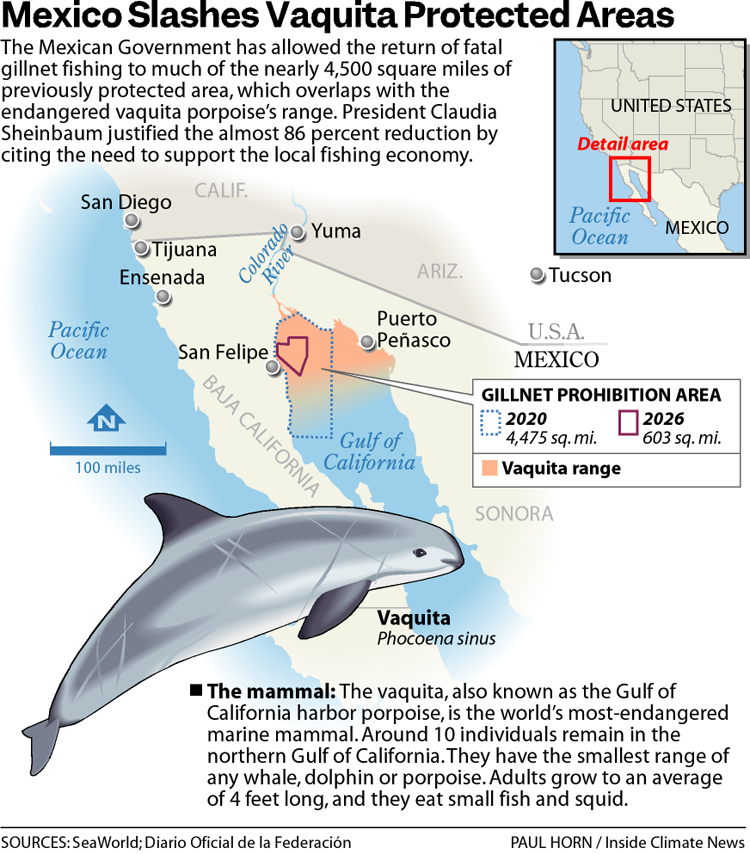
Known for their distinctive black-ringed eyes, lipstick-like mouth markings and timid, elusive nature, the vaquita is the world’s rarest marine mammal. Last year’s survey—carried out by a team of international scientists and state environmental officials—estimated just seven to 10 remain in the waters of Mexico’s Upper Gulf of California.
Yet Mexican authorities announced last week that they were rolling back 2020 protections for the globally adored porpoise. Having declined from more than 550 in 1997 to just a handful today, conservationists warn the vaquitas’ future hangs in the balance.
“We’ve reached the point where every single vaquita matters. With such a small population remaining, even losing one individual has serious consequences for the future of the species,” said Heidy Martínez, a shark scientist and science communicator who has spent years on board vaquita-monitoring vessels in the Upper Gulf.
“I really hope that years and years of effort working on protecting the vaquita are not going to get diminished because of this,” said Martínez.
New regulations, announced last Wednesday, reduce the regional area where gillnets are prohibited by almost 86 percent, from around 4,300 square miles to just 600.
Mexico previously banned the use of gillnets in the region to bolster vaquita populations and combat criminal activity. Though used legally for decades by fishermen from the town of San Felipe to catch shrimp and sharks, the vertically hanging, curtain-like fishing gear is known for snaring high levels of indiscriminate bycatch.
The gear is also the poaching tool of choice for those hunting large silvery totoaba. A similarly endemic and endangered fish with a highly valuable swim bladder that sells on the Chinese black market for between $20,000 and $80,000 per kilo, totoaba is prized for its alleged medicinal and aphrodisiac benefits.
In addition to allowing gillnets back into vast swathes of the Sea of Cortez, the “Zero Tolerance Area”—where fishing and all boat traffic were previously banned—will also open up an 1,100-foot wide vessel transit corridor.
While conservation advances have been made in banning commercial fishing between the hours of 7 p.m. and 5 a.m., and requiring local fishing boats to have satellite vessel-monitoring systems on board, the latter will not be required for a further 12 months.
“With only a handful of vaquita left, it’s absolutely shocking that the government is gutting protections rather than stepping up to help these little porpoises,” Alex Olivera, the Mexico representative at the Center for Biological Diversity, said in a press release. “It’s heartbreaking because if this isn’t reversed it will almost certainly lead to the vaquita’s tragic extinction, which could’ve been prevented.”
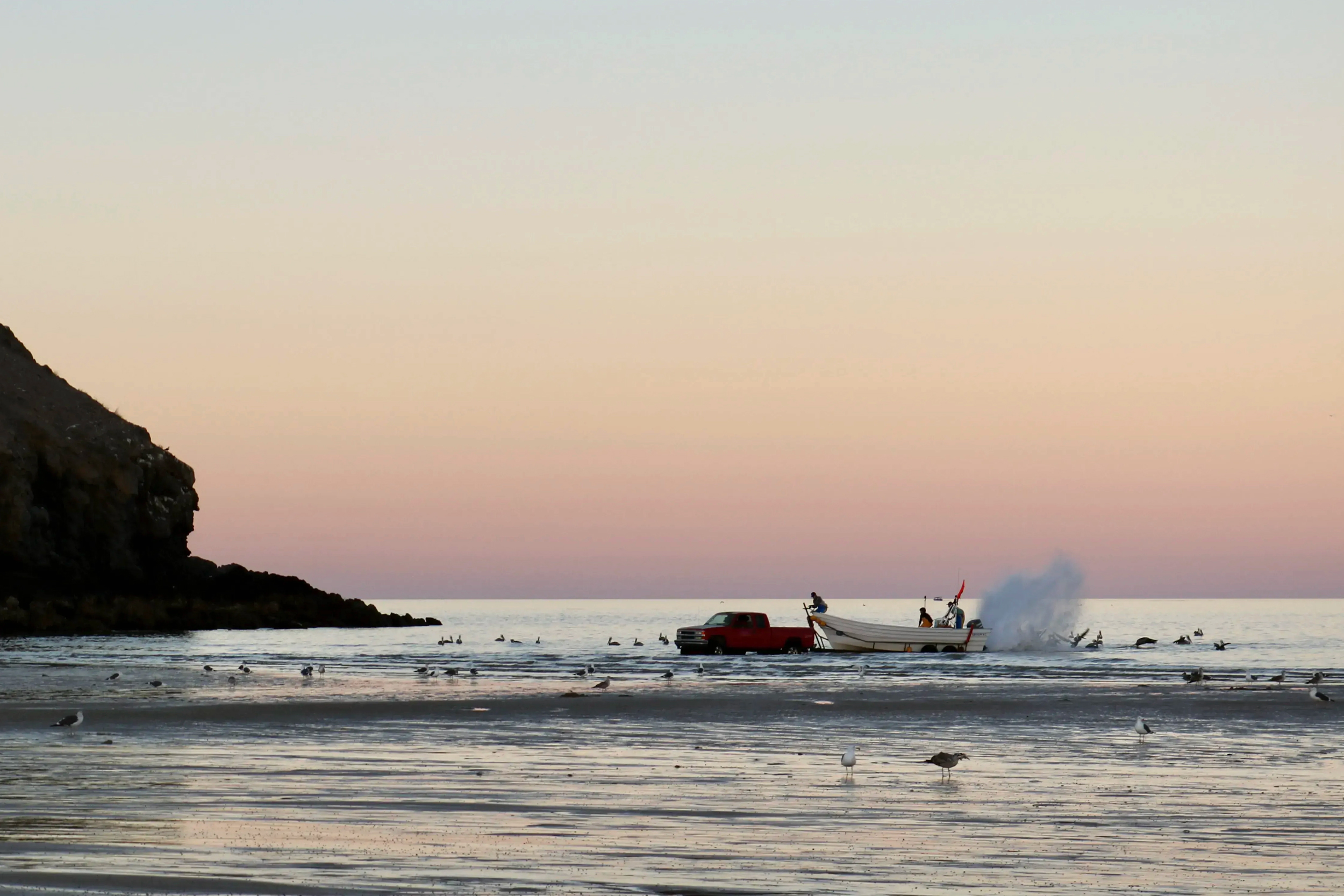
Beyond international conservation concerns, however, lies a story of local struggle. For residents in San Felipe, a town built on fishing, vaquita protections have often been seen as a barrier to their own economic survival.
In December 2020, this conflict came to a head when a collision between Molotov cocktail-hurling fishermen and a 150‑ton cutter operated by the ocean nonprofit Sea Shepherd resulted in the death of 56-year old local fisherman, Mario García Toledo. In the weeks that followed, trucks were scorched, a Navy patrol boat was set on fire and local police and army units were called into the region to restore order.
Mexico—pressured internationally to protect the vaquita but locally to look after the 17,000 residents of San Felipe—appears to finally have chosen a side. On Thursday, Mexican President Claudia Sheinbaum defended the lifting of regulations by emphasizing the need to let local people earn a living from the ocean.
Marina del Pilar Ávila, the governor of Baja California, similarly welcomed the move on social media, describing the development as “great news for the fishing community of the Upper Gulf of California.”
Counterintuitively, some local fishermen were dissatisfied with the change.
Following the government announcement, fishermen blockaded the road out of San Felipe, unhappy that the “Zero Tolerance Area”—one of the most productive shrimp areas—remained in place. With previous gillnet bans poorly enforced, they contended that the reconfiguration of fishing zones will actually restrict them further.
“The whole new agreement was very controversial,” said Valeria Towns, a National Geographic Explorer and field coordinator for Pronatura Noreste, who has spent years trying to build relations between conservationists and the community.
“Since the former agreement was never applied, for the fishers, anything new that implies real enforcement is obviously a threat to the way they’ve been doing things for years,” she said.
While the blockades were lifted over the weekend, talks about government compensation for fishermen who avoid the restricted zone will continue: “It’s the most just and fair thing to do considering the fishers, and also the most effective way to ensure that Mexico can comply and actually enforce a polygon where we know vaquitas are,” added Towns.
Indeed, among some conservationists, there is a recognition that maintaining harmony with local communities is paramount to protecting vaquitas.
“My biggest question is whether these changes will actually result in more or fewer nets in the water, because ultimately that’s what determines whether the vaquitas are safe or not,” said Martínez, noting that more stringent restrictions on an already struggling fishing community haven’t always been enough to protect the species.
About This Story
Perhaps you noticed: This story, like all the news we publish, is free to read. That’s because Inside Climate News is a 501c3 nonprofit organization. We do not charge a subscription fee, lock our news behind a paywall, or clutter our website with ads. We make our news on climate and the environment freely available to you and anyone who wants it.
That’s not all. We also share our news for free with scores of other media organizations around the country. Many of them can’t afford to do environmental journalism of their own. We’ve built bureaus from coast to coast to report local stories, collaborate with local newsrooms and co-publish articles so that this vital work is shared as widely as possible.
Two of us launched ICN in 2007. Six years later we earned a Pulitzer Prize for National Reporting, and now we run the oldest and largest dedicated climate newsroom in the nation. We tell the story in all its complexity. We hold polluters accountable. We expose environmental injustice. We debunk misinformation. We scrutinize solutions and inspire action.
Donations from readers like you fund every aspect of what we do. If you don’t already, will you support our ongoing work, our reporting on the biggest crisis facing our planet, and help us reach even more readers in more places?
Please take a moment to make a tax-deductible donation. Every one of them makes a difference.
Thank you,

Fisheries Reporter
Johnny Sturgeon is a London-based reporter covering fisheries and aquaculture. Joining us from the Outlaw Ocean Project, he has experience producing in-depth maritime investigations for nonprofit newsrooms. A former boatbuilder, he holds a B.A. in History & Politics from the University of Oxford, and an M.S. from Columbia Journalism School.
