


- Indigenous People Minister Eloy Terena warned that all achievements and historical reparation agreements for native peoples since 2023 could be undone if far-right candidate Flávio Bolsonaro is elected Brazil’s president.
- In almost four years, the ministry has celebrated the full demarcation of 20 Indigenous lands, the eviction of intruders from 12 territories and a 98.77% drop in illegal gold mining in the Yanomami Indigenous Territory, in addition to “historical agreements” for the reparation of Indigenous peoples and the creation of the country’s first Indigenous Federal University.
- Philosopher and Indigenous leader Ailton Krenak told Mongabay that Bolsonaro’s policy could corrupt the management of federal bodies that defend Indigenous interests, even if they are not abolished.
“With a single stroke of a pen, he can undo all the achievements we have accomplished in these almost four years,” said the Minister of Indigenous Peoples, Eloy Terena, regarding a possible victory of the far-right candidate, Senator Flávio Bolsonaro, for Brazil’s Presidency. “We are very concerned.”
With 47.03% of the vote, Flávio topped the first round of the presidential election on Oct. 4, despite voting polls showing current President Luiz Inácio Lula da Silva as the favorite for reelection. “If elected, one of the first ministries that will be abolished is the Ministry of Indigenous Peoples,” Terena told Mongabay by phone. “For us, this is a given, because it’s a government that has no commitment to Indigenous peoples.” The candidates face a runoff on Sunday, Oct. 25.
The unprecedented Ministry of Indigenous Peoples (MPI) was created by Lula in January 2023, fulfilling a promise to native peoples who supported his candidacy. Sonia Guajajara was appointed minister, the first time an Indigenous person led a ministry.
“The creation of the Ministry of Indigenous Peoples has a very great symbolic, but also effective, power, because it is a government that comes precisely after a period in which Indigenous peoples were extremely attacked during Bolsonaro’s administration,” said Terena, who took office in March when Sonia left the ministry to run for reelection as a federal deputy for São Paulo.
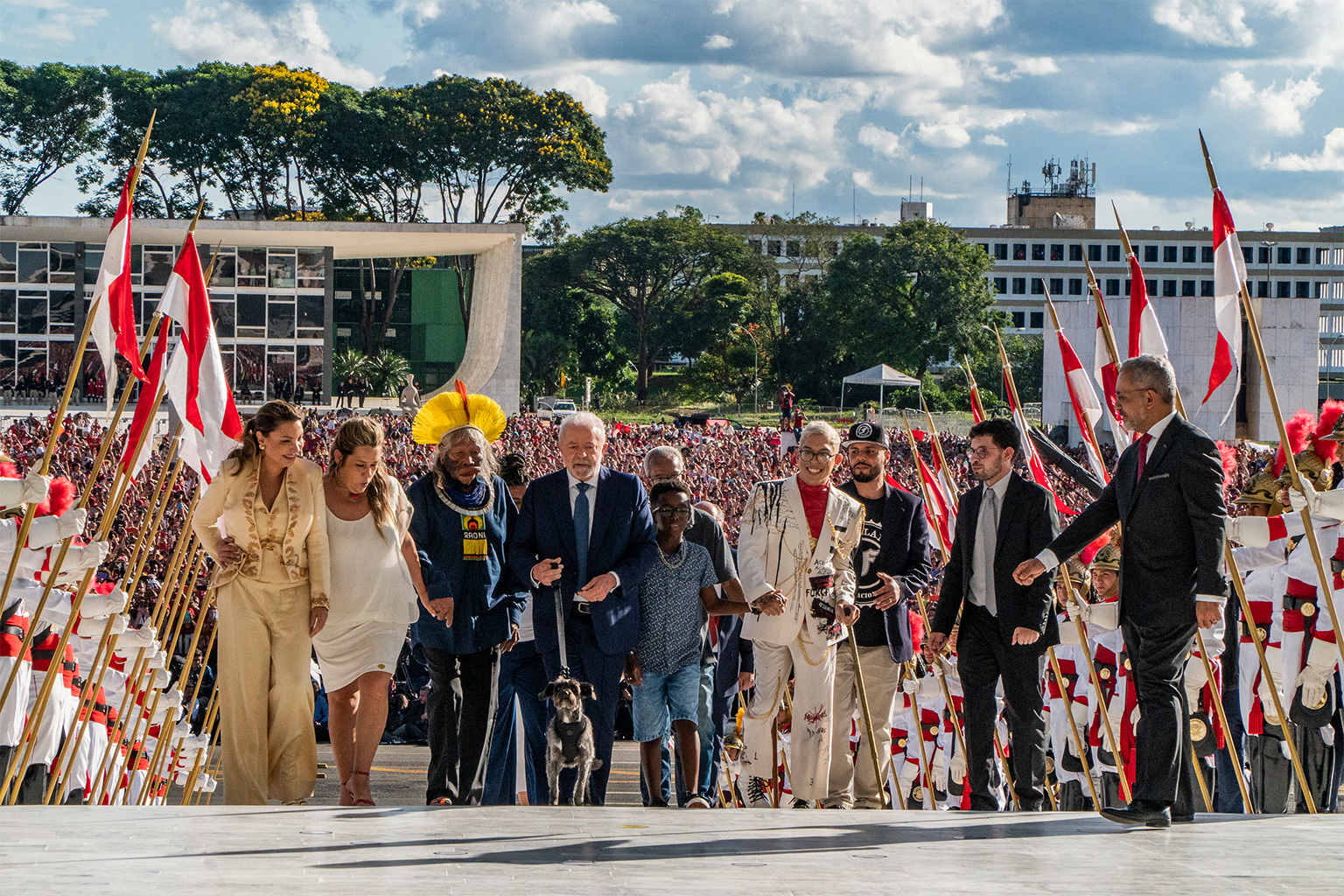
The unprecedented Ministry of Indigenous Peoples was created by President Lula in January 2023. Sonia Guajajara was appointed minister, marking the first time an Indigenous person has headed a ministry. Image by Ana Pessoa/Mídia NINJA via Flickr (CC-BY-NC 2.0).
The administration of far-right President Jair Bolsonaro (2019–2022) was marked by various acts against the environment and Indigenous peoples, such as not demarcating a single Indigenous land, fulfilling his campaign promise during the 2018 elections. Under his government, there was also an escalation of deforestation and violence against Indigenous groups, as well as measures to open Indigenous lands to mining and agribusiness, in violation of the Federal Constitution.
For the minister, the rights of Indigenous peoples have always been, in a way, “violated” since the arrival of the Portuguese in 1500, but under the Bolsonaro government this became institutionalized. “It was the first post-redemocratization, post-1988 Constitution government that instituted a truly official, public, blatant policy of disrespect for the rights of Indigenous peoples,” Terena said. “Not surprisingly, during Bolsonaro’s administration, four complaints against the Brazilian government reached the Inter-American Commission on Human Rights. And, also in an unprecedented manner, a complaint against Bolsonaro for the crime of genocide reached the Hague Tribunal [the International Criminal Court, ICC].”
The conviction in a trial for an attempted coup d’état prevented Jair Bolsonaro from running in this year’s elections, but his son, Flávio, promised to continue his father’s government, which for environmental and human rights defenders means the return of anti-environmental and Indigenous policies.
Flávio said he will not demarcate any Indigenous land. “If it depends on our government, none of these reserves will be demarcated because the vocation of the State is production,” the senator said during a visit to an agribusiness fair in the state of Mato Grosso, the country’s largest grain producer. Flávio is one of the co-authors of a constitutional amendment bill, which removes the authority for demarcating Indigenous lands from the Presidency of the Republic and the MPI and transfers it to the National Congress.
Like his father, the candidate also made controversial statements regarding Indigenous peoples. “Indians want Wi-Fi. Why? Because they want to connect, they want to be part of society. They no longer want to be a zoo animal that tourists pay to see dancing there, making fire with wood,” Flávio said in an interview for the Market Makers podcast. The candidate also promised to review the role of federal agencies in charge of environment and Indigenous affairs.
Land demarcations and ‘historical’ reparations
When Lula took office in 2023, one of his first measures was to revoke and amend six decrees from the Bolsonaro administration against Indigenous peoples and the environment, including one that encouraged mining in Indigenous lands and protected areas. During the almost four years under Lula’s administration, 20 Indigenous lands were fully demarcated, equivalent to 3.28 million hectares (8.1 million acres), in addition to signing an act recognizing boundaries and authorizing physical demarcation for another 21 territories, according to the MPI management report to which Mongabay had access.
The document highlights a “strategic milestone”: the removal of illegalsquatters from 12 territories, including a 98.77% drop in illegal mining in the Yanomami territory between March 2024 and January 2026, from extraction points to supply and gold runoff routes, with estimated losses of more than 642 million reais ($126.75 million) for wildcat miners.
There were also “historical agreements,” such as one aimed at remediating the impacts on the Avá-Guarani people of the construction of the Itaipu Hydroelectric Power Plant — the world’s third-largest in terms of installed capacity — on the border between Brazil and Paraguay. After more than half a century, the company agreed to pay 240 million reais ($47 million) as an emergency stage; the Federal Government also issued an official apology for the damages and human rights violations, according to the document. Another highlight was the legal deal that secured the return of the Guarani Kaiowá people to the Ñande Ru Marangatu territory in Mato Grosso do Sul state.
The MPI also celebrates the “historical achievement” of allocating at least 20% of the resources from the Tropical Forest Forever Facility (TFFF) directly to Indigenous peoples and local communities. For the first time, the federal government’s multi-year investment plan included Indigenous peoples as a cross-cutting agenda for other ministries, according to the report.

The document also highlights the creation of the country’s first Indigenous Federal University (Unind) and the establishment of quotas for Indigenous people in public service. The Federal Constitution, which had been translated for the first time into an Indigenous language — Nheengatu — in a 2023 initiative by the Supreme Federal Court and the National Council of Justice, also gained versions in the Tikuna, Kaingang and Kaiowá languages through actions of the MPI in the following years.
“And we want to move forward, but these programs will certainly be terminated if [Flávio] Bolsonaro is elected,” Terena said. “We just need to remember that during his father’s administration, two Indigenous languages became extinct. We had two ethnocides, because two Indigenous individuals who were the last representatives of their people died, and with them we also lost all the culture, language and tradition.”
For philosopher and prominent Indigenous leader Ailton Krenak, the MPI placed Indigenous issues “in the top-level State management structure,” representing an unprecedented gain for Indigenous peoples. “In the State hierarchy, when a secretariat deals with an issue, it is subordinate, in the second or third tier. By the time such an issue reaches top administration, the forest has already burned, the Yanomami have already died.”
In the event of a Flávio Bolsonaro victory, Krenak believes it is more likely that he would keep the MPI to have an additional ministry to distribute positions to allies and implement “predatory actions” against Indigenous peoples, such as illegal mining and illegal logging operations in Indigenous territories. “The most vivid image I could indicate is the Amazon on fire, the Pantanal burning without help, and the Yanomami abandoned to a pandemic condition,” he told Mongabay during a video call. “Necropolitics does not assume abolishing forms of management; it assumes corrupting forms of management.”

Constitutional rights threatened?
“There is nothing more important from the point of view of defending Indigenous rights than the Constitution,” said Márcio Santilli, founding partner of the Instituto Socioambiental (ISA), a civil society organization working on environmental and Indigenous rights. He highlighted Article 231, which guarantees territorial rights for native peoples, and warned that any alteration to this provision leaves Indigenous peoples “very vulnerable.”
“Flávio keeps constantly talking about changing the Constitution. He didn’t speak specifically about altering Indigenous rights, but he has already spoken enough against the Constitution for us to consider this a real fear,” Santilli told Mongabay by phone. “He said he will not demarcate anything, when the Constitution requires the Federal Government demarcate Indigenous lands, and his father already failed to comply with the Constitution in that regard.”
The 1988 Constitution established, for the first time, fundamental rights for Indigenous peoples in Brazil. Krenak was the main spokesperson for the Indigenous movement during the 1987 Constituent Assembly. “There is Indigenous blood in every hectare of Brazil’s 8 million square kilometers [3.1 million square miles]. You are witnesses to this,” the Indigenous leader said in his speech 39 years ago at the speaker’s podium in the lower House of Congress, painting his face with the black dye of jenipapo.
Krenak said that this image — and the same feeling from that time — came clearly to his mind at different moments in recent history, such as during the impeachment of former President Dilma Rousseff in 2016 (considered a coup d’etat, by Krenak), the election of Bolsonaro in 2018, and Flávio Bolsonaro’s recent speeches about changes to the Constitution.
“I feel that whole context of grief, so to speak, grief and struggle, a grief-struggle, where you have reached your limit,” said the Indigenous leader. “It is an offense to all those who managed to bring Brazil to the place it is today.”
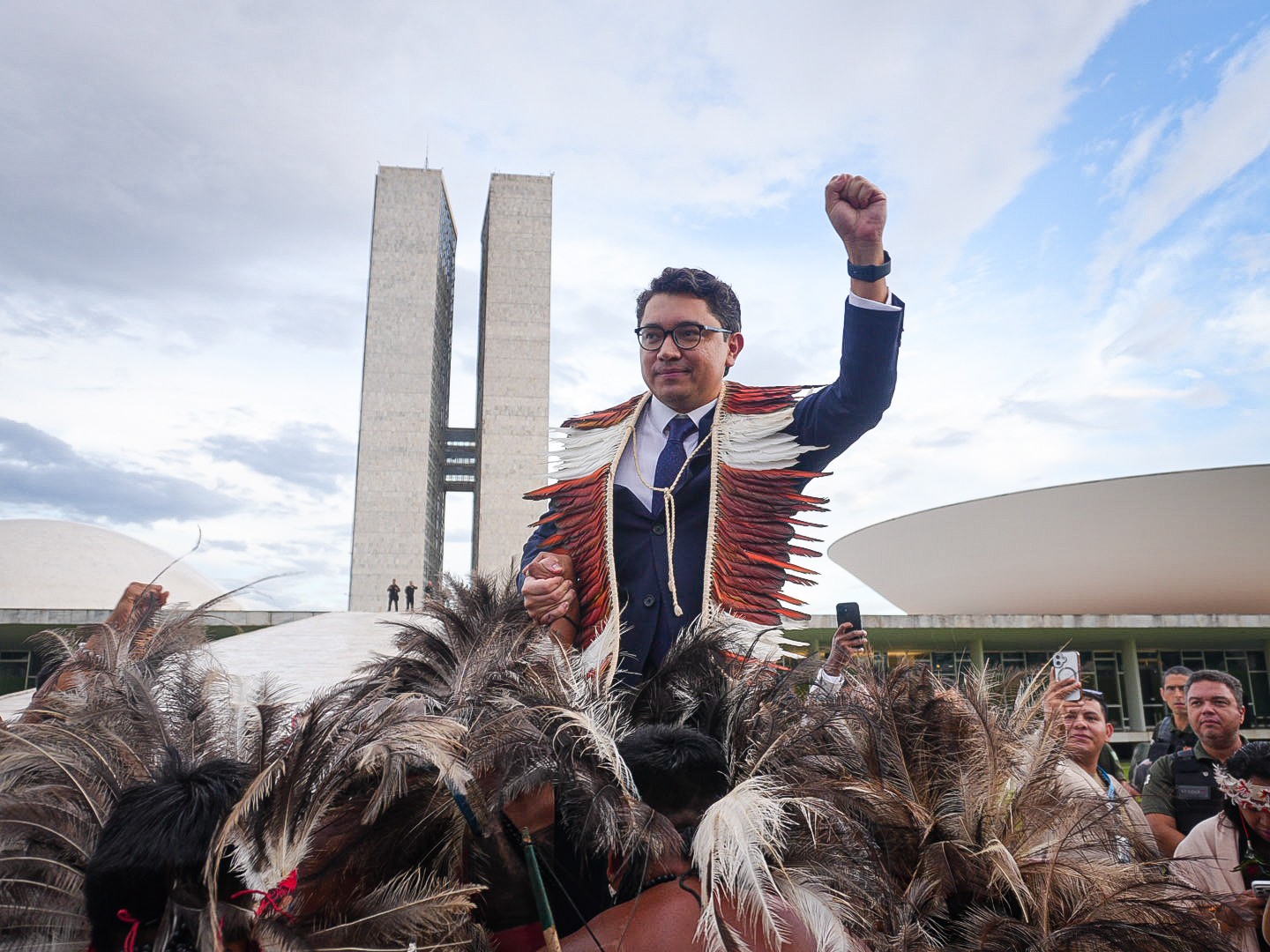
Banner image: Minister of Indigenous Peoples Eloy Terena is celebrated after being sworn in as minister in March 2026. Image courtesy of the Ministry of Indigenous Peoples (MPI).
Karla Mendes is a staff investigative and feature reporter for Mongabay in Brazil and the first Brazilian to win the John B. Oakes Award for Distinguished Environmental Journalism. A member of the Pulitzer Center’s Rainforest Investigations Network, she is also the first Brazilian and Latin American ever elected to the board of the Society of Environmental Journalists (SEJ); she was also nominated Diversity, Equity and Inclusion (DEI) chair. Read her stories published on Mongabay here. Find her on LinkedIn, Instagram, Threads, Bluesky and 𝕏.
Brazil election could put 95% of the Amazon under right-wing governments
FEEDBACK: Use this form to send a message to the author of this post. If you want to post a public comment, you can do that at the bottom of the page.

