


Reading Time: 9 minutes
Click here to read highlights from the story
- Electrical line work pays a median salary of more than $95,000 and does not require a college degree.
- The demand for electricity, driven by data centers, means line workers enjoy job security and union benefits in addition to their salaries.
- However, the work can be dangerous, with line workers exposed to the elements, heights and thousands of volts of power.
- Wisconsin Watch visited a pre-apprenticeship program at Northcentral Technical College in Wausau that trains 14 students annually to learn more about the work.
On a sunny morning in late August, a dozen teenagers wearing reflective vests and work boots stand on a hill overlooking the farm fields of their central Wisconsin college.
A few steps away is the classroom where they’ll learn how electricity works. Beside it, a handful of poles six stories tall mark the training yard where they’ll train to install and repair power lines, a skill that’s increasingly in need as Wisconsin’s infrastructure ages and data centers demand ever more energy.
Today, they’ll try out some of the toughest physical parts of the job — while racing against the clock.
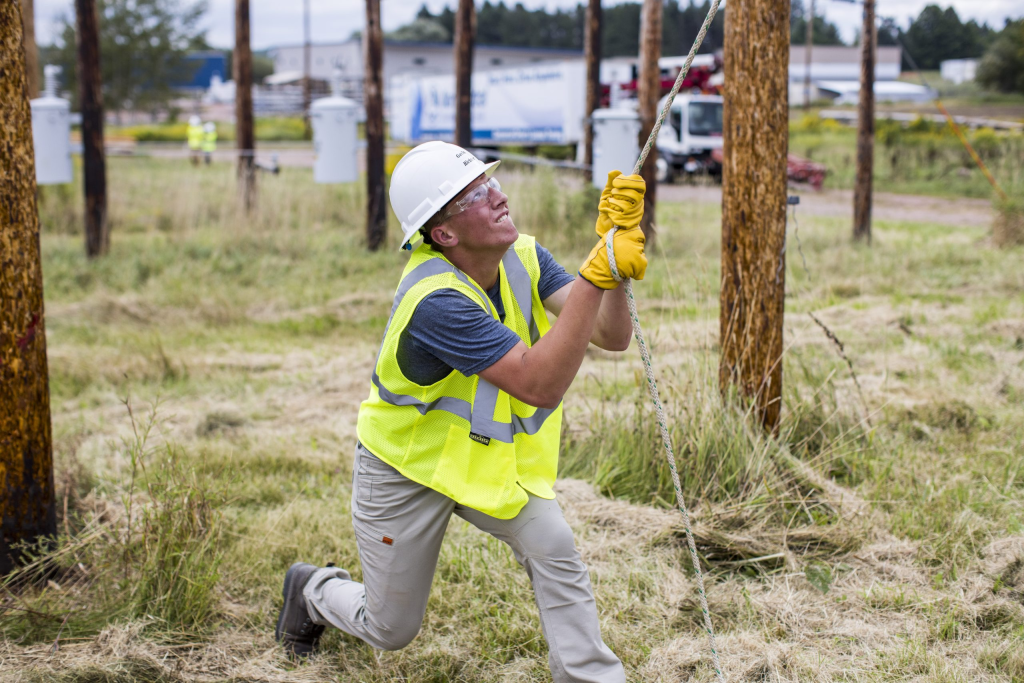
The students have just 30 minutes to dig a hole 4 feet deep and 2 feet wide. Then they must walk two 100-pound wooden pole chunks down the school’s dirt road and haul a 70-pound piece of wood up a 65-foot pole twice, using only a pulley and their own strength. The student who finishes in the shortest time wins.
This is day three of the nine-month Electrical Power Distribution Program at Northcentral Technical College in Wausau, which prepares about 14 students each year for careers with electric utilities or power line construction companies.
It’s one of seven such programs at the state’s tech colleges, which together enrolled 265 students in 2025.
With a median salary of more than $95,000, electrical line work is one of the country’s most lucrative jobs for people without a college degree. It can also be dangerous and draining, as it often involves long days of manual labor, as well as exposure to the elements, heights and thousands of volts of power.
Most of the students in this class were still in high school just a few months ago. By the end of September, they’d begun scaling utility poles six stories tall. Within a year, they could land apprenticeships that pay more than $34 an hour and put them on track to earn union pensions.

It’s instructor Marc Cegielski’s job to make sure they’re ready.
“It is physically demanding. It is mentally demanding, and your work-life balance is probably not going to be very good — unless you want your work-life balance to be more work than not work,” said Cegielski, who spent four years doing line work before he started teaching. He still works as a lineman for several weeks each summer to keep his skill sharp.
The field of electrical line work is thriving. The country is expected to add 13,600 line worker jobs between 2025 and 2035, according to the U.S. Bureau of Labor Statistics. That’s a jump of 10%, much faster than the average for all jobs. In Wisconsin, the ranks are expected to swell nearly 14% from 2024 to 2034, with about 240 job openings projected each year. The International Brotherhood of Electrical Workers (IBEW) Local 2150, which represents line workers and a variety of other workers in Wisconsin, reports its membership is at an all-time high.
One reason for that growth: the explosion of artificial intelligence.
While the data centers that provide the computing power for all that AI tend to employ relatively few people once they’re up and running, constructing them takes a lot of labor. And it’s not just the work of building the data centers themselves. Hyperscale data centers, designed to be able to scale up their computing power as needed, will need massive amounts of electricity to power their computers, and Wisconsin will need to expand and update its electrical grid to meet the demand. Wisconsin’s first hyperscale data center opened in Mount Pleasant this summer, and others are under construction in Beaver Dam and Port Washington. Proposals for additional centers are under review in other communities, including Kenosha and Wisconsin Rapids.
The new energy demand comes at a time when states finally have the money to strengthen and expand aging electric grids, thanks to the $1.2 trillion bipartisan infrastructure bill signed into law in 2021. Those funds could help Wisconsin’s electrical infrastructure accommodate more energy sources and rebound more quickly after storms, changes proponents say are needed whether or not the state adds more data centers.
Meanwhile, line workers, like many other tradespeople, have been in increasingly short supply as Wisconsin’s workforce shrinks.
“There’s never been a better time to get involved in this trade, and the work outlook right here at home in Wisconsin looks awesome for the next 10-plus years,” said IBEW Local 2150 business manager Jim Meyer.

Risk versus reward
Installing and maintaining power lines is rewarding work, Cegielski said, because workers can see the difference they’re making. Sometimes they turn the lights back on after a storm. And sometimes, they bring electricity to a place that’s never had it, as he and a few students do each spring on the Navajo Reservation.
“Getting people’s electricity back feels really good,” Cegielski said.
But the job isn’t for everyone.
Line work involves heavy exertion in all kinds of weather. Machines can handle the tough tasks some of the time, but Cegielski warns his students there are plenty of times when they’ll need to dig or lift by hand because no machine is available, or it’d be too hard to maneuver the machinery — say, in a residential backyard. Plus, if there are buried utilities within 18 inches, mechanical digging is prohibited.

“You can’t always use a machine. Sometimes you’re the machine,” Cegielski tells his students as they race to dig their holes. He says he’s sometimes spent a whole day digging a single hole, with or without a machine to help.
The students wipe their brows. One slips off his gloves. Cegielski urges them on. “Come on, man. The customer needs their electricity back.”
With four minutes left on the clock, Sam Volm, 18, unfolds a ruler to check his progress.
“I’m only about 2 feet deep! This is so crazy,” he says. He’s not alone. None of the holes are nearly deep enough.
It’s just one example of the challenges of the job. Some line workers work for contractors hired by utility companies to build or maintain their infrastructure. Those workers could be on the road, often out of state, for weeks or months at a time. Line workers employed by local utility companies generally work close to home. Still, many work 12- to 16-hour shifts, and they may need to be available to help on nights or weekends.

“Your phone rings a lot,” Cegielski said. “You’re going to be missing a lot of things that you’d rather be doing with your friends and your family to answer that phone call and get people’s power back on so that they can cook supper, so that they can go to work and earn money for their own families.”
And then there are the safety concerns. Cegielski said he’s never been seriously injured doing line work, but he knows the risks that come from working with high voltage and at high heights, sometimes on busy roads. Electrical power line installers and repairers had the 16th highest fatal injury rate of all U.S. jobs, with an annual rate of around 24 fatalities and 189 nonfatal injuries per 100,000 workers, according to a USA Today analysis of federal data from 2020 and 2021.
Despite the challenges of the job, the training program at Northcentral Technical College consistently has a waitlist.
For Volm, who’s worked in construction since he was 14, spending his days outside was part of the appeal.
“You’re not behind a computer or nothing. It’s real physical work, it’s what I’m used to,” Volm said.

His dad, an electrician, encouraged him to consider line work. Bigger lines mean bigger money, he said, plus he’d get to travel.
The morning drill didn’t deter him. He’s been wrestling since first grade, so he’s got lots of practice putting his body to the test.
“It was pretty tough, but I muscled through it, obviously, and embraced the suck.”
College classes not required
Training programs like these are an optional extra step for those looking to enter the field. Line workers get most of their training through apprenticeships that last three to six years and require only a high school diploma. But doing a program like the one at Northcentral Tech first gives students a chance to try out the work before they commit.
That’s how Pat Keegan, a business agent with IBEW Local 2150, got started in the industry 25 years ago.

“I’m glad I did it because I got comfortable with climbing and I knew I wanted to do this career,” Keegan said, though plenty of line workers go straight into apprenticeships.
“I’ve seen people right out of high school, skip the tech school part of it … and have no issues,” Keegan said.
Prospective line workers shouldn’t assume this training will help them get an apprenticeship faster, Meyer said. Instead, they should think of it as a chance to solidify their skills and learn more about things like electrical theory.
For Cegielski, the Northcentral Tech program is also about teaching the all-important “soft skills” that employers are increasingly looking for, like how to solve problems and persevere through challenges.

Take the August morning’s drill. What the students don’t know is that Cegielski designed the digging portion to be nearly impossible within the time limit.
“I like to observe to see, once they figure out they’re running out of time, do they continue trying, or do they give up? It’s a really good marker of character,” Cegielski said. “Even if they don’t think they can complete the task, they should keep going at it.”
Six other Wisconsin tech colleges offer electrical power distribution programs, but capacity is limited. Graduates earn around $43,000 more a year than the median high school graduate, according to an analysis of earnings data from three of the programs, conducted by Open Campus and The HEA Group. Program cost varies by school but typically runs from $8,500 to $11,000.
Despite the growing demand for line workers, Northcentral Technical College hasn’t expanded its small program. Cegielski says he hasn’t heard anything about plans to do so.
“They need more people than I can provide,” Cegielski said, “and I don’t see that changing anytime in the near future … I don’t know if that’s a problem that the technical college system wants to handle or can even handle.”

Leaders at Northcentral Technical College did not respond to a request for comment.
Kristina Haensgen, a spokesperson for Moraine Park Technical College, which also trains future line workers, noted the “strong and ongoing demand for skilled electrical line workers” but said the school has no immediate plans to grow its program.
Chippewa Valley Technical College, Milwaukee Area Technical College and Southwest Wisconsin Technical College did not offer comment on their line worker training programs.
If colleges do want to expand these programs, the booming industry might actually make it tougher, said Katy Pettersen, a spokesperson for the Wisconsin Technical Colleges System.
“We have not heard much on this front, other than colleges may be having trouble finding qualified instructors because the companies building the data centers are paying so well.”
Jobs aplenty
Meyer of IBEW Local 2150 said the number of apprenticeships available through his union depends on how much local employers are hiring. In a good year, there could be room for around 170 new apprentices, he said, and it looks like Wisconsin is on track for some good years. Those waiting for an apprenticeship can get jobs as “groundmen” assisting line-working crews until a spot opens.
Cegielski talks with many of his former students, and he doesn’t think any of them are struggling to find work.
That stands in contrast to many other fields, where AI has left many uncertain about the future. Recent college graduates with four-year degrees are having more trouble finding jobs. Across the country, office workers are wondering if they’ll be replaced by increasingly powerful AI agents, or if they’ll have the skills they’ll need to use ever-more-ubiquitous AI tools.
“At the moment, it doesn’t seem like AI is knocking at our door to take our jobs,” Cegielski said with a laugh. ”(The work) is hands-on, and it doesn’t look like machines and robots are going to be able to take it in the future. Maybe someday.”
Natalie Yahr reports on pathways to success statewide for Wisconsin Watch, working in partnership with Open Campus. Email her at nyahr@wisconsinwatch.org.

Wisconsin Watch is a nonprofit, nonpartisan newsroom. Subscribe to our newsletters for original stories and our Friday news roundup.
As data centers test Wisconsin’s electrical grid, job opportunities flourish 60 feet in the air is a post from Wisconsin Watch, a non-profit investigative news site covering Wisconsin since 2009. Please consider making a contribution to support our journalism.
