


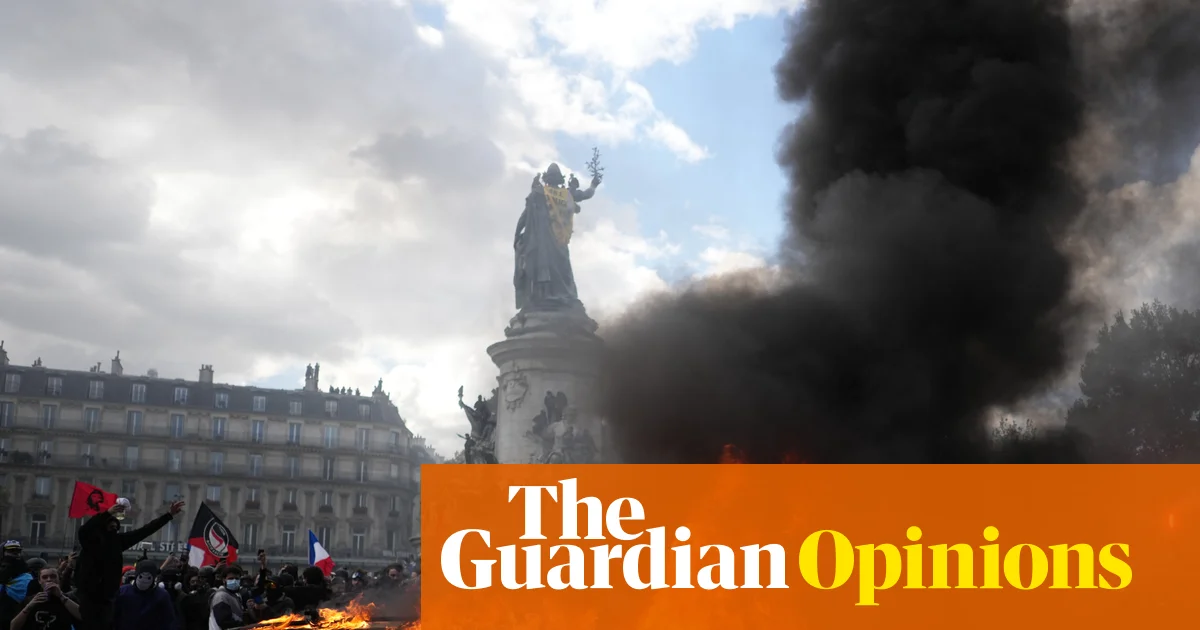
In Emmanuel Macron’s book Revolution, published ahead of the 2017 presidential election that he went on to win, he promised to restore hope to a country that was losing faith in its future. As Mr Macron’s lame-duck second term enters its last phase against a quasi-insurrectionary backdrop of torched public buildings and looted shops, the failure of that political project appears total.
The worst scenes of urban violence for years overshadowed a weekend of protest that gravely undermined what is left of the French president’s authority. As police lost control of the streets, more than 2,000 shops were ransacked. Far-left groups targeted town halls and local buildings, and engaged in pitched battles with the police, whose disastrously heavy-handed response to last week’s high school protests has succeeded only in escalating tensions.
In a statement on Sunday evening, Mr Macron rightly condemned what he described as episodes of “unbridled violence”. On the far right, Marine Le Pen is already exploiting a national sense of dismay to present herself as the law-and-order solution to the crisis. But the shocking actions of a minority should not obscure the significance of the vast, peaceful demonstrations that took place throughout France on Saturday. Calls to unite the student protests and the yellow vest movement, which disrupted Mr Macron’s first term over cost of living issues, mobilised up to 800,000 people.
The root cause of the unrest is a widespread perception that France’s social contract is broken. The young feel let down by an underfunded and unequal education system, and are fearful of the future impact of AI and the climate emergency. As is increasingly the case across Europe, they no longer trust mainstream politicians to find answers. The scale of the weekend protests showed that gen Z’s discontent has merged with that felt in the country’s neglected towns and banlieues, which have suffered repeated economic shocks since the Covid pandemic.
The obtuse and stubborn response from Mr Macron has been to double down on a cost‑cutting agenda to reduce France’s public debt, in order to appease the financial markets. But in an era where the asset-rich have continued to flourish, and the wealthiest have done best of all, to argue that that there is no alternative to spending less on schools and healthcare won’t wash. The economist Thomas Piketty pointed out during last week’s student protests that the boom in private wealth means that, despite the size of its public debt, “France has never been richer”.
Mr Macron’s reckless decision to call a snap election in 2024, which cost him his majority, left him a diminished political figure. His biggest subsequent error has been to haughtily persist with the economics of austerity, despite clear evidence of deepening political polarisation and rising popular anger. With each week that passes, the social consequences appear more ominous, ahead of presidential elections in six months’ time.
The latest polls suggest that the far right’s huge lead is widening ahead of that contest. Meanwhile, the hard-left leader Jean-Luc Mélenchon continues to outscore progressive rivals, though the numbers suggest that he would heavily lose a runoff against Ms Le Pen. In an increasingly febrile atmosphere, France is heading towards a seismic reckoning in May. Alarmingly, the civil strife witnessed at the weekend may only be a foretaste of what is to come.
-
Do you have an opinion on the issues raised in this article? If you would like to submit a response of up to 300 words by email to be considered for publication in our letters section, please click here.
