


- Saliza Bono, a Malaysian bioacoustician at nonprofit research group MareCet, studies the sounds of marine mammals to protect their population.
- Her research focuses on the impacts of underwater noise, particularly on Indo-Pacific humpback and Irrawaddy dolphins in Malaysia.
- In an interview with Mongabay, the marine biologist discusses her journey into bioacoustics, how underwater noise pollution impacts dolphin behavior, and the challenges of her research.
KUALA LUMPUR — Malaysia’s coastal waters are home to 27 species of marine mammals. These include protected species like the Indo-Pacific humpback dolphins (Sousa chinensis), Irrawaddy dolphins (Orcaella brevirostris), Indo-Pacific finless porpoises (Neophocaena phocaenoides), dugongs (Dugong dugon) and Indo-Pacific bottlenose dolphins (Tursiops aduncus).
But few Malaysians know about these sea animals, and even fewer are aware that there is a scientist who studies the vocal communications of these aquatic mammals. Meet Saliza Bono, the bioacoustics officer at MareCet, the country’s only NGO dedicated to research and conservation of marine mammals.
Saliza, 32, who also leads the NGO’s Langkawi Dolphin Research Project, studies marine mammal sounds, as she believes learning about these animals is the first step toward saving them. Her research focuses on the impacts of underwater noise, particularly on Indo-Pacific humpback and Irrawaddy dolphins in Malaysia.
In an interview with Mongabay via video call, the marine biologist discusses her journey into bioacoustics, how underwater noise pollution impacts dolphin behavior and the challenges of her research.
Mongabay: How did you get interested in becoming a bioacoustician?
Saliza Bono: I think I saw my very first dolphin when I was in Australia. As a 10-year-old, I was amazed at how these are mammals. They have lungs like us but live underwater.
I was so curious, and I wanted to know more. Then I heard the term “marine scientist,” and I knew I wanted to be a marine scientist studying dolphins. So I went on to do my undergrad in Australia at James Cook University for marine science.
And it was during my undergrad that I heard that orcas, killer whales, have dialects. And that was it. I decided I was going to study bioacoustics for the rest of my life. I found that so interesting because coming from Malaysia, we have dialects too. So just hearing that was so mind-blowing to me.
Mongabay: How much do we know about dolphin language?
Saliza Bono: Not at all. For MareCet, we started with the baseline bioacoustic studies when I began my Ph.D. in 2018. Whenever we see the dolphins socializing or foraging, we’ll record the sound to build a baseline. But we’re not yet at the level where we can interpret what they’re saying. In Sarasota, [in the U.S. state of] Florida, researchers can understand dolphin communication better, but that comes after 50 years of research. It takes a very long time.

Mongabay: Do different species of marine mammals have different sounds and dialects?
Saliza Bono: Different species have different sounds and frequencies, but not many species are known to have dialects. That’s still currently being discovered. Orcas are most known to have dialects. But almost all marine mammals have different types of sounds.
For example, baleen whales, the category that includes humpback whales [Megaptera novaeangliae] and blue whales [Balaenoptera musculus], produce very low-frequency sounds. It’s so low that humans can’t hear them, whereas toothed whales like humpback dolphins and Irrawaddy dolphins are in the mid-frequency range. Porpoises are high-frequency, almost ultrasonic, which humans can’t hear since they’re above 100 kilohertz. We can pick those frequencies up with hydrophones. So when we see these animals, we’ll deploy a hydrophone by the side of our boat, and then we’ll record the sounds to analyze them.
Mongabay: Why is sound so much more crucial than sight when it comes to marine mammal conservation?
Saliza Bono: Malaysia’s waters can be very murky, so marine mammals can’t rely entirely on eyesight. They use sound to navigate, forage and communicate with one another. In South Asia, the Ganges River dolphin [Platanista gangetica] is known for being completely blind and relying entirely on sound to survive.
Part of my Ph.D. research looked at how anthropogenic noise — noises from fishing boats and tour boats — affects dolphins. I found that when a boat passes a group of communicating dolphins, the amount of whistles they produce drops significantly when the boat is near them. Even after the boat leaves, their whistling rate doesn’t immediately return to normal.

Mongabay: And when you say near, how near is that?
Saliza Bono: It depends on the species, but for the ones we study in Malaysia, I’d say a boat within a 500-meter (1,640-feet) radius can already affect them.
Mongabay: What are some of the main threats marine mammals face in our waters?
Saliza Bono: Bycatch [accidental capture] is one of the biggest concerns. Interviews with local fishermen showed us that there’s bycatch of dolphins. So we recently started a bycatch mitigation project.
We are trialing out acoustic pingers with the fishermen. What these pingers do is produce a high-frequency sound that only works underwater and can only be heard by marine mammals. Other fish won’t hear the frequencies. So the fishermen will attach [them] to their nets, and the pingers will alert the dolphins that there’s a net in front of them.
Dolphins can’t see the nets since they’re very thin. Even with their echolocation sounds, the echolocation signals will go straight through the net instead of being echoed back to them. So the acoustic pingers are pinging and telling the dolphins, “Look, there’s something in front of you; stay away.”
So it’s really a win-win situation because a dolphin doesn’t get caught in a net, and the fishermen’s net doesn’t get destroyed by the dolphins.
Mongabay: What are challenges in your work?
Saliza Bono: As an NGO, funding is always a challenge. Take these acoustic pingers, for example. They’re not cheap. There are a few other bioacousticians in Malaysia who study terrestrial animals, studying the soundscape of forests, birds, and langurs. And when you compare those acoustic devices to ours that are marine-related, ours can be almost five times more expensive.
Mongabay: Is it hard to convince funders of the importance of your work?
Saliza Bono: I think it depends on where and which grants we apply for. Locally, it may still be a bit difficult. One of my goals is getting the government to formally recognize underwater noise as a threat to marine mammals.

Mongabay: Do you see any interest or pushback from parties who might want to develop the coastline?
Saliza Bono: Some developers now do reach out to us before construction begins to understand the underwater acoustic environment. It’s really interesting to see that change happening.
Mongabay: What key changes in human activity would make the biggest difference in dolphin survival?
Saliza Bono: I think in general it’s to increase awareness. As you know, many Malaysians don’t even know that we have marine mammals in our waters. So what our executive director always says, “If you don’t know, then you don’t love,” right? So if more people are aware that there are dolphins or whales in the area, then I think more people will care.
Mongabay: Is there anything else you want to add?
Saliza Bono: MareCet is a mostly female team. People often assume that studying marine mammals is a girl’s job or a hobby rather than an actual career. But I want to change that perception. This work is important because marine mammals are key indicators of the ocean’s health. When you see lots of dolphins in an area, then we know that the ocean is thriving.
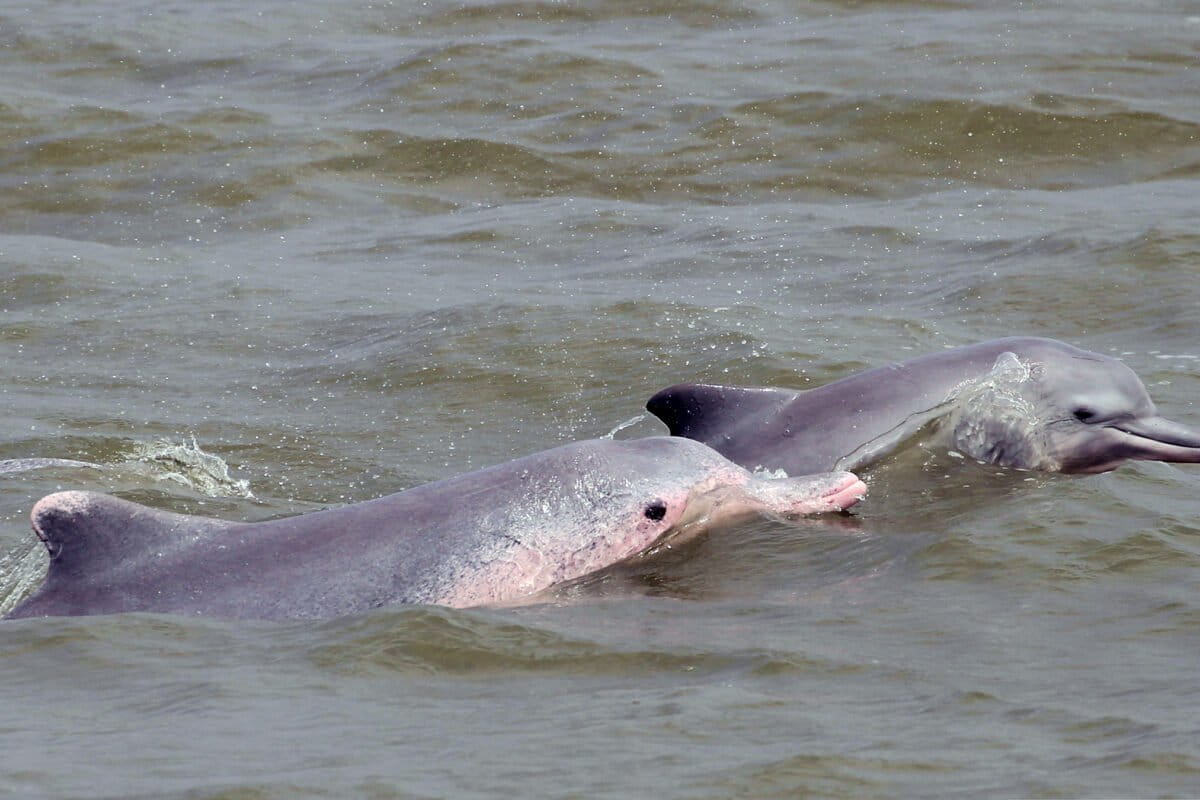
Banner image: Indo-Pacific humpback dolphins, listed as vulnerable on the IUCN Red List, face increasing threats in Malaysia, from coastal development, boat traffic, and fishing net entanglement. Image courtesy of MareCet.
Counting whales by eavesdropping on their chatter, with help from machine learning
Cite this article
Ashley Yeong (2026). Eavesdropping on Malaysia’s dolphins: Interview with marine bioacoustician Saliza Bono. Mongabay Conservation news. DOI: https://doi.org/10.66709/news-332551

