


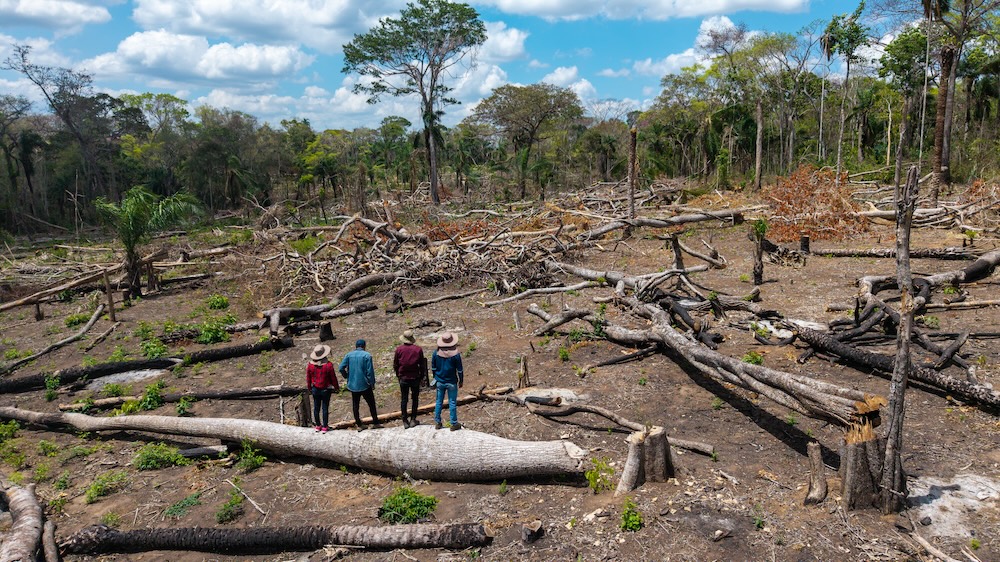
- Nine out of every 10 hectares (22 of every 25 acres) of forest lost in Amazonian Indigenous territories in Bolivia were cleared illegally, new data analysis suggests.
- Between 2003 and 2023, more than 186,500 hectares (460,900 acres) of forest disappeared — an area nearly three times the size of Madrid — with illegal clearing accounting for more than 90% of that total.
- Land invasions to expand the agricultural frontier pose a constant threat to Amazonian Indigenous peoples in Bolivia: of 30 territories surveyed, 28 reported occupations by outsiders, as most of these conflicts remain unresolved.
- The yearlong investigation led to the launch of VISTA, a platform presented by the Pulitzer Center, Mongabay and Bolivian organizations RAI Bolivia and Asuntos Centrales, that tracks and analyzes key data on deforestation, fires, land clearing, soy expansion and settlements across the 48 Indigenous territories of the Bolivian Amazon.
For most Indigenous peoples in the Bolivian Amazon, the forest is far more than a collection of trees. It is the casa grande, Spanish for “the main house”, where communities, rivers, wildlife, spiritual beings and ancestral memories coexist. For them, conserving the forest means conserving life itself.
Yet data analyzed by Amazonía Traficada (Trafficked Amazon) — a journalistic collaboration backed by the Pulitzer Center in partnership with Mongabay, Bolivian independent environmental journalism platform RAI Bolivia and the multiplatform newsroom Asuntos Centrales — show that this casa grande is now under siege.
According to the analysis, between 2003 and 2023, more than 186,500 hectares (460,900 acres) of forest were cleared across the 48 Indigenous territories of the Bolivian Amazon basin — an area nearly three times the size of Madrid. Of that total, the Bolivian Authority for the Supervision and Social Control of Forests and Land (ABT) authorized only 10%; the remaining 90%, or 168,670 hectares (416,800 acres), was cleared illegally.
For Rivelino Segundo, leader of Isoso — the Bolivian Indigenous territory with the largest area of illegal forest clearing, more than 43,000 hectares (106,000 acres) — the deforestation eating into ancestral lands is directly tied to land invasions and an expanding agricultural frontier. Those occupying the land illegally seek to convert forest into farmland, he told Mobgabay: “We are not the ones clearing the land. It is the invaders. [In Isoso], they do it to plant large-scale soy. We, as the Guaraní Indigenous people, coexist with nature.”
These findings stem from a yearlong investigation in which the reporting team, working alongside geographers, analyzed and verified thousands of leaked records from the ABT and Bolivia’s National Institute of Agrarian Reform (INRA). They combined those records with data from the collaborative mapping platform MapBiomas, NASA’s monthly Global Burned Area satellite product (MODIS MCD64A1) that maps vegetation fires, and the Bolivia-based non-profit Friends of Nature Foundation (FAN). By cross-referencing satellite imagery across eight databases and conducting field reporting that included at least 30 interviews with Indigenous leaders, the team reconstructed in close detail how the 48 titled Indigenous territories of the Bolivian Amazon basin have transformed in recent decades.
From this investigation came VISTA, a platform that brings together and publishes the data analyzed by Amazonía Traficada. The tool allows users to explore each of the 48 Bolivian Indigenous territories individually to see what is happening within and around them, including deforestation, fires, soy expansion, land-clearing authorizations and third-party settlements.
The illegal frontier
Between 1986 and 2024, the 48 titled Indigenous territories of the Bolivian Amazon basin lost approximately 257,000 hectares (635,000 acres) of forest, according to GeoFAN, a geospatial data portal developed by FAN. According to Mongabay’s analysis, the loss represents 3.4% of all land deforested across Bolivia during those four decades, an area estimated at 7.6 million hectares (18.8 million acres).
To determine how much of that clearing was legal, Amazonía Traficada obtained a leaked, unpublished ABT database of land-clearing permits issued between 2003 and 2023. Over those two decades, the records show, the agency issued around 9,400 administrative resolutions authorizing the clearing of nearly 80,000 hectares (198,000 acres) of forest across 41 of those Indigenous territories.
Yet only a fraction of that permitted area was actually cleared. Comparing the leaked ABT data with satellite deforestation records, the investigation found that of the 80,000 authorized hectares, around 17,900 hectares (44,200 acres) of forest were felled.
The gap between what authorities permitted and what happened on the ground points to a more complicated reality. That only a fraction of the authorized area was cleared does not mean that forest loss slowed; rather, most deforestation occurred beyond regulatory boundaries. Between 2003 and 2023, forest loss in unauthorized areas reached 168,670 hectares (416,800 acres).
In other words, for every hectare of forest cleared with a permit, more than nine hectares were cleared without one. Ninety percent of forest loss in Amazonian Indigenous territories occurred outside state regulatory oversight.

Amazonía Traficada requested information and an interview with the ABT’s national leadership to discuss these findings. The agency said the request remained under “internal administrative review and coordination” and did not provide an official response before publication.
The pressure bearing down on Amazonian Indigenous territories is part of a wider pattern. According to a report by the World Resources Institute, Bolivia ranked second globally in primary forest loss in 2025. The Andean country was only behind Brazil.
Clearing is not the only driver of forest loss in the Indigenous Amazon: Fire has also left deep scars. Data analyzed for this investigation show that between 2001 and 2024, burns and wildfires scorched 23.8 million hectares (58.8 million acres) across Bolivia. Of that total, 4.1 million hectares (10.1 million acres) — 17% of the national total — burned within titled Indigenous territories of the Bolivian Amazon basin.

What factors led to the current situation?
Understanding how this situation developed requires looking back through several decades of the history of Amazonian Indigenous peoples’ struggles to defend and secure recognition for their ancestral lands.
The 1990s proved decisive for Indigenous land rights in Bolivia, marked by historic milestones in 1990 and 1996. In both years, Indigenous peoples left the forests, rivers and savannas of their Amazonian homelands to march hundreds of kilometers to the seat of government in La Paz, the country’s administrative capital.
On the two occasions — the first of many such mobilizations — Indigenous groups walked for more than 30 days to press a historic demand. They were not seeking new land; they demanded that the Bolivian state recognize the territories they had inhabited since before the founding of the South American republic in 1825.
Pressure from the 1996 march helped spur passage of the INRA Law, which established the framework for regularizing and titling Bolivian Indigenous lands. Yet nearly three decades later, territorial recognition remains far from complete, as documented by research from the Center for Legal Studies and Social Research (CEJIS) and the Center for Research and Promotion of Campesinos (CIPCA).
Together, the 48 Indigenous territories of the Bolivian Amazon basin sought title to roughly 22.7 million hectares (56.1 million acres), but INRA titled only 11.7 million hectares (28.9 million acres) — barely 52% of the area they claimed, according to the International Work Group for Indigenous Affairs (IWGIA).
More than 11 million hectares (27 million acres) were left untitled.

Despite those claims remaining unresolved, the state continued to allocate land bordering Indigenous territories to outside groups. These recipients included private entities and communities of colonizadores or colonizers — the term used in Bolivia for campesinos (rural residents), mostly from Andean regions, who migrated to lowland areas to farm and expand the agricultural frontier. Through a leak from INRA, the Amazonía Traficada team obtained settlement resolutions — the initial step in the land grant process — issued by the agency over the course of a decade.
An analysis of these records reveals that between 2009 and 2019, INRA allocated approximately 318,500 hectares (787,000 acres) to establish 236 communities in areas adjacent to 19 titled Indigenous territories. The main beneficiaries were the Unified Syndical Confederation of Campesino Workers of Bolivia (CSUTCB) and the Trade Union Confederation of Intercultural Communities of Bolivia (CSCIB), both of which were allied with the political party that held power between 2006 and 2025.

Under Bolivian law, communities that receive a settlement resolution must fulfill the land’s social function within two years to obtain its final title. That requires them to physically occupy the parcel, live on it and use it productively. If they fail to do so, the land can revert to the state and the community risks losing its land rights. Asked about the current status of these settlements, INRA did not respond to repeated requests for information.
Reporters also made phone requests for interviews to the heads of the CSCIB and CSUTCB, Juan Cáceres and Víctor Hugo Roca Leyte, respectively, but neither could be reached.
Land trafficking
Beyond pressure from state-sanctioned settlements, Indigenous peoples in Bolivia also face invasions from inside territories legally recognized by the state with collective property titles.
Amazonía Traficada interviewed leaders from 30 of the 48 titled Indigenous territories in the Bolivian Amazon basin: 28 land invasions have been reported in the past two decades; in 22 of those cases, the conflicts remain unresolved.
Who is behind these occupations, and what are they after? According to testimonies gathered, pressure on the land begins with illegal land grabs. When those grabbing land belong to a social organization such as the CSUTCB or the CSCIB, they move in as a group settlement, a pattern reported in 78% of the interviews.
When asked why they are occupying these territories, those responsible usually give the same response, Indigenous leaders say: Without providing proof, invaders say the area is vacant state land and that they have already applied for land grants through INRA. They then divide the land into plots, put up makeshift shelters and begin clearing the forest, according to Indigenous leaders.
While Indigenous communities report the invasions, state agencies take months or years to act, trees keep falling and an illicit land market takes hold within Indigenous territories.
Land invasions are not always driven by social organizations, however. When private actors move in, the process often works differently. Those entering say they bought the properties and, according to testimonies, indicate that an intricate network of intermediaries, land traffickers and other actors fueling an illegal market in Indigenous land lies behind these transactions.
In both cases, the ultimate goal is the same: to clear land for farming and cattle ranching at varying scales.
Alongside occupational and land conflicts comes another pressure: the expansion of soy cultivation. Data from MapBiomas analyzed for this investigation show that between 2021 and 2024, farmers grew soy in 15 of the 48 Amazonian Indigenous territories — nearly a third of the total.
The Indigenous inhabitants of the Bolivian Amazon continue working to defend their increasingly besieged casa grande. What happens to it will echo far beyond their borders.
Banner image: In the Los Ángeles community within the Monte Verde territory in Bolivia’s Santa Cruz department, the Indigenous Chiquitano people confront and evict the invaders. Image by Edy Yobanny Velasco.
This report is part of Amazonía Traficada, a project produced in collaboration with the Pulitzer Center and in partnership with Mongabay and Bolivian organizations RAI Bolivia and Asuntos Centrales.
Cite this article
Nelfi Fernández Reyes (2026). New tool reveals siege on Indigenous lands in Bolivia’s Amazon. Mongabay Conservation news. DOI: https://doi.org/10.66709/news-331568


