


- Erratic rainfall and changing weather patterns are disrupting the availability of non-timber forest products (NTFPs) affecting communities that depend on these products in India.
- Women account for 60-80% of India’s NTFP collection and primary processing workforce but receive a disproportionately small share of the market revenues.
- A recent review examines the challenges facing communities that depend on NTFPs even as an e-commerce initiative intends to solve the value chain problem by connecting producers directly with buyers, helping reduce middlemen and improving market access.
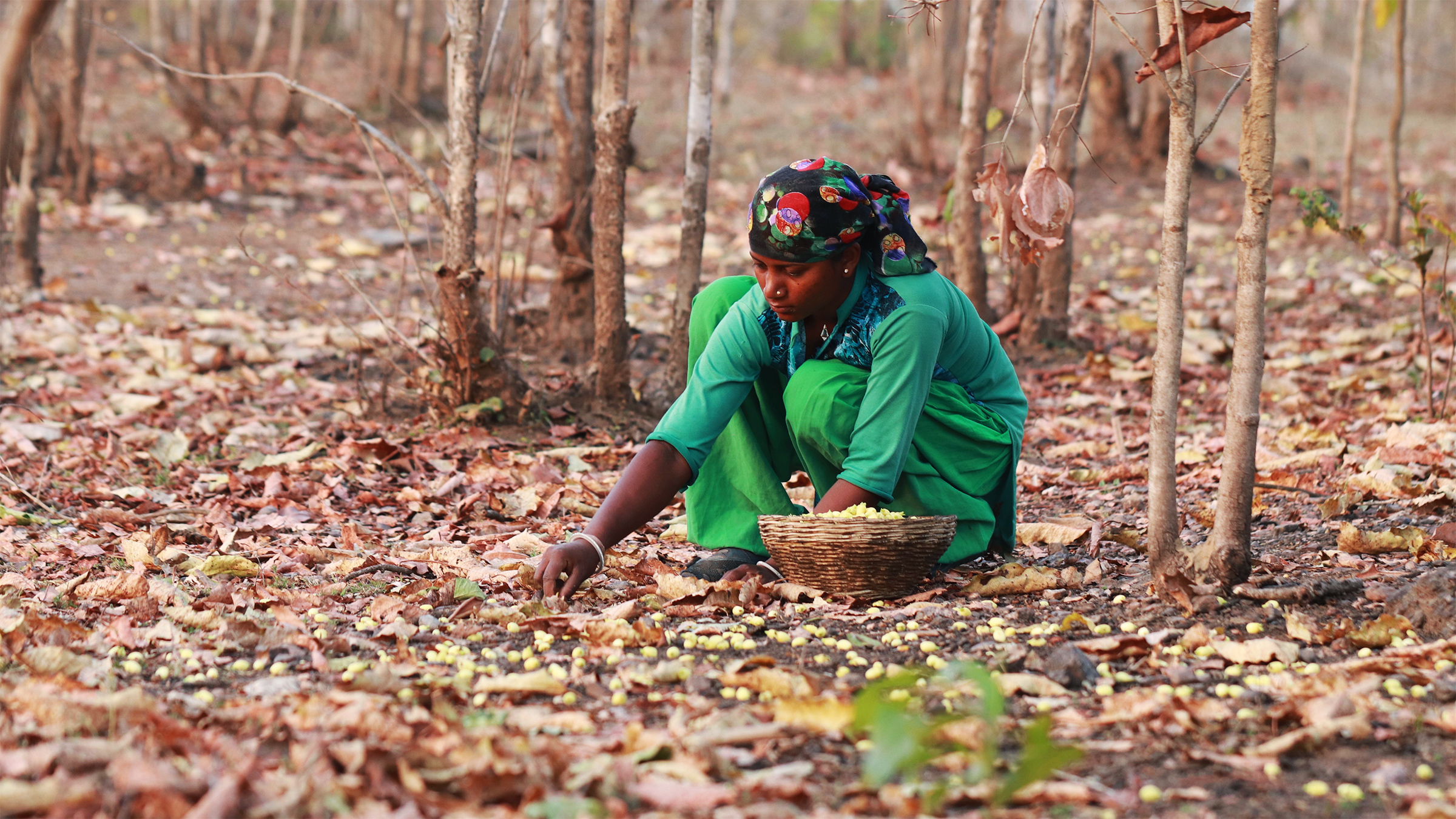
Every year between February and May, when mahua flowers begin to fall, Mamta Tigga collects them. Mamta comes from a village in Gumla in the Indian state of Jharkhand and has been collecting mahua (a flower from Madhuca longifolia), gethi kanda (or air potato, Dioscorea bulbifera) and tendu leaves from the Indian ebony tree (Diospyros melanoxylon) for the past three years. All of these plants are important sources of food, medicine and other traditional uses in her culture.
Mamta is not just a tribal gatherer, but a homemaker and a mother of two children. Over the years, she has noticed a change in what the forest gives her.
“There is less mahua than before,” she says, and the amount changes with the weather. When there is more heat, more mahua falls and when it rains, the mahua flower sheds off. “This year there was less mahua, between March to April we usually collect around 4-5 quintal [100 kilograms or 220 pounds] but this time due to excessive rain we got around 25 kg of mahua.”
Forest produce is an essential source of income for families like Mamta’s. Her husband is a driver, and often, when they are short on money, the funds collected by selling mahua help them survive. But what happens when the resources people depend on begin to change, while the demand for those products continues to grow?
A recent review in the journal Frontiers in Sustainable Food Systems examines this question in the Indian states of Jharkhand and Madhya Pradesh as well as the Sundarbans mangrove forest in West Bengal through the economic, ecological and social importance of non-timber forest products, or NTFPs.
“NTFPs have always been treated as a footnote to timber forestry,” Arkajyoti Dutta, assistant professor at the School of Bio Sciences and Technology, Vellore Institute of Technology, Vellore, and the corresponding author of the review, says in an email. “Classified into the ‘minor’ category, quite literally called minor forest produce in Indian policy language, even though it touches nutrition, health, income, and identity for tens of millions of people.”
For Dutta, what makes NTFPs particularly interesting is that they bring together ecology, economics, governance and traditional knowledge. “Something as ordinary as a mahua flower falling to the ground, or a tendu leaf plucked at dawn, is quietly carrying an entire household’s seasonal survival. There’s an entrepreneurial instinct buried in every forest-dependent household already,” he says.

From the forest to the market
Even after playing a huge role in the collection and trade of NTFPs, rural communities are often left behind because there is a massive gap between the collector’s price and the consumer’s price. “The value chain arithmetic was genuinely startling, even though we expected some disparity,” says Preyoshi Chakrabarti, co-author of the study. “The collectors capture under 20% of the final consumer price, with the tendu leaf chain showing almost a 6X value multiplication between collection and retail, most of which never reaches the person who did the actual labor.”
One example she gives while discussing solutions is e-TRIFED, a dedicated e-commerce initiative of the Tribal Cooperative Marketing Development Federation of India (TRIFED) under the Ministry of Tribal Affairs. The tool is aimed at linking producers directly with buyers, eliminating middlemen and hence empowering tribal artisans.
“Producer groups with direct e-TRIFED registration are already seeing 28 to 35% higher prices than those going through conventional intermediaries, which tells you the mechanism works when it’s built correctly. A blockchain system should embed the collector’s identity, location, and price received right at the first node of the chain so that when a consumer scans a QR code on a jar of Sundarbans honey, they’re not just verifying authenticity; they’re seeing exactly who was paid what,” Chakrabarti adds.

The knowledge behind collection
The work of collecting forest produce is also more specialized than the word “collector” might suggest.
Dutta, for instance, points to nighttime honey harvesting from giant honey bee (Apis dorsata) colonies. According to the study, in the Sundarbans, smoke is used to pacify these wild bees during honey harvesting. Dutta describes it as a specialized and dangerous inherited knowledge held by relatively few people.
Yet, he says, urban markets often consume the final product without seeing the knowledge and risk involved in producing it. The review also argues that traditional ecological knowledge is often treated as folklore to be documented rather than as a living and adaptive system. This knowledge includes knowing when and how a particular forest product should be collected.
Take, for instance, mahua, whose flowers, seeds and wood are used for food, traditional alcohol, medicine and industrial oils. Traditional practices described in the review involve collecting flowers after they naturally fall rather than stripping them from the tree. Rotational harvesting can also allow particular patches to rest and regenerate.
The researchers argue that such practices could be incorporated into formal forest management, alongside climate and plant life cycle monitoring, so that harvesting windows can adjust as flowering and fruiting patterns respond to warming and erratic rainfall. “Traditional practice already encodes a lot of the ecological discipline that formal conservation science is trying to reconstruct from scratch,” Dutta says. “The model we’re pushing throughout the review is not science replacing tradition but science giving tradition better instruments to keep doing what it already does well.”

Women’s role in NTFPs
According to the review, women constitute approximately 60-80% of the NTFPs collection and primary processing workforce in India, yet they capture a disproportionately small share of final market revenues. Dutta says that time-use studies in Jharkhand show that women surveyed in these studies spend around 4-6 hours each day on NTFP-related activities, including collection, drying, sorting and selling, much of which remains unaccounted for in household income estimates.
Nonetheless, research shows that NTFPs offer important opportunities for women in rural and tribal areas — in India as well as parts of Africa — to increase their household income and economic empowerment.
While the Frontiers in Sustainable Food Systems review identifies direct market access and stronger community control as important factors in improving returns from NTFPs, organizations working directly with women in forest-dependent communities are attempting to address the problem of disproportionate earnings through collective action.
“We organize women farmers into self-managed clusters to help them get a fair price for their produce,” says Rohin Kumar, program director of Palakiya Foundation, a nonprofit focusing on climate justice and sustainable food systems. “In local markets like Gumla, oversupply keeps incomes as low as 200 to 400 rupees [2-4$] a week. We change this by training clusters in value addition, like making and packaging sal leaf plates or processing mahua, and connecting them directly through MOUs with businesses in larger markets like Ranchi. From gathering leaves to negotiating transport and calculating costs, the women manage the entire economics themselves.”

Mamta herself is part of a cluster with the Palakiya Foundation. Apart from collecting tendu leaves and mahua, she also collects khajur (date palm, Phoenix dactylifera) to weave floor mats to sell in the market.
Depending on its size and type, the final selling price for a mat ranges from approximately 250-1,000 rupees ($3-$10). The price can fall when demand is low, leaving makers with less income despite the time and labor invested.
But the effort to make these mats takes a long process, Mamta says. “Making one mat takes more than a week. First, we bring the khajur leaves, then separate each strand, dry them and leave them in the sun. After that, we soak them before we can begin weaving the mat. We have to sit and work on it for a few hours every day. It is also physically demanding because we have to sit for long hours, and weaving continuously causes back and hand pain.”

Increasing climate pressure
There is another side to the growing commercial value of NTFPs.
The review identifies the Himalayan medicinal plant belt, an area spanning across Bhutan, China, India, Nepal and Pakistan, as an area where ecological pressure is particularly visible. Species including sarpagandha (Rauvolfia serpentina), also known as Indian snakeroot, used for high blood pressure and nervous system disorders; kutki (Picrorhiza kurroa), a bitter Himalayan herb used in traditional Ayurvedic medicine; and Indian aconite (Aconitum ferox, known in Ayurveda as vatsanabha), have experienced population declines of 30-70% over three decades in the cases examined by the review.
According to Dutta, commercial collection outpacing natural regeneration is a major driver, with demand from the nutraceutical and pharmaceutical raw-material sectors contributing to the pressure.
This creates a tension at the heart of the NTFPs economy.
Forest products can provide essential income for rural communities — and particularly for women — as well as bolster a growing market for natural goods. However, increasing commercial demand can also put intense pressure on the very species and ecosystems that those livelihoods depend on.
Banner image: A woman picks fallen mahua flowers near Kanha Tiger Reserve, Madhya Pradesh state. Image by Kandukuru Nagarjun via Flickr (CC BY 2.0).
Citations:
Chakrabarti, P., & Dutta, A. (2026). Beyond timber: A review on the role of non-timber forest products for ecological sustainability and rural empowerment in India. Frontiers in Sustainable Food Systems, 10. doi:10.3389/fsufs.2026.1792816
Thapa, A., & Singh, K. (2021). Women’s role in non-timber forest product management: A review. Role of Women In Nation Development, 116-121. doi:10.47531/mantech.2021.13
