


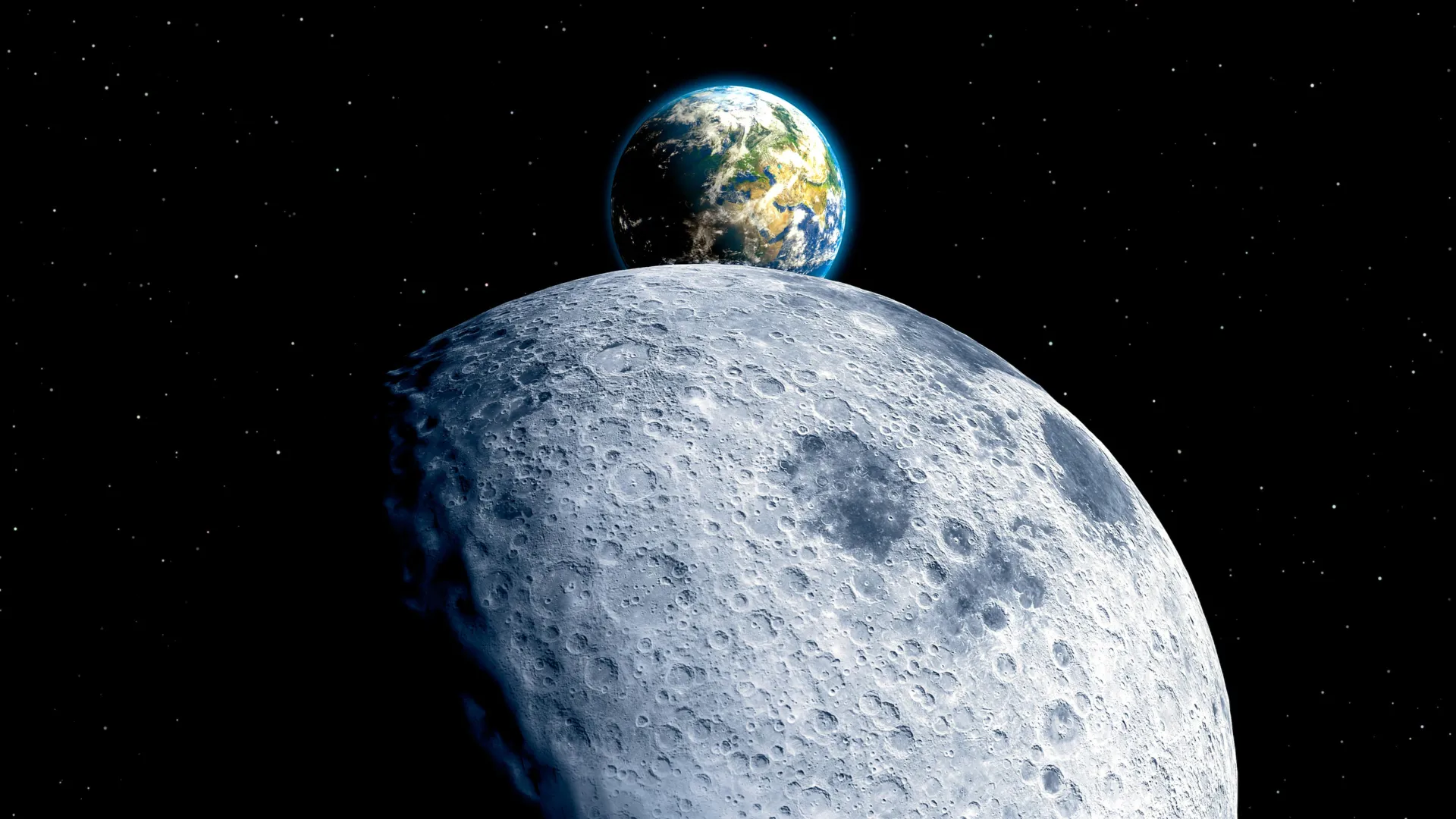
Scientists investigating why the Moon’s two sides look so different have uncovered new evidence that could help explain this long-standing mystery. A research team led by Professor Hejiu Hui of Nanjing University analyzed lunar rocks collected by China’s Chang’e-6 (CE6) mission and found clues suggesting that enormous movements of molten rock shaped the Moon billions of years ago.
The researchers examined the chemical compositions of three types of lunar rock: anorthosites, Mg-suite rocks, and mare basalts. They compared these samples from the Moon’s far side with material collected from the near side during the Apollo and Chang’e-5 missions. Their findings suggest that the Moon’s striking differences emerged through large-scale heat-driven circulation within its ancient lunar magma ocean (LMO), after the Moon became tidally locked to Earth.
Why the Moon’s Two Sides Are So Different
The side of the Moon facing Earth looks remarkably different from the hemisphere permanently turned away from us. The near side features vast plains of dark volcanic basalt and relatively high concentrations of potassium, rare earth elements, and phosphorus (KREEP). In contrast, the far side is dominated by ancient, heavily cratered highlands, with a much thicker crust and relatively few volcanic plains.
Scientists have debated the origins of this uneven structure for decades. Proposed explanations have included differences in how the Moon’s original magma ocean circulated, a massive collision, heating caused by gravitational tides, and uneven development of the lunar crust. However, none of these ideas has gained universal acceptance.
Another important question has remained unanswered. Although the contrasts between the two hemispheres are clearly visible at the surface and within the crust, scientists have been uncertain whether similar differences extend deep into the lunar mantle.
Chang’e-6 Samples Reveal a Surprising Similarity
A major opportunity to investigate this mystery arrived in 2024, when Chang’e-6 became the first mission to return samples from the Moon’s far side. For the first time, scientists could directly compare rocks collected from both lunar hemispheres.
The analysis revealed an important similarity beneath the Moon’s contrasting surfaces. Basalts collected by Chang’e-6 show chemical signatures indicating that they originated from depleted mantle material, much like the low-Ti basalts brought back by Apollo astronauts. This suggests that the mantle cumulates, minerals that accumulated as the Moon’s magma ocean crystallized, do not differ substantially in composition between the two hemispheres.
The researchers found additional support for this conclusion in Mg-suite rocks. These rocks form through interactions between the crust and mantle when portions of the accumulated mantle material partially melt. Their magnesium number (Mg#) provides an important indicator of the composition of the mantle material from which they originated.
Because Mg-suite samples from Chang’e-6 and Apollo have similar Mg# values, the researchers concluded that the mantle cumulates beneath both sides of the Moon share broadly similar chemical characteristics. In other words, the materials that crystallized from the Moon’s original magma ocean show no significant compositional divide between the near side and far side.
The Moon’s Crust Tells a Different Story
While the mantle appears relatively uniform in composition, the lunar crust reveals a much more pronounced contrast.
Anorthosite samples returned by Chang’e-6 have higher peak Mg# values than comparable Apollo samples, indicating that the far side’s crust contains more magnesium-rich material. This agrees with earlier observations made by instruments studying the Moon remotely.
The researchers also identified important chemical differences in Mg-suite rocks. Samples from Chang’e-6 contain extremely low concentrations of rare earth elements and have lower thorium-to-samarium ratios, expressed as Th/Sm, than their Apollo counterparts.
These differences suggest two possible explanations. Either Mg-suite magmas formed on the far side without substantial involvement from KREEP-rich material, or the layer containing these elements developed unevenly across the Moon, leaving the two hemispheres with different chemical compositions.
How Earth’s Gravity May Have Shaped the Moon
Combining these findings, the researchers developed a model that could explain how the Moon acquired its two dramatically different faces.
According to their proposed scenario, the Moon’s early magma ocean initially cooled and crystallized in a relatively uniform manner. This process produced the first mantle cumulates and anorthositic crust, before the Moon became tidally locked to Earth.
The situation changed once the Moon settled into an orbit that kept the same hemisphere facing our planet. At that time, Earth and the Moon were much closer together, and gravitational tidal forces generated more heat on the lunar near side than on the far side.
This uneven heating created a temperature difference across the Moon’s molten interior, setting off large-scale horizontal circulation. Hot magma moved from the near side toward the far side, carrying previously formed magnesium-rich anorthosite material with it.
Over time, this movement accumulated more crustal material on the far side, helping explain why that hemisphere developed a thicker crust with a higher magnesium content.
At the same time, the remaining molten material flowed preferentially toward the near side. As a result, the far side developed only relatively thin layers enriched in KREEP and ilmenite-bearing cumulates (IBC), while more of these late-stage materials became concentrated on the near side.
This model of heat-driven magma circulation provides a possible explanation for why the Moon has a chemically similar mantle but such dramatically different crustal compositions. By connecting the newly analyzed Chang’e-6 samples with the Moon’s early thermal history, the findings offer fresh insight into the processes that shaped Earth’s closest celestial neighbor.
