


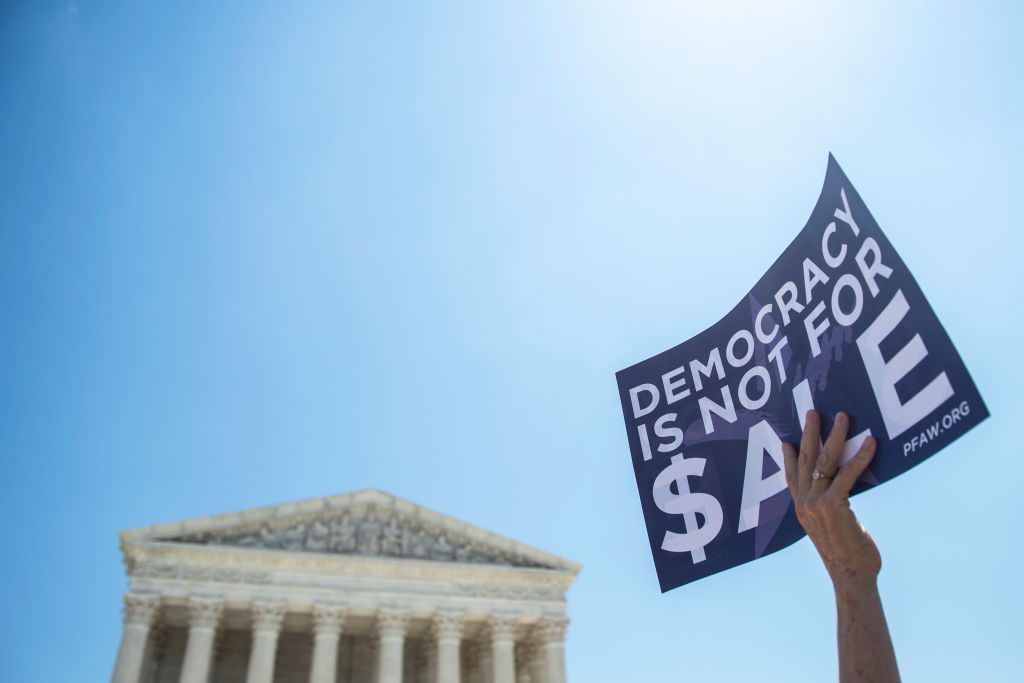
Voters on the left and the right want a constitutional amendment overturning Citizens United and new restrictions on officials’ stock trading. (Photo by Caroline Brehman/CQ Roll Call/Getty Images)
Even in the most politically divided parts of the country, voters from both parties agree that the role of money in politics must be curbed, according to a new survey by the University of Maryland.
The school’s Program for Public Consultation queried nearly 20,000 Americans in 11 competitive states and 28 competitive House districts, asking questions on a range of political reforms, all based on proposed legislation.
Respondents were asked if they were in favor of “passing a new Constitutional amendment to allow Congress to restrict corporate and PAC spending on elections, effectively overturning Citizens United.” Bipartisan majorities in those competitive jurisdictions heavily favored such an amendment, with (Democrats’ “yes” responses ranging from 80% to 93%, Republican falling between 73% and 89%. Nationally, the survey found that more than 8 in 10 are in favor (Democrats 85%, Republicans 82%).
Citizens United v. Federal Election Commission, decided by the Supreme Court in 2010, rolled back prohibitions on independent political expenditures by corporations and unions. Weeks later, under the precedent of the Citizens United ruling, a federal court ruled in SpeechNow.org v. FEC that limits on contributions to independent expenditure committees were unconstitutional.
The two decisions dramatically changed the role of money in politics, opening the door for unlimited raising and spending by what became known as super PACs. Since the decision, outside spending has jumped from $574 million in 2008 to $4.5 billion in 2024.
In September 2025, four Democratic lawmakers introduced the Citizens Over Corporations Amendment, a proposed constitutional amendment that would overturn Citizens United. The resolution has not yet received a vote in the House or the Senate. Twenty-five states have passed a resolution calling on Congress to put forth a constitutional amendment, according to the nonprofit group American Promise.
The PPC survey also found that a bipartisan majority favors banning individual stock trading by members of Congress, the president, the vice president and Supreme Court justices. The largest majorities favored banning members of Congress from trading – 65% to 94% among Democrats in the surveyed districts and states, 63% to 88% among Republicans. Nationally, 75% of Democrats and 76% of Republicans were in favor. But overwhelming majorities also favored banning the White House and Supreme Court from trading (Democrats, 54% to 92%; Republicans, 55% to 82%; nationally: Democrats 70%, Republicans 74%, ).
On Sept. 30, the Stop Insider Trading Act failed a procedural vote in the Senate, going down 53-47 on a procedural vote that required 60 Senators to say yes in order to advance to a final vote. The legislation would have prevented lawmakers from buying new stocks in publicly traded companies, but allowed them to keep existing stocks and continue to buy private stocks. Democrats who voted against the bill argued it did not go far enough to address corruption.
The PPC said the findings reveal bipartisan agreement at a time when trust in U.S. political institutions “remains near an all-time low.”
“The American people believe the current rules of the political system produce a government that serves special interests and politicians themselves,” said Steven Kull, director of the PPC. “They agree on major reforms to make elected officials more responsive to the people, and more likely to serve the common good.”
