


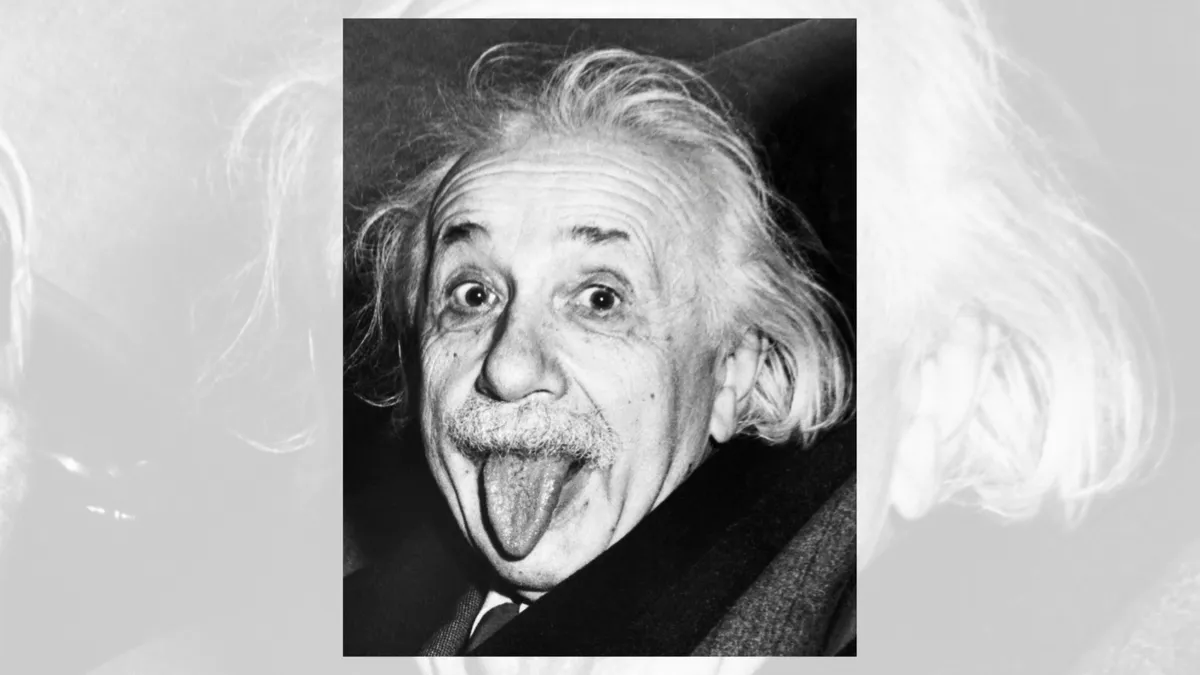
Physicist Albert Einstein once said, “Learn from yesterday, live for today, hope for tomorrow.”
For at least several decades, people have attributed the following quote as something physicist Albert Einstein once said: “Learn from yesterday, live for today, hope for tomorrow.”
On social media, users’ posts pairing the quote with Einstein’s name have appeared, for example, on Bluesky (archived), Facebook (archived) and X (archived).

(@ramblingsloa via X)
However, no evidence supported the claim that Einstein ever said the words. Research into historical records found that other people expressed the exact same thought without Einstein’s name as early as the 1970s. Other persons from decades prior shared the same general idea, albeit in different words, about learning from the past (yesterday), that you can only live in the now (today) and have aspirations for the future (tomorrow).
No records from the years during or immediately following Einstein’s 1955 death featured the quote with his name. The authoritative compendium “The Ultimate Quotable Einstein” also did not include the quote — or similar thoughts — in its text, not even in its list of misattributions.
If Einstein had truly spoken or penned the thought, credible historical documents, such as books or newspapers, would contain that information. It would not only appear in social media posts and on quote-collecting websites — two types of sources that can lack credibility.
Some posts, for example on Facebook (archived) and Reddit (archived), featured the incorrectly attributed quote with the added line, “The important thing is not to stop questioning.” Einstein truly once said that sentence while talking about pursuing curiosity in life. Life magazine printed the “not to stop questioning” quote without the “Learn from yesterday, live for today, hope for tomorrow” part in 1955.
Researching the quote
As a small part of beginning our research, we noted that searching Bing, DuckDuckGo, Google and Yahoo failed to locate any credible historical records documenting that Einstein said, “Learn from yesterday, live for today, hope for tomorrow.”
To perform deeper and more meaningful research, we then looked to archives of literature via Google Books, as well as newspapers on Newspapers.com, where we found several interesting results — though none indicated Einstein ever said the words.
For example, in 1965, a Kentucky newspaper credited a teacher named Donna Jean Roberts as saying, “Learn from yesterday and hope for tomorrow, but live today for today.”
A 1971 Indiana newspaper article reported, “HERE’S A slogan which makes sense to Mack McGinnis: ‘Live for Today—Dream for Tomorrow — Learn from Yesterday.”
In 1972, a newspaper in Illinois printed the earliest record we found of the exact quote that users later wrongly attributed to Einstein. The paper credited the thought as the class motto for Gardner High School in Gardner, Illinois. Some books published in the 1970s also featured the exact quote without any direct attribution.
A 2000 classified advertisement for a California mobile glass company featured possibly the earliest newspaper record of the quote containing the attribution to Einstein. According to Google Books, the 1998 edition of “The Michiganensian,” the University of Michigan’s annual yearbook, also showed the quote with Einstein’s name.
In 2011, an author wrote a book with the quote as the title, saying in the text that he was inspired to publish the work thanks to Einstein supposedly penning the thought.
1930 article about meaning of ‘Today’
In all of our searches, one California newspaper article from 1930 featured the Chicago Journal of Commerce opining in a unique way about the meaning of “Today”:
We live only today. Yesterday we lived, and through all the multitude of yesterdays, each of which had its influence in making us what we are today. What we do and are today will have its effect on what we shall do and be tomorrow.
We all live in the present—not in the past, which is gone forever, nor in the future which we cannot know until time makes it the present for us. We all have aspirations as to what we shall be and do in the future, but we have only our todays in which to put in action the principles and forces by which we may make our tomorrows what we would have them be.
We may, and must, learn from our yesterdays in order to make today count in our ambitions. Our mistakes in the past are warnings. Our achievements alone can encourage us by promises for the future. We all have our settled purposes as well as our past experiences, to guide us. Thus memories have power to help us to the future we desire. The purpose is a powerful incentive, strengthened by the knowledge if what has been accomplished in the past through definite purpose.
We learn from the past that all good things come slowly, that we must earn every advance we make. That is what makes today so prodigiously important to thinking men. It is the introduction to our tomorrow. When we go to bed after having done our level best, we have the finest assurance that we can do better tomorrow.
For further reading, we previously reported that Einstein truly married his double cousin.
Sources
Averett, Tera Byrd. Byrd History and Related Families of Averett, Callaway, Chancey and Goff. Wiregrass Printing Company, 1978. Google Books, https://www.google.com/books/edition/Byrd_History_and_Related_Families_of_Ave/s_MYAQAAMAAJ.
Calkins, Thomas D. “Today.” The Atwater Signal [Merced County, California], 21 Mar. 1930, p. 2, https://www.newspapers.com/article/atwater-signal/207864679/.
“Donna Jean Roberts Teacher of Month.” The Manchester Enterprise [Manchester, Kentucky], 2 Dec. 1965, p. 8, https://www.newspapers.com/article/the-manchester-enterprise/207863884/.
Einstein, Albert. The Ultimate Quotable Einstein. Princeton University Press, 2010. Google Books, https://books.google.com/books?id=G_iziBAPXtEC.
Google Books. https://books.google.com/.
Kaku, Michio. “Albert Einstein.” Britannica, https://www.britannica.com/biography/Albert-Einstein.
Michiganensian. Vol. 102, Senior literary, law, and engineering classes, 1998. Google Books, https://www.google.com/books/edition/Michiganensian/otzhAAAAMAAJ.
Newspapers.com. https://www.newspapers.com/.
Nussbaum, Lowell. “Absence of Sparrows Lamented.” The Indianapolis Star [Indianapolis, Indiana], 3 May 1971, p. 27, https://www.newspapers.com/article/the-indianapolis-star/207864031/.
O’Toole, Garson. “Quote Origin: The Important Thing Is Not to Stop Questioning. Curiosity Has Its Own Reason for Existence.” Quote Investigator, 17 Oct. 2024, https://quoteinvestigator.com/2024/10/17/curiosity-reason/.
Parker, Barry Richard. Learn from Yesterday, Live for Today, Hope for Tomorrow. Barry Parker, 2011. Originally published by Stardust Press. Google Books, https://www.google.com/books/edition/Learn_from_Yesterday_Live_for_Today_Hope/rvV5FyBJjzMC.
Pennsylvania Holstein News. Holstein-Friesian World, 1973. Google Books, https://www.google.com/books/edition/Pennsylvania_Holstein_News/gfQOAQAAMAAJ.
“Personals.” The Modesto Bee [Modesto, California], 25 Apr. 2000, p. E-9, https://www.newspapers.com/article/the-modesto-bee/207864550/.
Time Inc. LIFE. Time Inc, 1955. Google Books, https://books.google.com/books?id=dlYEAAAAMBAJ.
“Valedictorian, Salutatorian Named at Gardner High School.” Morris Daily Herald [Morris, Illinois], 17 May 1972, p. 8, https://www.newspapers.com/article/morris-herald-news/207864212/.
