


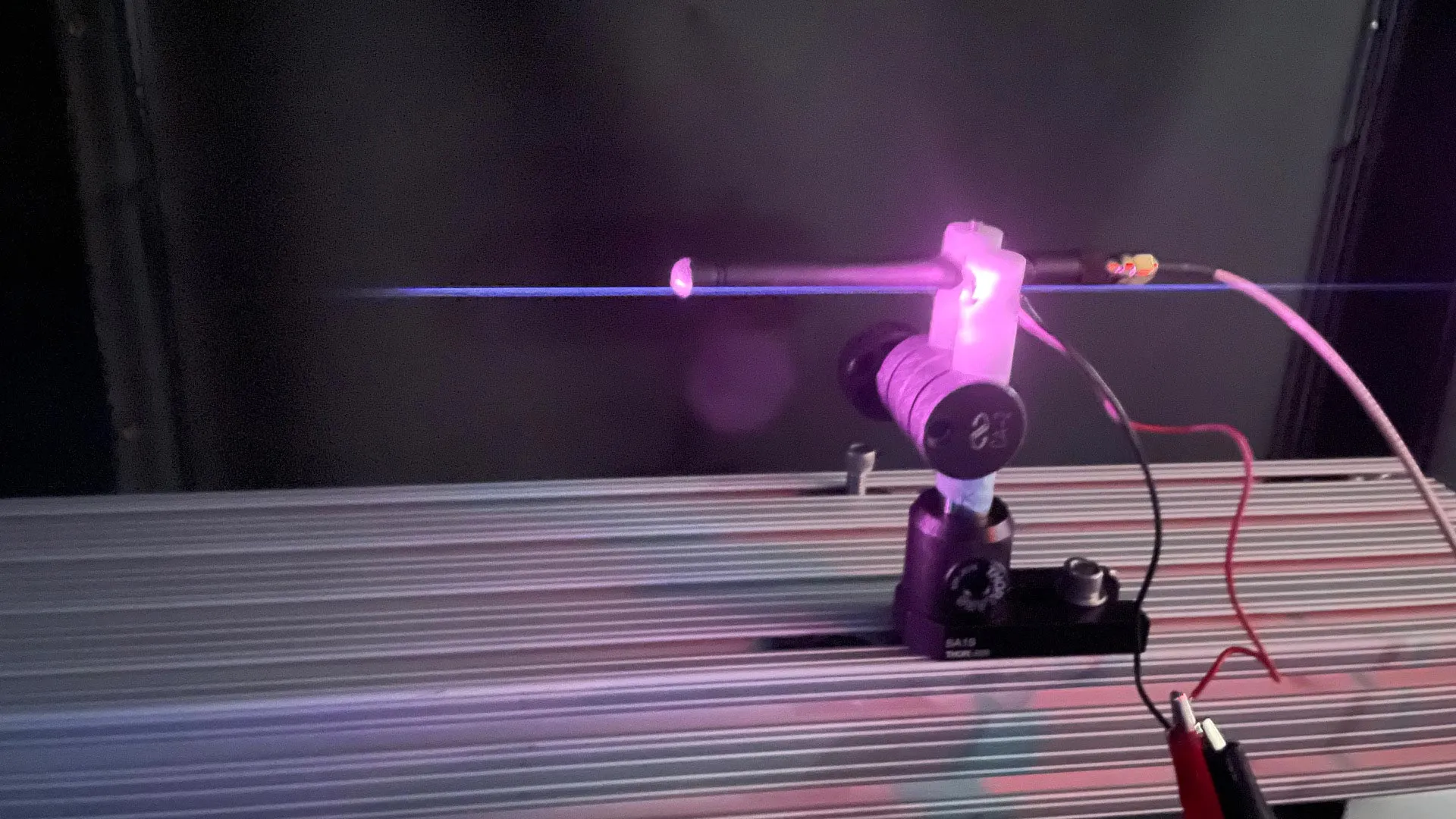
Scientists have demonstrated a new type of radio antenna that looks remarkably like a lightsaber. Instead of using a conventional metal structure, the device relies on a laser to create a narrow beam of plasma capable of transmitting radio waves.
The technology could eventually make it possible to build antennas that change their length and direction on demand, opening up new possibilities for wireless communications, radar, satellites, and space exploration.
“The plasma beam antenna looks like a lightsaber and is tunable, meaning we should be able to transmit across a broad range of frequencies,” says Prya Darshni, corresponding author of a journal article on the work and a Ph.D. student at North Carolina State University. “And while we have not demonstrated its ability to serve as an antenna that can receive radio signals, there’s no reason to believe it wouldn’t also work as a receiver.”
“This is an exciting new concept that enables one to be able to have a customized antenna without complex mechanical deployment mechanisms,” says Paul Franzon, co-author of the paper and the Cirrus Logic Distinguished Professor of Electrical and Computer Engineering at NC State.
Why Scientists Want Antennas Made From Plasma
Traditional antennas depend heavily on their physical dimensions. In particular, an antenna’s length helps determine which radio frequencies it can efficiently transmit or receive. Changing that length can allow an antenna to operate at different frequencies, but making such adjustments often requires moving mechanical components or complicated engineering.
That becomes especially challenging in applications such as space exploration, where equipment must be compact, lightweight, and reliable.
The NC State researchers wanted to investigate whether a laser could offer a simpler solution by creating an antenna directly in the surrounding air. Instead of physically extending or retracting a metal antenna, the idea was to adjust the laser to produce a plasma beam of the desired length.
“One of the questions we wanted to explore with this work was whether it would be possible to create plasma antennas using lasers, which would allow us to generate antennas at whatever length was needed,” says Darshni. “And we have now shown that it is possible.”
Turning a Laser Beam Into a Radio Antenna
The approach begins with a laser directed through the air. By carefully controlling the laser’s power and beam diameter, the researchers can ionize a narrow region of air, stripping electrons from atoms and molecules to produce plasma.
Plasma is often described as the fourth state of matter, alongside solids, liquids, and gases. Because it contains electrically charged particles, it can interact with electromagnetic fields in ways that ordinary air cannot.
In this experiment, the laser produces a thin, concentrated channel of plasma known as a plasma filament. This filament becomes the foundation of the antenna.
However, creating a plasma beam was only part of the challenge. To make it transmit radio waves, the team also needed a way to deliver an electrical signal to the plasma without relying on a conventional physical connection.
Their solution was a specially designed contactless antenna feed.
The system uses a metal ring that functions as a capacitor, a component that stores electrical energy in an electric field. The laser passes through the center of the ring, producing a plasma filament that extends through the capacitor’s surrounding electromagnetic field.
This arrangement allows the researchers to transfer energy to the plasma without physically touching it.
When a radio frequency generator sends a signal into the capacitor, the resulting electromagnetic field interacts with the plasma filament. That interaction causes the filament to transmit radio waves at the supplied frequency.
Using this method, the researchers successfully demonstrated radio transmission at 30 megahertz (MHz), within the very high frequency (VHF) radio band.
An Antenna That Could Change Length and Direction
One of the most promising features of the technology is its potential flexibility. Because the antenna is created by a laser rather than built from a fixed metal structure, its dimensions can be adjusted by changing the laser’s settings.
“By controlling the parameters of the laser, you can control the characteristics of the plasma filament — including its length,” says Darshni. “This is valuable for applications where you need an antenna that can sweep all frequencies. But there’s another benefit as well.
“There are also applications where it is important to be able to control the angle of the antenna, in order to target the direction of radar sweeps or to improve the strength of a signal you want to pick up,” says Darshni. “The technique we’ve demonstrated here would allow users to control the angle of the plasma filament antenna via beam steering — simply shifting the direction of the laser.”
This capability could be valuable in systems that need to communicate across different radio frequencies or direct signals toward specific locations.
Conventional antennas may require mechanical devices to change their orientation. A laser-generated plasma antenna could potentially accomplish similar adjustments by steering the laser beam itself, reducing the need for moving parts.
Although the researchers have demonstrated that the plasma filament can transmit radio waves, its ability to receive signals and operate across a broad range of frequencies still needs to be tested.
Potential Applications in Satellites and Space Exploration
The researchers believe the technology could eventually serve several purposes, with satellites and space exploration among the most promising possibilities.
Spacecraft designers face strict limits on the weight and size of the equipment they can launch. Traditional antenna systems can also require complicated deployment mechanisms, particularly when large structures must be folded for launch and extended after reaching space.
A laser-generated antenna could offer a different approach, potentially allowing spacecraft to create and adjust antennas without carrying the same kinds of mechanical structures.
The ability to operate across different radio frequencies could also be useful for spacecraft communications and scientific instruments.
“In low earth orbit, there is sufficient air to form a plasma,” says Franzon.
While this suggests a possible application in the thin atmosphere surrounding Earth, the technology remains at an early experimental stage. Additional research will be needed to determine how effectively laser-generated plasma antennas could operate under real space conditions.
First Successful Demonstration Opens the Door to Further Research
For now, the researchers see their achievement as an important proof of concept. They have shown that a laser can generate a plasma filament that functions as a transmitting antenna, establishing a foundation for future improvements.
“This is the first step, but it is a big step — it is the first time anyone has ever demonstrated that plasma-filament antennas can work,” says Darshni. “Now that we’ve shown it is possible, we can begin improving its performance.”
The findings are described in the open-access paper, “Laser-Induced-Plasma-Filament Antenna Transmitting 30 MHz VHF,” published in the IEEE Journal of Microwaves.
Arthur Dogariu, affiliated with Texas A&M University and Princeton University, co-authored the research and contributed to the experimental measurements.
The research team also acknowledged Chris Hewett, Byron Goode, and Joe McElveen of NC State’s Instrument Shop for their ingenuity in manufacturing the components used in the experiments.
