



The cease-fire last October ostensibly brought an end to Israel’s war in Gaza after the Hamas-led attacks on Oct. 7, 2023.
A year later, however, Israeli strikes, though less frequent, haven’t stopped. More than 1,400 people in Gaza have been killed since the truce was signed, according to local health officials. Israel says it is still targeting Hamas militants.
Palestinians in Gaza are trying to reconstruct their lives and livelihoods, seeking to wring a measure of normalcy from the debris. Some are trying to rebuild, using whatever materials they can scavenge. Others are trying to revive their businesses or launch new ones.
For three years, their lives have been consumed by death and destruction. But the bombs, hunger and displacement have not erased their aspirations for something better.
Jaafar Atallah, 28, once earned a living in his family’s factory making bowls and vases from rich clay deposits near his home in the al-Waha area of the northern Gaza Strip. His home was razed during the Israeli military campaign. So Mr. Atallah and his family reestablished their business in al-Zawaydeh, a town in central Gaza.
For a place to live, Mr. Atallah built a modest dwelling out of red bricks fired in their kiln. They no longer have the heavy machinery required to extract clay from the ground, but they have something nearly as good, he said.
“We go to a crater from an Israeli bombing, because there you can get to the clay,” Mr. Atallah said. “We dig it out, purify it and get to work.”
The dwelling is a single room in which he now lives with his pregnant wife. The walls, made from brick reinforced with hay, provide natural cooling during Gaza’s punishing summer heat.
Mr. Atallah hopes they will also help keep them warm in winter.
The United Nations says about 80 percent of Gaza’s buildings were destroyed or damaged in the war. Much of the enclave was leveled during Israel’s withering attack, which killed at least 74,000 people, according to Gaza health officials, who do not distinguish between civilians and combatants. That offensive was prompted by the Hamas-led assault on southern Israel on Oct. 7, 2023 in which about 1,200 people were killed and 250 hostages were seized.
A few Gazans are lucky enough to have homes that are still standing or wealthy enough to pay rent. Most of the rest live in the enclave’s sprawling tent camps.
Israel restricts the entry of heavy machinery, concrete and cement into Gaza, noting that Hamas — which still controls part of the enclave — used those materials to build a sprawling network of military tunnels.
Some Palestinians are trying to make use of the enclave’s most plentiful resource — rubble. One resourceful builder converted broken slabs of concrete into bricks to build a house.
Another, Hassan al-Huweihe, 34, is making a business out of cracking open concrete from damaged buildings to extract the iron struts inside. The metal is straightened and then used as frames for newly built or repaired structures.
“We are trying to make something new out of the rubble,” Mr. al-Huweihe said.
A Reason to Celebrate
Before the war, weddings in Gaza could be extravagant affairs, featuring sumptuous meals of roast lamb and processions through the winding streets.
Such pleasures now feel like faraway luxuries for many Gazans.
One couple held their wedding in a United Nations school packed with displaced Gazans. Another pair tied the knot on a beach with little fanfare.
To pay for his wedding, Saeed Kafarneh, 21, worked for several months doing odd jobs and selling gas tanks and cartons of aid he received from relief groups to raise about $2,000.
“We worked so hard to make it happen,” Mr. Kafarneh said. “But thank God, we did it.”
Last month, Mr. Kafarneh married his wife, Nermeen Abdul Hadi, in a displaced persons’ camp in the central Gaza Strip, where Mr. Kafarneh’s family had been sheltering. On the day of the ceremony, Mr. Kafarneh and his relatives decorated a large tent donated by a Pakistani aid organization, setting up lights and arranging flowers. They rented a large loudspeaker.
In one Palestinian custom, grooms bathe beforehand at a bathhouse or friend’s home, a ritual marking the transition to married life. Instead, friends and neighbors poured water on a grinning Mr. Kafarneh in a tent while they cheered and danced.
The couple had their zifaf, or ceremony. Many friends and family members could not make it. Traveling even a short distance in Gaza — where fuel prices are sky-high — can be enormously expensive. Others avoided making the trip fearing potential Israeli attacks during their return journey after dark, Mr. Kafarneh said.
“Even people just a few kilometers away didn’t come,” he said. “So we celebrated with those around us.”
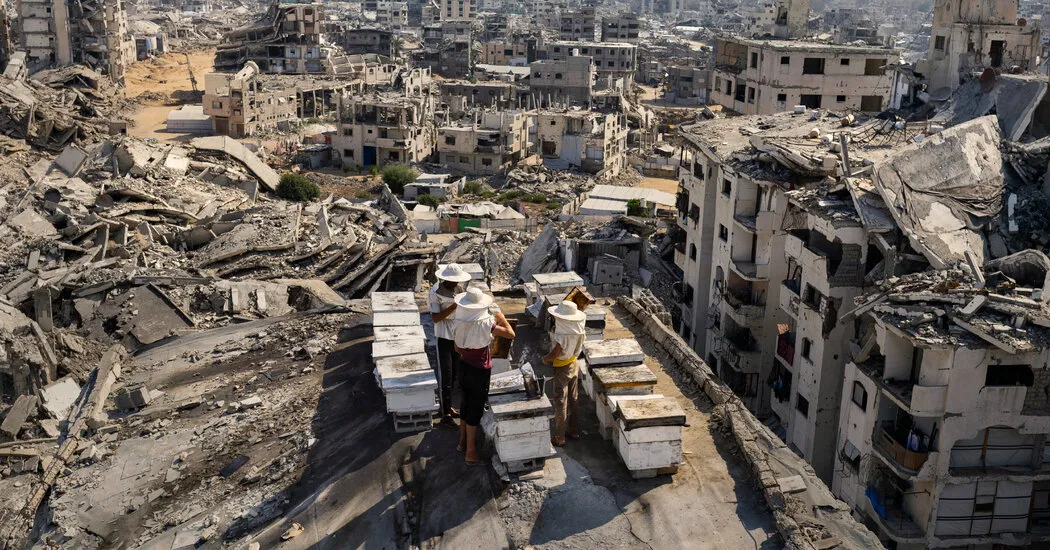
Nivin al-Ashqar hears two constant hums when she goes onto the roof of her home in the northern Gaza town of Jabaliya.
One comes from the beehives that she and her husband cultivate to produce honey and beeswax for sale. The other is from Israeli drones that hover overhead, a reminder that their house lies just a few hundred yards from the demarcation line behind which the Israeli military has entrenched itself.
The Trump administration’s cease-fire plan envisioned a gradual Israeli withdrawal, in parallel with Hamas’s disarmament, but neither has happened.
Before the war, in addition to a single hive they kept at home, Ms. al-Ashqar’s family had about 400 hives, mostly in the area now under Israeli military control. Almost all those hives were destroyed during the conflict, she said.
Early in the war, Ms. al-Ashqar fled fighting in Jabaliya with her family. When they returned more than a year later to try to clean up their badly damaged house, she heard a relentless buzzing.
“We climbed up to the roof and we saw a cloud of bees emerging from the rubble,” Ms. al-Ashqar said. “It was an unbelievable feeling, indescribable.”
Ms. al-Ashqar is the primary breadwinner in her household because her husband and one of her sons were wounded during the war. She has turned again to raising bees, hoping to sell their honey.
“With both of them wounded, I’ve become the one responsible for the home,” Ms. al-Ashqar said. “My husband helps, with his experience, but I have to run it.”
Gaza’s economy was devastated in the war. A few, like Ms. al-Ashqar, are slowly coaxing their businesses back to life.
Fishermen are setting out to sea, although they fear running afoul of an Israeli naval blockade of the enclave if they head too far out. Barbers who once owned their own shops now practice their trade in makeshift salons.
Ms. al-Ashqar’s bees now populate six hives but produce relatively little honey. Even basic staples like sugar to feed them are more expensive, while other materials — like miticides — can be hard to come by at all.
More than half of Gaza is now also effectively off-limits to Ms. al-Ashqar, as it is to the vast majority of the two million Palestinians living there. But, she said, she regularly sees her bees flitting away toward the Israeli-controlled zone, crossing to places she can no longer visit.
“Sometimes, I wish I were a bee,” Ms. al-Ashqar said, “so I could fly away from here, go to other countries, rather than stay here, trapped.”
Hoping to Deliver a Better Life
Mohammad Abdelhadi, 39, had long worked as a carpenter. He had his own workshop where he crafted furniture and had spent time working in Turkey. His profession had lifted him into Gaza’s middle class.
The invasion knocked him back down. But Mr. Abdelhadi says he is determined to deliver a better life for his nine children, the youngest of whom — nine-month-old Mahmoud — was born since the outbreak of war.
They have no running water. So each morning, he and his wife, Khitam, along with the children, leave the tent where they now live to fill large plastic containers with water from a nearby truck. They have no electricity. So they charge their phones by paying to use a generator a few hundred yards away.
They often eat simple food, like soft white cheese and bread, provided by aid groups. For lunch and dinner, they rely on communal kitchens, which prepare large pots of staples like rice and lentils.
Most of his children still don’t have access to regular schooling, and Mr. Abdelhadi frets at times about what lies ahead for them. “What will be their fate here? Waking up, filling up water jugs, going to soup kitchens, no school?” he asked.
After dark, his family must confront an onslaught of rats, which populate the massive trash heaps that now rise from the Gaza Strip. The war largely decimated the Hamas-run government, meaning public services like trash collection are meager.
Mr. Abdelhadi tries to comfort his children. At the end of the day, he lights a fire. He brews them tea.
He plays with Mahmoud, who has never known a home other than a tent.
