


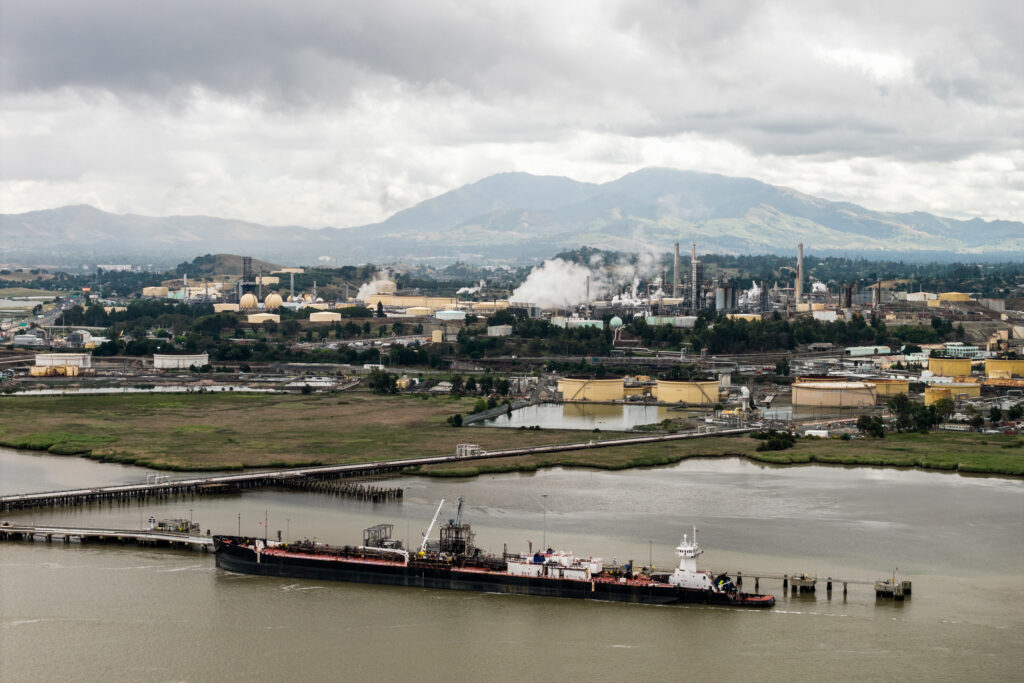
MARTINEZ, Calif.—Scores of people tired of living near accident-prone refineries packed an elementary school auditorium to hear what their government officials were doing to protect them.
Two local refineries, Marathon Martinez Renewables and Martinez Refining Co., have racked up hundreds of air quality violations over the past five years. MRC agreed in February to pay $10 million in fines for 163 violations that included an accident that blanketed residents’ homes with 24 tons of metal-laden dust four years ago on Thanksgiving Day.
The settlement did not cover a similar episode in 2025, when a fireball sent thick clouds of smoke across town, leaving residents wondering, again, if it was safe to go outside or eat from their gardens.
Marathon’s Martinez Renewables, which recently locked out more than 100 workers in a labor dispute, has received more than 100 violations from the air district for flaring and other infractions since 2021.
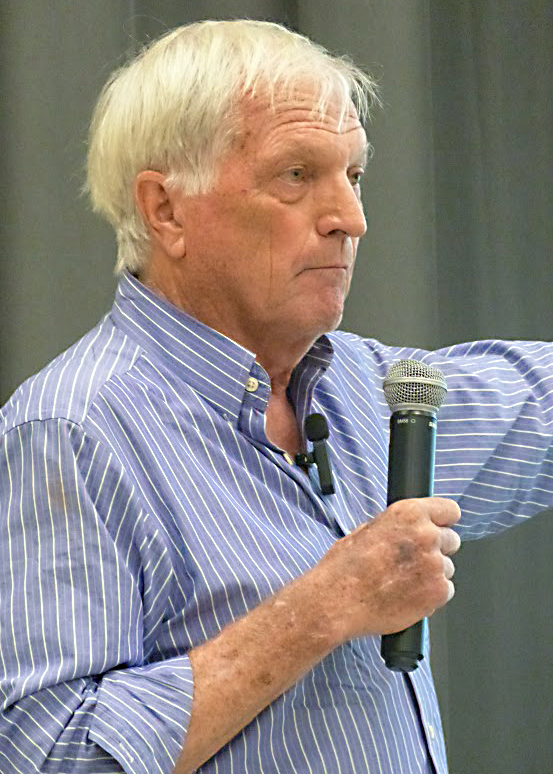
Such incidents inspired U.S. Rep. Mark DeSaulnier, a Democrat, to meet with his constituents in this small city an hour northeast of San Francisco on Thursday night. DeSaulnier, a former air regulator whose district includes four refineries, stressed the need to balance the economic benefits refineries bring to the region with the risks they pose to workers and communities.
Refineries are among the county’s top property-tax contributors and provide thousands of good-paying jobs, DeSaulnier said. The region needs these refineries as it transitions toward renewable energy, but they need to be safe, he said. “It’s a constant battle.”
Flaring incidents have increased in recent years, spiking to nearly 70 in 2023. Flaring involves the controlled burning of flammable gases to manage a buildup of pressure in equipment and reduce the risk of explosions. It also releases a mixture of toxic chemicals, fine particles and climate pollutants.
Recognizing residents’ concerns about ongoing flaring, county officials at the meeting announced the release of a new public dashboard that allows people to track incidents, something residents like Heidi Taylor have been asking for.
Taylor, who co-founded Healthy Martinez after MRC showered her home with heavy metals, wants the refinery to undergo a new health risk assessment, which hasn’t been done in 36 years, she said.
“We need to know what health risks Martinez residents are facing, when that information will be made public and how quickly any unacceptable risks will be addressed,” Taylor said.
MRC did not respond to a request for comment from Inside Climate News.
These incidents require greater enforcement but the Trump administration is working to undermine federal oversight of refineries, DeSaulnier said.
The administration has repeatedly tried to eliminate the U.S. Chemical Safety and Hazard Investigation Board, an independent federal agency that investigates the root causes of industrial chemical accidents. So far, Congress has continued to fund the agency.
Keeping refinery workers and surrounding communities safe requires real-time accountability measures that trigger automatic investigations or corrective actions after incidents, DeSaulnier argued in a recent op-ed. He suggested following Chemical Safety Board recommendations such as tracking equipment failures, overdue inspections, leaks and failed safety systems.
DeSaulnier has a long history of trying to improve refinery safety, dating back to his days as a Contra Costa County supervisor. The congressman was briefly overcome with emotion during Thursday’s meeting as he recounted the deaths of five men at the Tosco Avon Refinery in the 1990s, when he said the county averaged one refinery-related death or serious injury every year.
“I went to a couple of funerals,” he said, regaining his composure, “and I will never forget hearing about the lives of five individuals who, in my opinion, never should have died.”
The Avon refinery is now operated by Marathon Petroleum as Martinez Renewables, where an explosion in 2023 left Jerome Serrano, an operator with four children, fighting for his life for months. Workers with the United Steelworkers Local 5 blamed understaffing and unsustainable overtime shifts for the accident.
This story is funded by readers like you.
Our nonprofit newsroom provides award-winning climate coverage free of charge and advertising. We rely on donations from readers like you to keep going. Please donate now to support our work.
More than 100 employees went on strike for safer conditions after Marathon refused to give them the same contract it had negotiated with the USW for more than 200 other bargaining units across the petroleum and renewables industry.
The strike turned into a lockout when the company rejected union members’ unconditional return to work offer. Workers have now been out of the plant for 165 days.
Nick Plurkowski, USW Local 5 president, was glad to see so many people show up to learn about refinery safety. The meeting covered current regulations and other important topics in a way “only the congressman can do,” Plurkowski said, referring to his personal connection to the workers who died. “He understands that the worst possible outcome isn’t the refineries paying fines, it’s when someone we know gets hurt or killed.”
“The amount of flaring is concerning to say the least,” said Plurkowski. He filed a complaint with state occupational health and safety regulators, alleging that the workers who replaced the USW Local 5 workers, who he said were illegally locked out, aren’t qualified to operate the plant safely. As a result, he said, the state is investigating Marathon’s training of the workers currently running the plant.
Marathon spokesperson Jamal Kheiry said the company continues to staff the Martinez Renewables facility with highly qualified personnel, including supervisors, engineers and technical experts with extensive experience and training in safe, reliable plant operations.
DeSaulnier, who has visited workers on the picket line six times, thinks Marathon is trying to make an example of its plant in Martinez, where workers have the support of the community, to show they can break a union anywhere in the country.
But he’s not aiming to shut down renewable refineries, which he sees as a vital link in the transition to renewables. “The energy industry accounts for a fifth of the gross national product,” he said. “You can’t just turn that off overnight.”
About This Story
Perhaps you noticed: This story, like all the news we publish, is free to read. That’s because Inside Climate News is a 501c3 nonprofit organization. We do not charge a subscription fee, lock our news behind a paywall, or clutter our website with ads. We make our news on climate and the environment freely available to you and anyone who wants it.
That’s not all. We also share our news for free with scores of other media organizations around the country. Many of them can’t afford to do environmental journalism of their own. We’ve built bureaus from coast to coast to report local stories, collaborate with local newsrooms and co-publish articles so that this vital work is shared as widely as possible.
Two of us launched ICN in 2007. Six years later we earned a Pulitzer Prize for National Reporting, and now we run the oldest and largest dedicated climate newsroom in the nation. We tell the story in all its complexity. We hold polluters accountable. We expose environmental injustice. We debunk misinformation. We scrutinize solutions and inspire action.
Donations from readers like you fund every aspect of what we do. If you don’t already, will you support our ongoing work, our reporting on the biggest crisis facing our planet, and help us reach even more readers in more places?
Please take a moment to make a tax-deductible donation. Every one of them makes a difference.
Thank you,

Reporter, California
Liza Gross is a reporter for Inside Climate News based in Northern California. She is the author of The Science Writers’ Investigative Reporting Handbook and a contributor to The Science Writers’ Handbook, both funded by National Association of Science Writers’ Peggy Girshman Idea Grants. She has long covered science, conservation, agriculture, public and environmental health and justice with a focus on the misuse of science for private gain. Prior to joining ICN, she worked as a part-time magazine editor for the open-access journal PLOS Biology, a reporter for the Food & Environment Reporting Network and produced freelance stories for numerous national outlets, including The New York Times, The Washington Post, Discover and Mother Jones. Her work has won awards from the Association of Health Care Journalists, American Society of Journalists and Authors, Society of Professional Journalists NorCal and Association of Food Journalists.
