


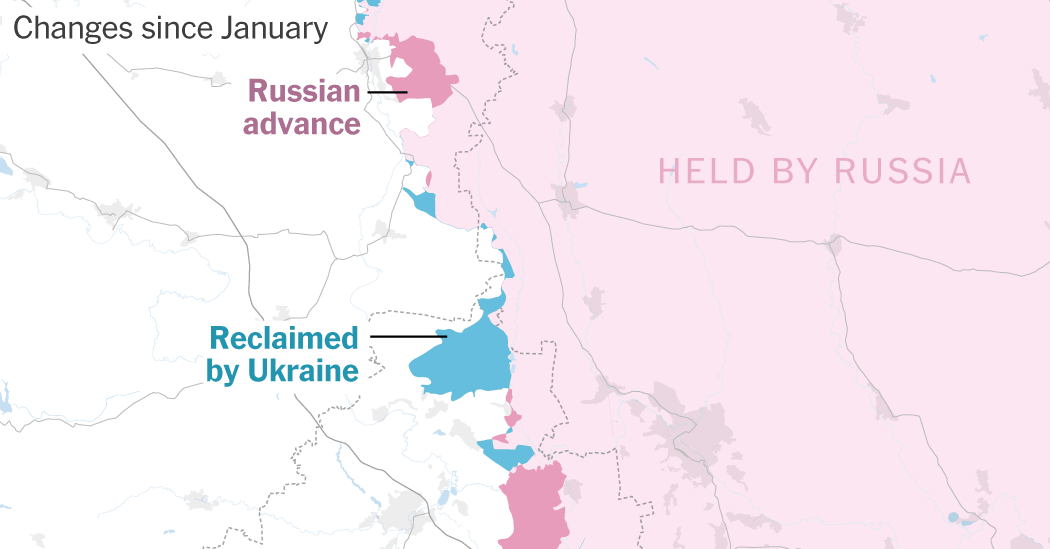
The Russian president, Vladimir V. Putin, has repeatedly said that the fall of the Donbas region in eastern Ukraine is inevitable and will happen faster than Kyiv thinks.
Recent trends on the battlefield paint a different picture.
A monthslong Ukrainian counteroffensive in the northern part of the Donbas has thwarted Russian efforts to encircle the remaining Ukrainian-controlled cities in the region. Russia, Western analysts say, has lost dozens of square miles of territory during the Ukrainian campaign, which Kyiv is calling Operation Vivaldi.
In the southern Donbas, Russia continues to mount furious assaults to break through Ukrainian lines. But Kyiv has reorganized its defense there and has so far kept the Russian military from pressing farther in its efforts to surround the major Donbas cities.
More broadly, Russian gains across Ukraine have slowed markedly in 2026 from their already glacial pace of last year. September was the worst month in net territorial gains for Russia inside Ukraine since June 2023, according to the Finland-based research firm Black Bird Group.
While Western researchers who track the battlefield report varying numbers, they generally agree that Russia has gained only slightly more land than it has lost this year.
That contrasts sharply with the narrative put forward by the Russian Ministry of Defense, which said on Sept. 19 that Russia had captured more than 2,000 square miles. Even ultranationalist Russian military bloggers have pushed back, voicing concern that Russia’s push to envelop the so-called fortress cities of the Donbas is failing.
The Ukrainian gains have come as both sides have tried to find a way to restore movement on a battlefield that had become largely deadlocked because of ubiquitous drones.
The Vivaldi operation, said George Barros, a senior analyst at the Washington-based Institute for the Study of War, shows that when a military lays the necessary groundwork, mechanized movement remains possible even under dense drone surveillance. Still, it took Ukraine months of preparations to reclaim a tiny fraction of its lost land.
Mr. Putin has said that full Russian control of the Donbas, gained either through force or through Ukrainian concessions, is a nonnegotiable condition for ending the war. Ukraine has rejected Trump administration proposals that it hand over land that Russia has failed to seize on the battlefield.
With its goals still unmet in the Donbas, Moscow has escalated its air war against Ukrainian cities, using its advantage in missiles and drones to bombard Kyiv, the capital. Strikes in several cities overnight Wednesday left at least 20 people dead, Ukrainian officials said. They have called the Russian bombardment a campaign of terrorism aimed at breaking the country’s will to fight.
The Northern Donbas
Operation Vivaldi is named for what Ukraine calls the campaign’s four “seasons,” or phases, and refers to the composer’s most famous work.
As Russian forces moved forward this year in areas east of the “fortress belt” cities of Sloviansk and Kramatorsk, and pushed into Kostiantynivka from the south, Ukraine was preparing a counteroffensive to the north.
Before launching offensive actions, Ukrainian forces first had to stabilize their defensive lines, stopping Russia’s slow advances in the northern Donbas, according to interviews with Ukrainian commanders.
Then, the commanders said, Ukraine moved to create conditions on the battlefield that would allow its troops to advance.
Kyiv’s forces targeted Russian logistics, expanding a middle-range strike campaign aimed at the roads and railways that feed Russia’s troops and matériel into battle. As part of that effort, Ukraine destroyed an oil pipeline, cutting access to fuel that Russia needed to conduct battlefield surveillance, said Lt. Col. Petro Horbatenko of the Third Army Corps, which led the counteroffensive.
Ukrainian troops also focused on eliminating elite Russian drone pilots, employing signals intelligence to find and attack their positions and shelters. In places where Russia used drones guided by fiber-optic cables, scouts traced physical line spools back to launch sites.
A third element of the Ukrainian preparations involved mines, Colonel Horbatenko said. Ukraine used advanced robotic mine removal systems to clear paths for its troops, he said. It also saturated Russian supply routes with mines laid by drones.
Once the stage was finally set, Ukraine began its offensive.
Behind the front lines, ground-based drones that Ukraine had dropped from the air went on the attack with explosives and machine guns, trying to sow chaos in the Russian rear. At the same time, Ukraine pushed forward along the front in armored vehicles in an effort to clear Russian positions bunker by bunker, commanders said.
The armored vehicles, whose battlefield deployment has waned because of their vulnerability to drones, were protected by enhanced reactive armor. Such armor uses controlled explosions to repel advancing drones, commanders said.
Ukrainian soldiers said the Russians, caught by surprise, often deployed reinforcements to areas where Ukrainian forces had already advanced, leading to ambushes.
President Volodymyr Zelensky of Ukraine said that more than 5,000 Russian troops had been killed in the operation so far, and that an additional 250 had been captured. The New York Times could not independently verify those figures. Ukraine does not release data on its own casualties.
The Southern Donbas
The biggest movement on the front before Operation Vivaldi was a Russian breakthrough last year. In the spring and summer of 2025, Russia broke Ukrainian defensive lines around Pokrovsk and surged forward several miles west into open terrain toward Dobropillia.
The advance threatened to let Russia cut Ukraine’s access to a crucial highway and to envelop the fortress belt cities — so called because Ukraine has erected heavy defenses around them — from the southwest. Seeking to contain the breach, Ukraine raced some of its best brigades to the area.
Early this year, Moscow’s forces captured Pokrovsk. They continued to advance slowly to the north in the months that followed. But Kyiv’s forces eventually stabilized their defenses, halting Russia short of its strategic objectives, according to Ukrainian soldiers and military analysts.
Russia is determined to regain momentum, Ukrainian commanders say, and continues to pour hundreds of troops into assaults every day. As the attacks and counterattacks continue, the area remains one of the most hotly contested sectors of the front.
Lt. Col. Kyrylo Dubrovskyi, a commander in the First Corps Azov of the National Guard of Ukraine, which has led the defense of the area, said that the integration of a digital battlefield management system known as Delta was crucial in blunting Russia’s advance.
The software, he said, made it possible to “organize real-time information exchange and to detect and neutralize enemy assault groups.”
Mykola Bielieskov, an analyst at the Come Back Alive Foundation, one of Ukraine’s biggest donors to the military, said that new technology, mass drone production and better coordination all contributed to a more effective defense. Among the advances are the robotic ground vehicles that Ukraine has used in tens of thousands of missions across the front.
Russian advances largely depend on infiltration tactics. Individual soldiers or small teams move on foot across what is known as the kill zone — a miles-wide stretch saturated with reconnaissance and attack drones. Once behind Ukrainian fortifications, troops gather, wait and then strike.
Mr. Barros, the military analyst, said that Russia had pushed these tactics near their limit as the kill zone has expanded, stretching the bounds of human endurance.
The infiltration strategy has resulted in an ever-growing gray zone where troops from both sides are present and control is not clear-cut. The two sides fight over individual tree lines, buildings, roads and logistical routes, said Col. Oleksandr Rashevsky, commander of the “Liut” Joint Assault Brigade of the National Police of Ukraine.
“There is no simple front in the Donbas today where it is enough to draw a single line on a map and say, ‘Up to this point, one side controls the territory, and beyond it, the other,’” Colonel Rashevsky said.
Liubov Sholudko and Dzvinka Pinchuk contributed reporting.
