


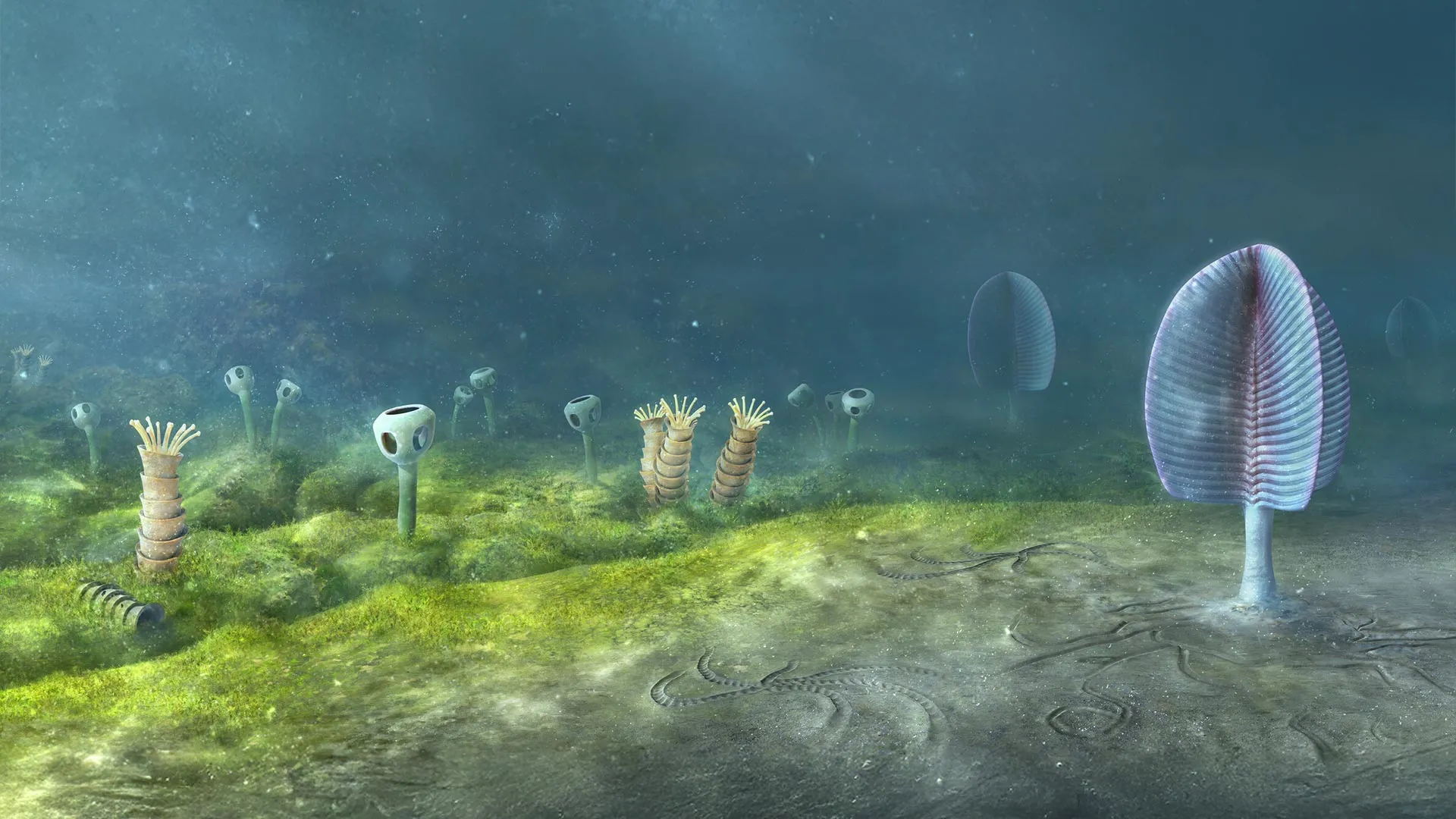
New research suggests animals may have evolved up to 200 million years before they first appear clearly in the fossil record, challenging a key assumption scientists have used to estimate when animal life began.
A study led by the University of Oxford suggests the earliest animals may have existed hundreds of millions of years before the first unmistakable animal fossils appear. The findings, published Oct. 2 in Science Advances, indicate that animals could have originated deep in the Neoproterozoic Era, possibly before some of the most severe ice ages in Earth’s history.
The research could reshape scientists’ understanding of a major evolutionary puzzle. Animals seem to appear relatively abruptly in the fossil record shortly before the Cambrian Period (539 to 487 million years ago), even though other lines of evidence have long suggested their evolutionary story began much earlier.
At the center of the new study is a question about how researchers have used ancient fossil deposits to place a maximum age on the origin of animals.
Rethinking a key fossil assumption
One important site is the Weng’an Biota in China, a roughly 590 million year old fossil deposit preserved in rocks of Ediacaran age. The site contains microscopic organisms preserved in exceptional detail, but none can be definitively identified as animals.
Because of this absence, scientists have previously argued that animals likely evolved after the Weng’an Biota formed. The reasoning was that if animals had already existed at the time, such an unusually well-preserved fossil deposit should have captured evidence of them.
The new research calls that assumption into question.
Mongolia fossils offer a crucial test
The international team, which included scientists from the University of California Berkeley, ETH Zürich, and Yale University, conducted an extensive study of exceptionally preserved microfossils from the Kheseen Biota in Mongolia.
The Kheseen Biota is more than 40 million years younger than Weng’an, although the two fossil assemblages share some species. Importantly, animals are already known from other locations around the world by the time the Kheseen Biota formed, including sites in Namibia and South China.
Researchers examined more than 140 samples, including material collected from previously undocumented locations, using scanning electron microscopy. Their analysis revealed exquisitely preserved new microfossil species, including acritarchs (tiny spherical organisms with spines and branching projections), along with embryo-like fossils containing internal cells.
Despite the remarkable preservation, none of the fossils can confidently be identified as an animal.
Senior author Associate Professor Ross Anderson (Museum of Natural History, Oxford University) said: “The Kheseen Biota breaks the argument that the exceptional microfossils of Weng’an mean we would have seen animal fossils in the assemblage had they existed at the time. The Kheseen microfossils are just as well-preserved, yet animals continue to be absent – despite the fact we know at that point they existed.”
This suggests animals may have occupied environments different from those represented in the Kheseen deposits, or that the chemical conditions responsible for fossilization there were not suitable for preserving animal remains.
A potentially hidden history of animal life
Because animals were already present when the Kheseen Biota formed but still do not appear in its fossil record, the researchers argue that the absence of animals from Weng’an cannot automatically be taken as proof that animals had not yet evolved 590 million years ago.
Instead, the team examined much older fossil deposits dating from about 850 to 730 million years ago. These included the Svanbergfjellet Formation (Norway), Bitter Springs Group (Australia) and Chuar Group (Arizona, USA) — all fossil rich deposits considered capable of preserving animals, although no confirmed animal fossils have yet been found in them.
These sites have previously been used to define maximum possible ages for the origin of animal life.
Using those older geological constraints, the researchers carried out molecular clock analysis. This technique compares genetic differences among living species and combines them with fossil dates and estimated rates of evolutionary change to calculate when common ancestors may have lived.
When the researchers used these older deposits rather than the younger Ediacaran Weng’an site as constraints, the estimated origin of animals moved backward by about 200 million years. The new range places the possible emergence of animals between 800 and 700 million years ago.
Clues from ancient chemical fossils
Other evidence already hints that animals could have a much deeper evolutionary history than their body fossils indicate.
Chemical fossils, also known as biomarkers, preserved in ancient rocks contain evidence consistent with sponges living at least 650 million years ago. That would place them tens of millions of years before the oldest definitive macroscopic animal fossils.
The earliest animals would likely have been small and soft-bodied. Without shells, bones or other hard structures, they would have been far less likely to survive the fossilization process than many later animals.
Their chances of being preserved would also have depended heavily on where they lived and on a rare combination of chemical conditions after death.
Did animals exist before Snowball Earth?
If animals originated between 800 and 700 million years ago, the timing raises an extraordinary possibility. Animal life may already have existed before Earth entered some of the most extreme ice ages in its history, or animals may even have emerged during that harsh period.
The Cryogenian Period began around 720 million years ago, when massive glaciers expanded across the planet during episodes commonly called Snowball Earth.
The new findings reopen questions about whether the environmental conditions associated with Snowball Earth influenced the origin and early evolution of animal life.
First author, PhD student Orin Lole Durbin (University of Oxford undergraduate at the time of the study, now at Virginia Tech) said: “Pre-Ediacaran animal body fossils still elude us, and this analysis does not prove that animals existed 800 million years ago. However, our new fossil evidence from Mongolia undermines one of the main arguments for restricting animal origins to the Ediacaran interval. Meanwhile, our molecular-clock analyses show how much further back their evolutionary history could extend.”
Searching for the earliest animals
The researchers say future studies should examine fossil deposits from a wider range of locations, environments, and preservation conditions in the search for evidence of early animals.
That search should also combine every available line of evidence, including animal body fossils, traces of animal activity, and chemical biomarkers.
Professor Anderson added: “Until that evidence becomes available, the precise birth date of the animal kingdom remains uncertain.”
