


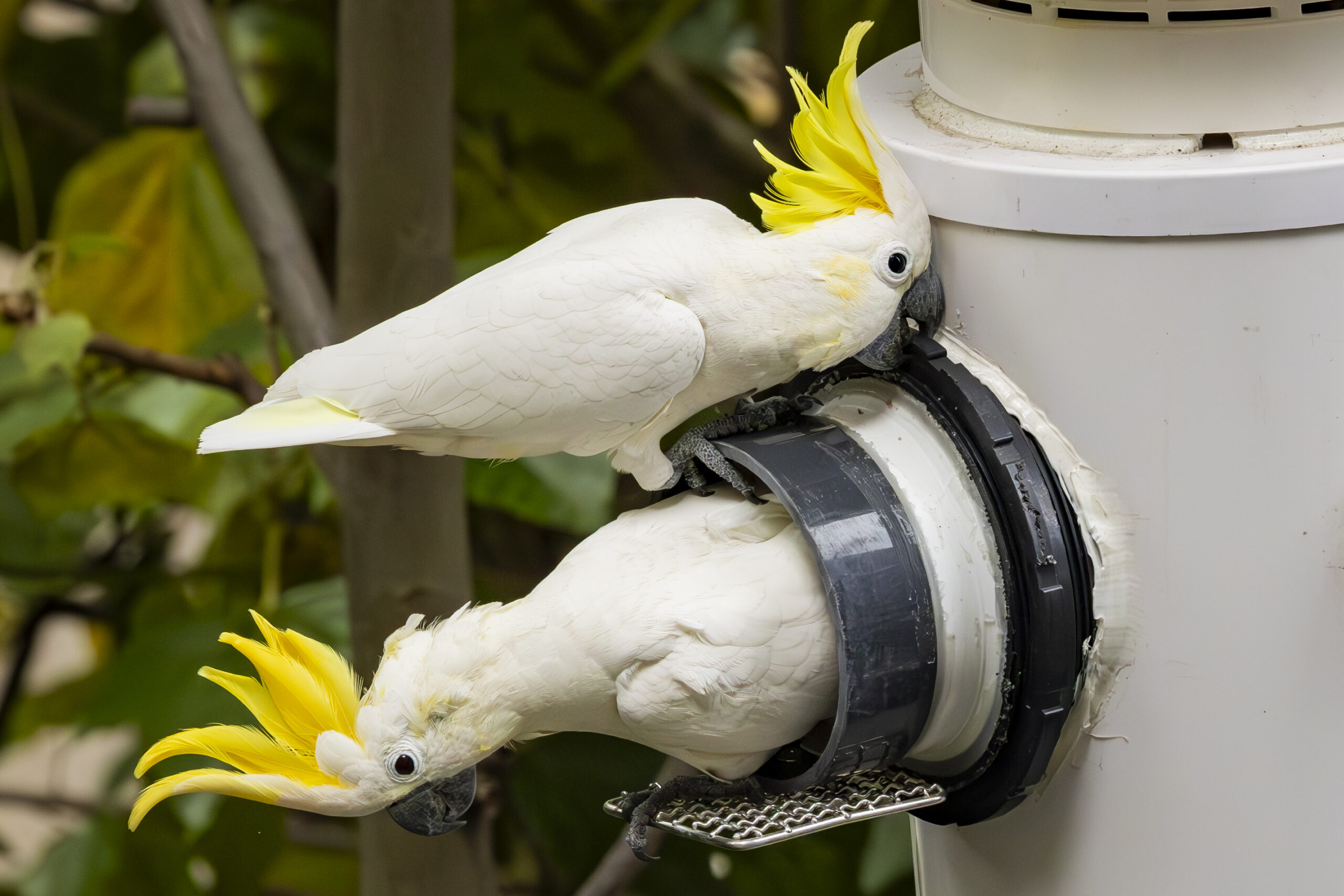
- Hong Kong-based biologist Astrid Andersson and arborist Harry Wong run a conservation project that seeks to protect the city’s feral yellow-crested cockatoos (Cacatua sulphurea).
- The critically endangered species enjoys a stable population in Hong Kong, numbering around 200 or about 10% of the global population.
- With few natural nesting spaces available, Andersson and Wong make artificial nest boxes and install them in public parks and on school campuses.
- Each box is equipped with an internal camera connected to a mobile signal, allowing researchers to remotely monitor breeding behavior.
HONG KONG — “Spiderman … Tom Holland,” two secondary school boys repeated to each other as they watched conservationist Harry Wong nimbly climb a tall tree at their school, St. Louis School, in downtown Hong Kong.
On a humid September afternoon, Wong installed a nest box for yellow-crested cockatoos (Cacatua sulphurea) on a candlenut tree (Aleurites moluccanus). Equipped with a harness and ropes, he climbed up the tree, installed the box, and quickly rappelled down.
Wong and Astrid Andersson, a biologist and postdoctoral researcher at the University of Hong Kong (HKU), are the dynamic duo behind HK Cockatoo Watch, a conservation project that seeks to protect the city’s feral yellow-crested cockatoos.
Yellow-crested cockatoos are considered to be critically endangered, with fewer than 2,000 individuals remaining in their native range in eastern Indonesia and Timor-Leste. However, few people know that Hong Kong is home to the largest wild population of the species outside the two Southeast Asian countries.
There are roughly 200 cockatoos in the city, or about 10% of the global wild population, believed to be descendants of released or escaped pets. The number is stable, thanks to the lack of natural predators and strict legal protection.
A recent DNA analysis study by Andersson and her research team found that Hong Kong’s feral cockatoos have unexpectedly high genetic diversity and may be key to saving the species from extinction in Indonesia.
Living in an urban jungle, however, is challenging for these parrots. They normally build nests in tree holes, which abound in Southeast Asian rainforests. “But in the city, they do not have that luxurious choice available,” Andersson said.


Andersson, who has spent a decade studying yellow-crested cockatoos in Hong Kong, said she has also noticed fewer and fewer natural nesting spaces available. Many of the birds’ 15 natural tree-nesting sites “have been removed by typhoons or government pruning,” she told Mongabay.
The biologist estimated that more than 60% of natural tree hollows in Hong Kong are gone, creating what she called “a housing crisis for these birds.”
Inspired by conservation work in countries such as Australia, she came up with a solution: Building artificial nests and installing them around the city to provide not only safe havens, but also breeding sites for the cockatoos.
But she didn’t have the technical know-how until a mutual friend introduced her to Wong, an arborist by training with the design and engineering skills to carry out her vision.
Birds and bees
Wong has six to seven years of experience in bee conservation, helping people relocate beehives or wasp nests safely in nature.
Seeing similarities between his work with bees and birds, he said he found it easy to branch off into cockatoo conservation. “What I am doing is to find a way: How can we coexist with them?” he told Mongabay.
Andersson and Wong’s nest boxes are modeled after Australian prototypes but are adapted to Hong Kong’s humid climate. Each box is also equipped with an internal camera connected to a mobile signal, allowing researchers to remotely monitor breeding behavior.
Since the project began in March last year, a total of 15 artificial nest boxes have been installed at different locations across Hong Kong Island. “We started at HKU campus, which was easy because I’m based there,” said Andersson, a Swede who grew up in Hong Kong.
They then approached the Leisure and Cultural Services Department, which is in charge of the city parks, and contacted schools located within the cockatoos’ range.
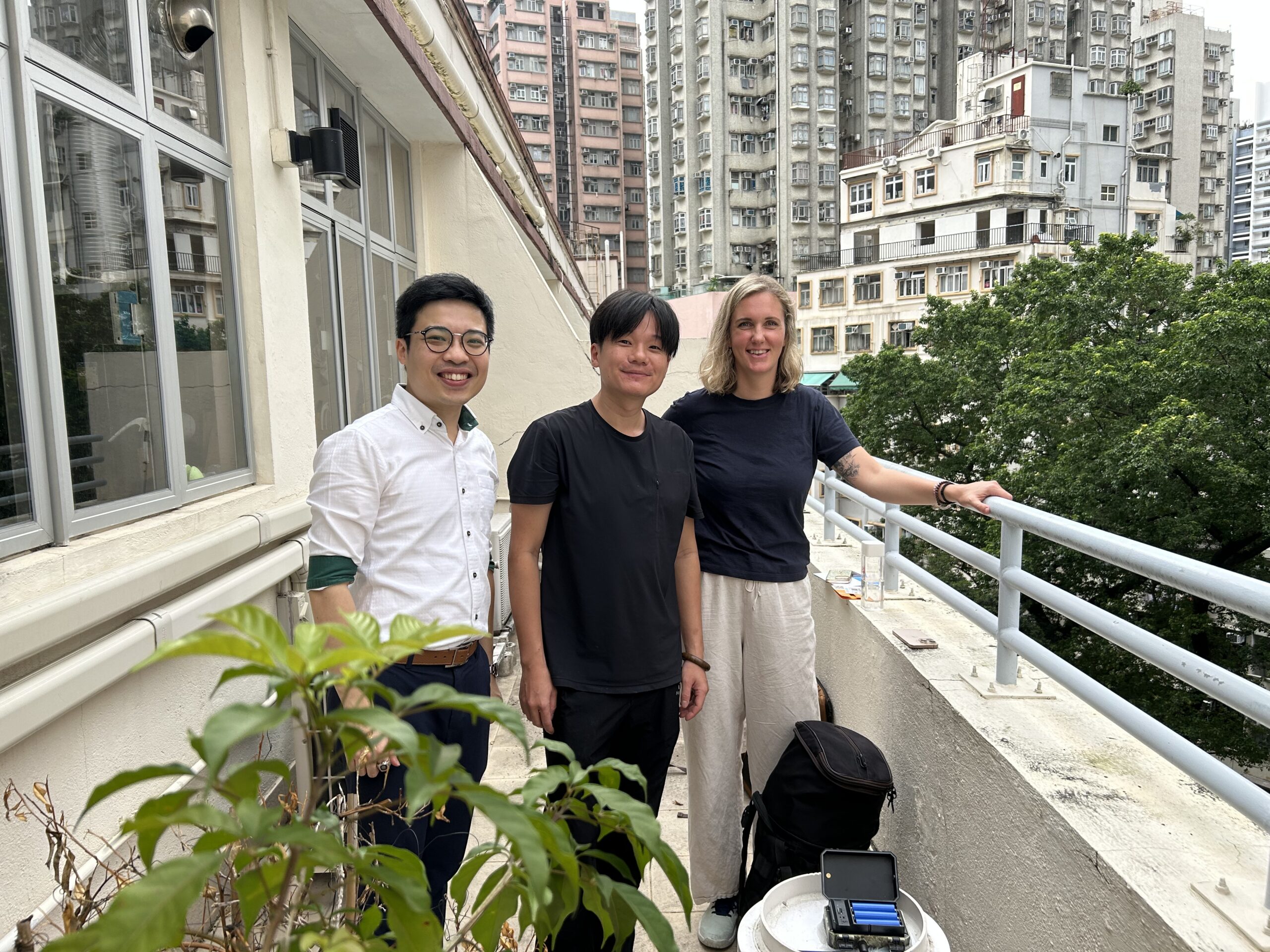
Several schools are currently involved with the project. St. Louis School, a local all-boys Catholic secondary school, has two boxes on its grounds.
Two international schools also participate in the project: the ISF Academy, which has one box on campus, and Quarry Bay School, a primary school, which sponsors a box installed in Victoria Park. A student at Chinese International School has a project to build a nest box on his own.
The rest are mostly placed in public parks, including Hong Kong Park, the nearby Hong Kong Zoological and Botanical Gardens, and Victoria Park.
School mascot
Despite being located among the high-rises on western Hong Kong Island, St. Louis School is a favorite spot for the city’s cockatoos, especially the arts classroom.
Visual arts teacher Winster Wong and his students said they see birds perching at classroom windows and peeking inside. During school assemblies, students and staff can hear cockatoos making loud squawking noises.


In October 2025, teacher Wong said he discovered a pair of birds trying to make a hole in a tree near the classroom. “I believe they wanted to make a home for themselves,” he said.
Winster Wong remembered watching an interview with Andersson on YouTube and decided to contact her. “I sent an email to Dr. Astrid to see whether she would be interested in building and installing a nest box on our campus,” he told Mongabay.
Andersson and Harry Wong came to the school in April 2026 to fit two nest boxes. The following month, a pair of cockatoos moved into a box installed on a tree just outside the visual arts classroom and have stayed there since. The second box, installed on a school building wall, failed to attract any birds, so Andersson and Harry Wong moved it to a nearby tree in September.
The school has also adopted the cockatoo as its mascot, Winster Wong said. Students’ cockatoo drawings are featured throughout the school’s orientation booklets.
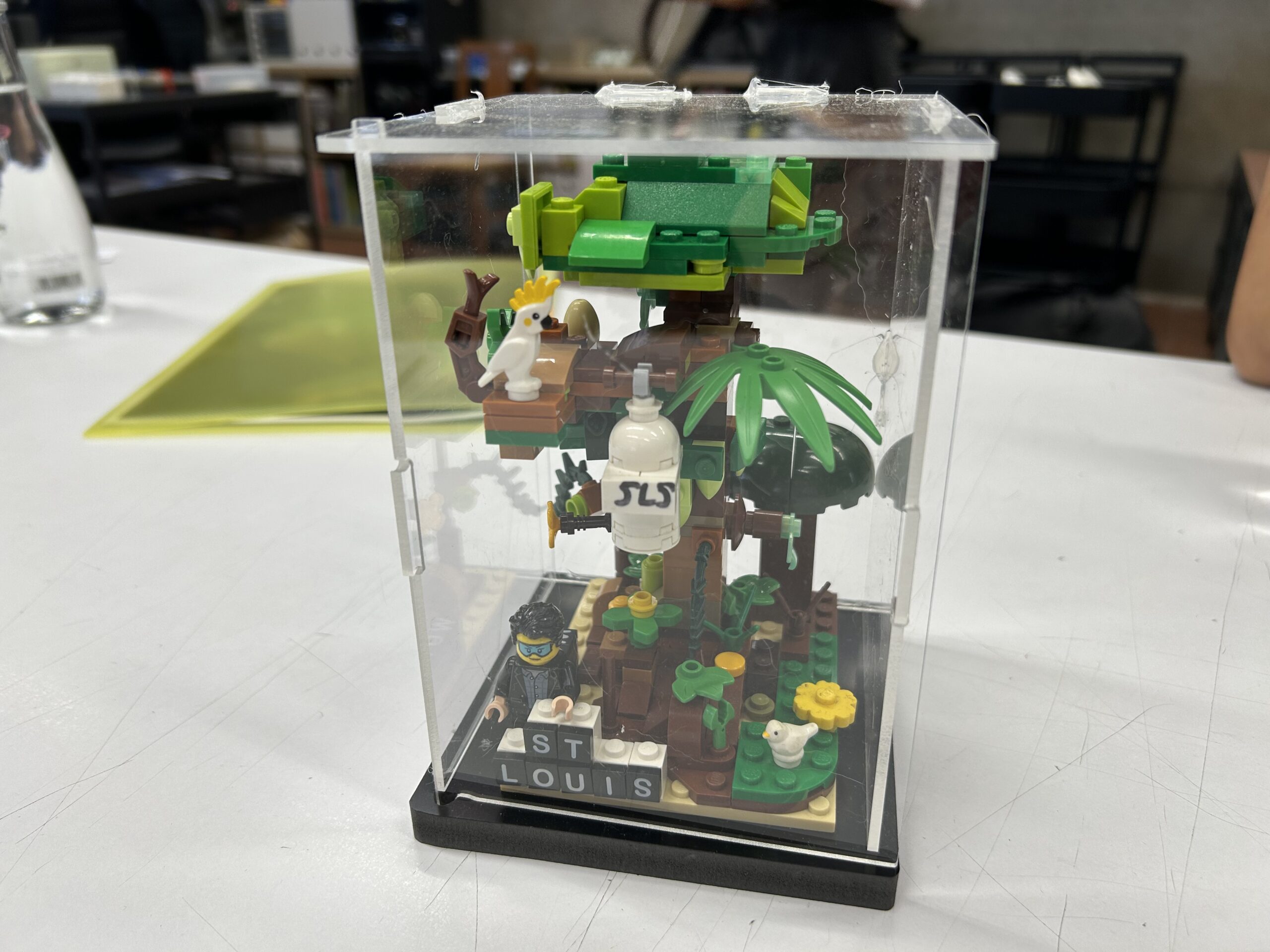
Students have also designed cockatoo bookmarks and keychains as souvenirs. Second-year student Owen Yu, who, with his friend Asa Tam, watched the second nest box installation, built a Lego tree, complete with a cockatoo and a nest box, that is currently on display in the school.
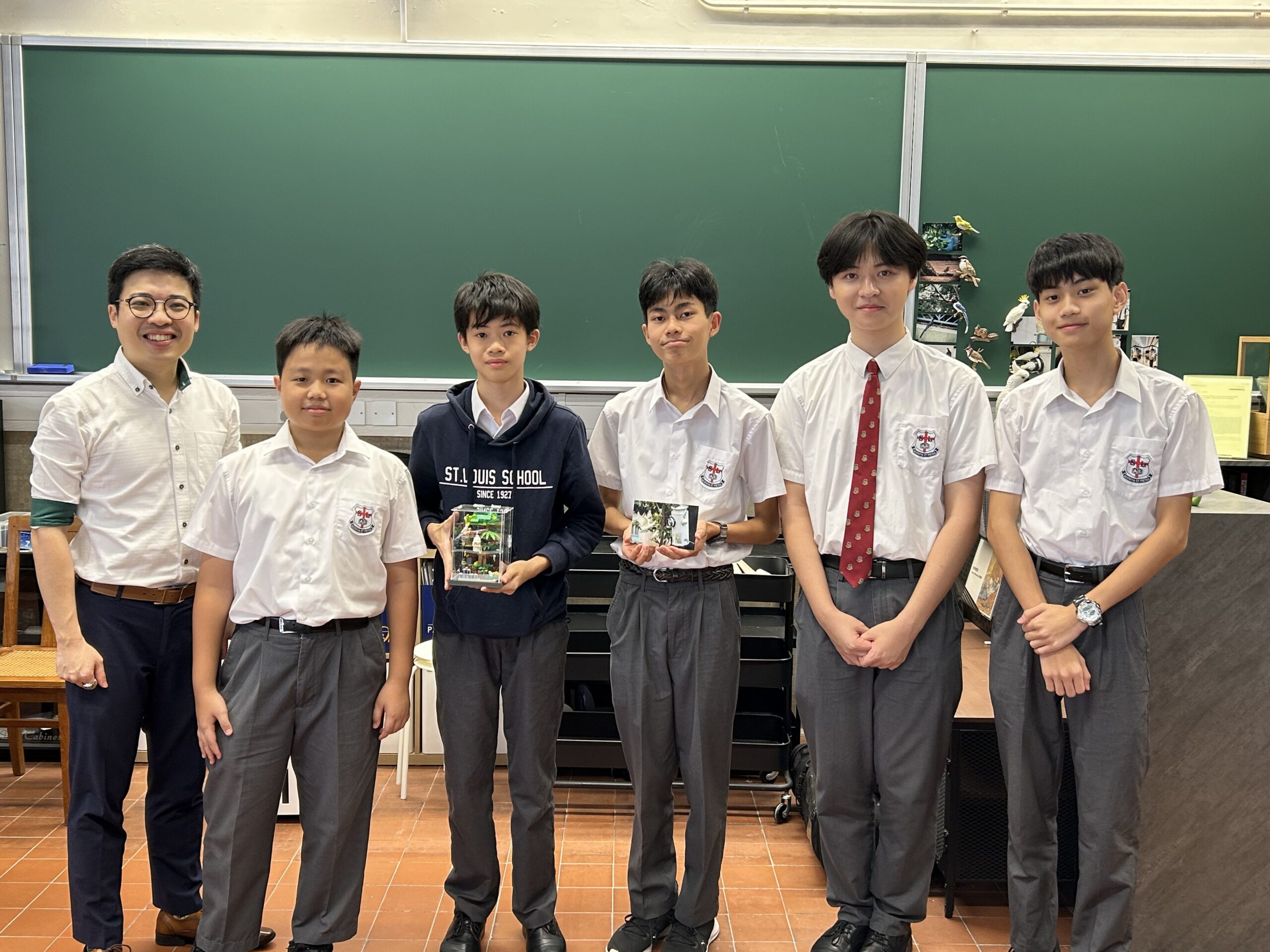
Students in the photography club have become avid bird-watchers. “Sometimes when we see them near us, we just grab a camera and take some pictures,” Rex To, a sixth-year student, told Mongabay. “Also at recess or lunchtime, if we have our free time, maybe I will just check whether they are here.”
A photo of a cockatoo about to fly into a nest box, taken by Rooney Cheung, now in fourth year, won a top prize in a citywide students’ wildlife photo competition in June.
Having cockatoos around the campus has given students a rare chance to witness what Andersson called a “National Geographic-style experience” in an urban neighborhood.
They watched “this critically endangered species mating,” which was captured on film, she said. “Winster has this amazing picture of them all [the students] looking out the window,” Andersson said.
Family reunion
Of the 15 boxes installed, only four are inhabited by pairs of cockatoos. Getting cockatoos interested in moving into the nest boxes takes a long time, Andersson said.
The cockatoos “‘need to get familiar, comfortable, feel OK to approach,” Andersson said. “Maybe one season, they check it out. Then, the next breeding season, they might decide to lay the egg. So it is a long-term project.”
She said their collaborators in Australia told her they were amazed that some birds showed an interest within just one breeding season. “They said it was a huge success,” she added. “But I think the cockatoos in Hong Kong are maybe a bit more bold or used to artificial structures.”

One success story happened recently. In May, Andersson and Harry Wong received a request to rescue a baby cockatoo found hatched inside an air conditioning vent in the ceiling of an apartment. They put the chick inside a nest box and placed it close to the original nesting site, hoping the parents could easily find their baby.
They waited for seven hours until the cockatoo parents found the nest box. The birds carefully looked inside and, much to the conservationists’ relief, decided to move in. “The parents were able to feed him and bring him from a tiny, little baby to a fully fledged bird,” Andersson said. “And he fledged successfully.”
In the meantime, Harry Wong is still perfecting the nest boxes. Every weekend, he spends hours in a workshop in an industrial neighborhood in Kowloon to craft and tinker with artificial nest boxes, trying to upgrade the design to make it more suitable for the birds.
He said he is thinking about how to make it much cooler inside the nest boxes, which are made of PVC tubes. “I think one of the reasons why they just see this box as a place they just take a rest but not lay eggs is also about the temperature,” he said. “So let’s see about the next season. How can we try to improve the box, and how is it resolved?”

They plan to install at least three more nest boxes later this month. “We hope to put as many out there as possible,” Andersson said.
So far, no cockatoos have moved into the second nest box at St. Louis School. But there is some promising news.
In late September, Winster Wong sent a message to Mongabay with an update — and a photo of cockatoos perching on a tree branch. “We are very excited,” he wrote. “A large group of cockatoos visited our campus after Harry relocated one of the nest boxes.”
Banner image: A pair of cockatoos is spotted perching on a nest box at St. Louis School in Hong Kong on May 9, 2026. Image courtesy of Winster Wong/St. Louis School.
Hong Kong’s urban cockatoos could be a genetic lifeline for Indonesian ancestors
On an Indonesian island, an ancient ritual evolves to protect an endangered cockatoo

