


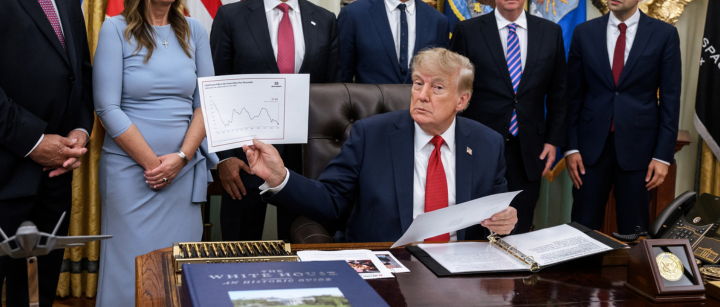
President Donald Trump and other federal officials are claiming that deals the administration has struck with pharmaceutical companies are “rescuing state budgets” or helping to “save Medicaid” by saving the program tens of billions of dollars on prescription drugs over a decade.
But experts say there are many unanswered questions about the scope of those deals that could limit the potential savings, including how many drugs they actually cover.
It’s also an exaggeration to suggest this program will single-handedly save state budgets, even under the rosiest of scenarios. According to the White House’s projections, the savings to states would initially come to less than 2% of what they spend on Medicaid annually, and diminish over time.
Trump has talked regularly about his efforts to lower prescription drug costs, arguing it’s unfair that the U.S. pays much higher prices for brand-name drugs than other wealthy countries.
Over the past 13 months, his administration has announced agreements with more than two dozen drug manufacturers — from large corporations like Pfizer and Johnson & Johnson to midsize biotech firms — to bring certain prices in line with those in other countries. The administration calls this approach “most favored nation” or MFN pricing.
Among other things, companies have agreed to sell certain drugs to state Medicaid programs at MFN prices. Trump and other administration officials touted the potential savings that could generate at a Sept. 18 White House event.
“The Council of Economic Advisers estimates that the most favored nations deals that we’re extending to states today will save Medicaid over $64 billion, and that’s over a relatively short period of time,” Trump said. “And others project the savings are going to be actually much more than that. I think they’re going to be much higher than that. Could be $100 billion.”
Those savings, Trump continued, “will help us save Medicaid and protect it for future generations.”
“We are rescuing state budgets with this program,” Dr. Mehmet Oz, the administrator of the Centers for Medicare & Medicaid Services, added. Medicaid prescription-drug spending, he said, “is crowding out schools and roads and long-term care and rural care.”
“It’s going to save the state budget,” Health and Human Services Secretary Robert F. Kennedy Jr. said, adding that states previously “had to choose between medicine and nutrition, lifestyle, prevention.”
The $64 billion number comes from a report released in May by the White House Council of Economic Advisers, which projected that MFN pricing could save Medicaid about that much over 10 years, split between the federal government and the states.
But experts told us it’s unclear how realistic that estimate is. The details of Trump’s agreements with drugmakers are largely confidential and key questions remain unanswered, including which drugs will be offered to Medicaid at MFN prices, the degree to which states will participate and how long those arrangements will last.
“It is unclear what assumptions were made to develop the administration’s estimates, and there are a number of factors that make it difficult to assess the overall impact the new model will have on Medicaid drug costs,” Robin Rudowitz, a senior vice president and director of the Program on Medicaid and the Uninsured at the nonprofit health policy research organization KFF, told us in an email.
Because Medicaid already gets substantial discounts on prescription drugs, the amount of savings will depend heavily on which drugs are included and whether the prices actually give states a better deal, said Edwin Park, a research professor at Georgetown University’s Center for Children and Families.
He said the administration initially made it seem like participating companies would offer all their drugs to Medicaid at MFN pricing, which the CEA report describes as the second-lowest prices among a small set of countries — the G-7 nations, plus Switzerland and Denmark. But a number of companies have since indicated that the agreements cover only some products.
“There’s just sort of a cone of silence around all these agreements,” Park said. “So, you know, I think a healthy dose of skepticism is warranted in this case.”
A White House official said the CEA analysis “is based on manufacturer and state participation” and the administration expects the actual savings to be in line with its estimates.
A spokesperson for the Centers for Medicare & Medicaid Services told us the Medicaid program, called GENEROUS, includes “hundreds” of drugs used to treat cancer, asthma, Parkinson’s and various other “costly and chronic diseases.”
“CMS estimated total [MFN] rebates flowing through GENEROUS could reach $5.2 billion annually, depending on which drugs, of those included in GENEROUS, states choose to access through the model each year,” the spokesperson said. “This figure represents a significant portion of annual net drug spend in Medicaid.”
We’ve previously written about other aspects of Trump’s drug-pricing deals, including his exaggerated claims about the savings available through the government’s direct-to-consumer TrumpRx platform and the administration’s questionable projections that his MFN policies will save hundreds of billions of dollars overall.
Here’s a closer look at the Medicaid drug-pricing initiative, what we know about it and the administration’s claims about potential savings.
Lack of Details Make It Hard to Assess Savings
Medicaid, which provides health coverage to more than 65 million people with low incomes or disabilities, already pays some of the lowest prices in the U.S. for prescription drugs. By law, manufacturers have to agree to certain rebates for their drugs to be covered by Medicaid. On top of that, most states negotiate “supplemental rebates” that further reduce the cost of branded drugs.
Those discounts reduce Medicaid’s drug costs by more than half. In fiscal year 2024, Medicaid’s gross spending on prescription drugs topped $106 billion, but net spending was only $48 billion after rebates, according to the Medicaid and CHIP Payment and Access Commission, a governmental body that advises Congress on Medicaid policy.
Nearly all of those costs are split between states and the federal government. Medicaid beneficiaries pay, at most, a nominal copay for their prescriptions, so they’re not directly impacted by Medicaid drug prices going up or down.
While prescription drugs account for a small share of overall Medicaid spending — around 6% in 2024 — rising drug costs can be a concern for state budgets. Pharmaceutical companies’ deals with the Trump administration include participation in GENEROUS, through which they’ll offer state Medicaid programs access to certain drugs at MFN prices. The five-year pilot program launched in January, and participation for states and drug manufacturers is voluntary.
The Council of Economic Advisers report estimated that the GENEROUS model would initially reduce Medicaid’s drug costs by $18 billion per year, though because it assumes the changes would also increase prescription drug utilization, it put the net savings at $14.4 billion.
The report said those savings would likely diminish over time as existing products lose patent exclusivity, though it says Medicaid would continue to benefit from other provisions of the president’s MFN deals that cover new product launches. (We’ve previously written about the shaky assumptions behind the administration’s claims of massive savings from those provisions.) Experts have also pointed out that companies could raise prices in other countries, so that they wouldn’t have to discount their drugs as much in the U.S.
Taking those diminishing effects into account, the report put the total savings over 10 years at $64.3 billion.
Outside researchers have come up with somewhat lower estimates. An analysis published in the journal JAMA in July estimated the potential one-year savings at $8.6 billion.
“The CEA estimates are basically sort of a back-of-the-envelope calculation,” said the study’s lead author, Dr. Thomas Hwang, director of the Cancer Innovation and Regulation Initiative at Harvard Medical School and Brigham and Women’s Hospital.
The CEA calculated its savings by assuming that current Medicaid prices are 2.5 times higher on average than MFN prices would be, but doesn’t go into detail about how it arrived at that figure. Hwang said it’s also unclear if CEA accounts for other supplemental rebates, which states would have to forego to access MFN prices.
Hwang’s study, which is based on drug- and state-specific data, looked at a somewhat smaller cohort of drugs than CEA’s, but he said that would only account for part of the difference between estimates.
The bigger issue, he said, is that it’s not yet clear which drugs will actually be included in GENEROUS.
The CEA report said its estimate is based on “implementation of Medicaid MFN across all single source branded drugs and biologics.” Hwang and colleagues made the same assumption in their study. He said that’s how federal officials initially described the program, including in a request for applications directed at states.
But “what we’ve seen in the past month or so is a lot of backsliding on that commitment,” Hwang said. Multiple companies have said in Securities and Exchange Commission filings or other public statements that MFN pricing for Medicaid applies only to “certain” or “select” products.
Because Medicaid requires additional rebates if a drug’s price rises faster than inflation, older drugs tend to be discounted more steeply, so the savings from MFN pricing could depend heavily on which specific drugs are included, he said.
“One of the concerns with this is, obviously, companies have every financial inventive to cherry-pick which drugs they offer MFN pricing for, in ways that will reduce their MFN liability,” Hwang said.
Jeromie Ballreich, an associate research professor at Johns Hopkins University who studies pharmaceutical policy, similarly said savings will vary widely from drug to drug.
In a forthcoming study, he and several co-authors looked at how GENEROUS could affect prices for 86 branded drugs accounting for more than half of Medicaid gross drug spending in 2024. For more than a third of those products, they found, there wouldn’t be any savings. For the others, savings ranged from 1.3% to 87.5%.
“Some drugs are going to provide a lot of savings,” he said. But “there’s going to be other branded drugs out there that will provide essentially no savings because of the way the inflation rebates affect Medicaid pricing. There are branded drugs in the Medicaid program that are [already] essentially free for Medicaid.”
The paper estimated the GENEROUS model could save Medicaid $3.1 billion over a year, but Ballreich said that’s going to be “highly dependent” on which drugs are actually included and how international reference prices are calculated.
“So there are still a number of question marks,” he said.
“The GENEROUS model includes hundreds of single source and innovator multiple source covered outpatient drugs from the portfolios of participating manufacturers,” the CMS spokesperson told us.
“The included drugs span most major drug classes, including those acutely important to Medicaid beneficiaries like oncology, diabetes care, and asthma. Some of these drugs are used to treat numerous costly and chronic diseases, including hemophilia, Parkinson’s disease, macular degeneration, glaucoma, liver disease, skin conditions, and various forms of cancer.”
State Uptake Remains to Be Seen
Another open question is the degree to which states choose to participate. Under the GENEROUS model, states can pick and choose which specific drugs they want. Whether the MFN price offers them a better deal will depend on what kind of rebates they’ve already negotiated with the manufacturer.
States will also have to agree to a standard set of coverage criteria for each MFN-priced drug, which could change guidelines for when certain drugs need prior authorization. Those changes could offset some of the savings if the criteria result in more people being prescribed those drugs.
“The key question for states is, how does [the MFN rebate] compare to their existing rebates, and then how expansive are the coverage terms,” said Park, the Georgetown professor.
Trump announced on Sept. 18 that all 50 states had joined the GENEROUS model, though the Centers for Medicare & Medicaid Services clarified later the same day that while every state had applied, 40 had actually signed agreements to participate. The health news site STAT reported on Sept. 24 that some states were still on the fence about doing so.
At least some of the remaining states did sign agreements with CMS before the Sept. 30 deadline, spokespeople for their health departments told us. However, those departments also told us they’re still evaluating whether to accept any MFN offers from manufacturers. Several of them said that signing participation agreements was the only way to access pricing information and determine whether there would be a benefit.
“Applying and signing a participation agreement does not commit the state to actually participate in the GENEROUS model in terms of entering into rebate agreements with manufacturers,” Anthony Cava, a spokesperson for the California Department of Health Care Services, told us in an email.
“Rather, signing a participation agreement will enable DHCS to obtain drug pricing information, evaluate whether the MFN prices offered under the model would meaningfully benefit Medi-Cal [California’s Medicaid program], and decide whether entering into supplemental rebate agreements with manufacturers would be advantageous.”
One state, South Dakota, announced last month that it “has currently identified three drugs that would benefit from these lower prices, saving the state approximately $750,000 a year.” South Dakota’s Medicaid program spent $167.2 million on prescription drugs in fiscal year 2024, with the costs split between the state and federal governments.
Multiple state health departments have told us or other news outlets that they can’t share specifics due to confidentiality agreements. CMS told us that its projections of potential savings will depend “on which drugs, of those included in GENEROUS, states choose to access through the model each year.”
There’s also uncertainty about how long these agreements will be in place. Some companies have indicated their deals with the administration run for three years. Pfizer’s ends on the last day of Trump’s term, according to a redacted copy released to the liberal watchdog group Public Citizen through a Freedom of Information Act request.
“Participating manufacturers voluntarily chose to sign participation agreements to take part in GENEROUS and we do not currently plan to renegotiate the GENEROUS model during its five-year performance period,” the CMS spokesperson told us.
The White House official said the CEA projections assume the MFN arrangements will continue under future administrations.
“Those who assume it won’t last a decade would be making an assumption that a future administration would not want MFN pricing and the hundreds of billions in savings associated with it,” the official said.
Ballreich said trying to make projections about the pharmaceutical market 10 years out is inherently difficult because of the number of variables. He said the administration’s estimate of $64 billion over 10 years is “probably a little high,” though not outside the realm of possibility.
But again, he said, it’s “hard to model out without knowing the details.”
Ballreich also noted that by agreeing to offer some discounts to Medicaid, drug companies appear to have negotiated exemptions from the administration’s implementation of mandatory MFN pricing in Medicare.
“For pharmaceutical companies, Medicare is where they make their money,” he said. “Medicaid is often kind of this afterthought.”
The MFN pricing initiative in Medicare has two components. One of those programs, called GLOBE, covers drugs administered in doctors’ offices. CMS recently released a final rule estimating it will save $440 million over seven years — a 96% decrease from the initial estimate of $11.9 billion in savings. According to the rule, the program will apply to just four manufacturers, as other companies have exemptions because they are participating in the Medicaid pilot. (The other one, GUARD, applies to prescription drugs and is still in the works.)
“The narrative that I’m understanding from industry, or at least how industry has been interpreting the approach by the administration, is that ‘We will participate in GENEROUS,’” Ballreich said. “‘In return, we’re going to be a lot more selective on what drugs are going to be in GLOBE and GUARD.’”
Questionable Claims of ‘Rescuing’ State Budgets
Whether or not the White House’s projections are realized, experts told us MFN pricing could create real savings for states and the federal government. But claims of “rescuing” state budgets are overblown.
We asked CMS what exactly Oz meant by that and didn’t get a direct answer. But even taking the White House estimates at face value, the savings represent a fraction of what states spend on Medicaid — not to mention all services — every year.
While prescription drugs are a small part of total Medicaid spending, a recent policy brief from KFF noted that rising drug prices and the “emergence of new, high-cost drugs can put pressure on state budgets.” More than a third of states cited rising pharmacy costs as one of the factors driving higher Medicaid spending overall in KFF’s most recent survey of state Medicaid directors.
Because states and the federal government split the cost of Medicaid, not all of the projected $64 billion in savings would go to states. The CEA report projects that states collectively would save $6.2 billion per year at first and $27.6 billion over a decade, or about $2.8 billion per year on average.
By comparison, in fiscal year 2024, states spent around $325 billion of their own money on Medicaid, according to KFF. The projected savings in the first year would amount to about 2% of that, falling to less than 1% in later years as MFN discounts diminish over time. The savings make up an even smaller share of total state expenditures, which came to around $2 trillion in fiscal year 2024, not counting costs reimbursed by the federal government, according to the National Association of State Budget Officers.
Of course, that’s not to say states wouldn’t welcome those savings.
Park said states are justifiably concerned about rising medication costs, especially as new, expensive blockbuster drugs come out.
“That being said, prescription drugs is only a very small share of Medicaid spending, well under 10%,” he said. “The big drivers are things one would expect, like hospital costs.”
Park also noted that the domestic policy law Trump signed last year, the One Big Beautiful Bill Act, includes cuts to Medicaid funding that could outweigh the potential savings from lower prescription drug prices.
Some of those changes, such as work requirements and more frequent eligibility checks, will reduce both state and federal Medicaid spending by limiting enrollment. But other provisions cut federal funding to states without reducing the size of the Medicaid program, meaning states will have to make cuts or use general funds to make up the difference.
On balance, a recent study from the nonpartisan research organization RAND estimated those changes could cost state general funds more than $80 billion through 2034, though the effects vary by state.
“You can see how there’s going to be some savings if these agreements go into effect,” Park said. “But it’s not a way for states to offset the historically large Medicaid cuts that were included in the budget reconciliation law, and that includes the significant cost shifts to states.”
Editor’s note: FactCheck.org does not accept advertising. We rely on grants and individual donations from people like you. Please consider a donation. Credit card donations may be made through our “Donate” page. If you prefer to give by check, send to: FactCheck.org, Annenberg Public Policy Center, P.O. Box 58100, Philadelphia, PA 19102.
