


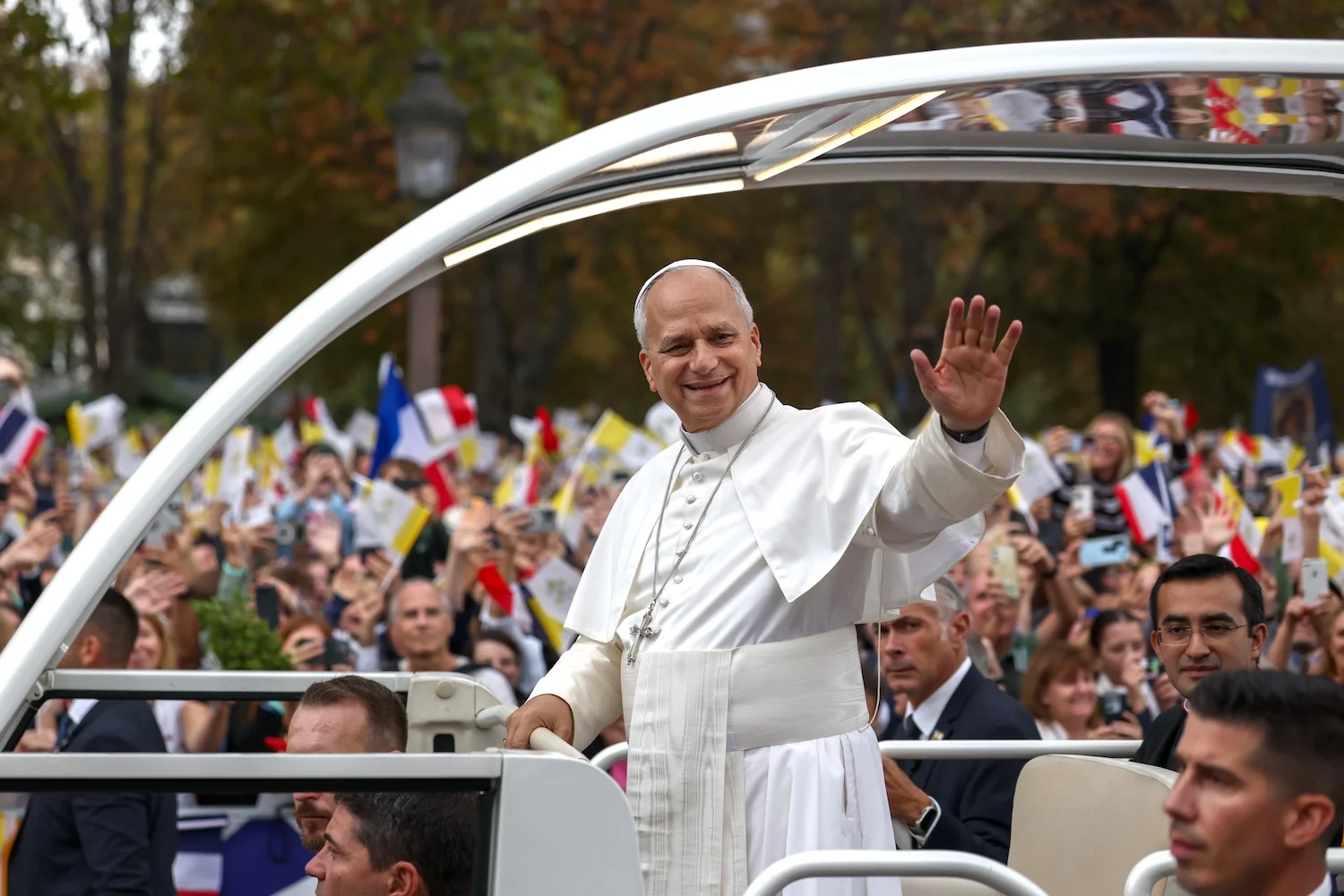
“The Republic is secular; France is Christian”—a phrase that sounds even more definitive in French: “La République est laïque, la France est chrétienne”—is frequently attributed to Charles de Gaulle, the very Catholic founder of the Fifth Republic. It is very much a phrase that can also be attributed to the French in 2026 as well—that is, if Pope Leo XIV’s visit to Paris is any indication.
His welcome was, quite literally, spectacular: The sight of hundreds of thousands of French lining the Champs-Elysée to greet the white-clad leader of the Catholic Church, calmly smiling as he waved from his “Popemobile,” was a spectacle as momentous as that of, well, de Gaulle calmly striding down the same avenue on Aug. 26, 1944, to attend the Te Deum, a celebratory hymn, at Notre Dame.
“The Republic is secular; France is Christian”—a phrase that sounds even more definitive in French: “La République est laïque, la France est chrétienne”—is frequently attributed to Charles de Gaulle, the very Catholic founder of the Fifth Republic. It is very much a phrase that can also be attributed to the French in 2026 as well—that is, if Pope Leo XIV’s visit to Paris is any indication.
His welcome was, quite literally, spectacular: The sight of hundreds of thousands of French lining the Champs-Elysée to greet the white-clad leader of the Catholic Church, calmly smiling as he waved from his “Popemobile,” was a spectacle as momentous as that of, well, de Gaulle calmly striding down the same avenue on Aug. 26, 1944, to attend the Te Deum, a celebratory hymn, at Notre Dame.
Joining the crowds greeting Leo were several former government ministers vying to become France’s next president following next spring’s election. They included former centrist Prime Ministers Gabriel Attal and Édouard Philippe, former Gaullist Foreign Minister Dominique de Villepin, and former archconservative Interior Minister Bruno Retailleau. In addition, there were the extreme-right National Rally’s Marine Le Pen and Jordan Bardella, neither of whom have ever served in government.
Yet, they are dead set on breaking this losing streak—this marks Le Pen’s fourth attempt to win the keys to the Élysée Palace—which is why she and Bardella, her likely prime minister, participated in an institutional Catholic event of the sort that the party’s founder—her father, Jean-Marie Le Pen—would never have entertained attending.
That Le Pen nevertheless felt compelled to pay respects to the church reflects the changed nature of France’s far-right electorate and, perhaps, the French nation as well.
The National Front, predecessor to the National Rally, was led by the elder Le Pen from its founding in 1972 till 2011. But the backgrounds of those who founded the party were equally as sinister as that of Le Pen, who was widely accused of committing acts of torture while serving as a French paratrooper during the bloody war for Algerian independence in the 1950s.
The founders included men who, like Pierre Bousquet, had served in the Waffen SS, others from the Organisation Armée Secrète—the terrorist organization that sought to prevent Algeria’s independence—or were members of the neofascist Ordre Nouveau, or New Order, such as François Brigneau.
Though raised a Catholic, Le Pen had a stormy relationship with the church, fueled by his hostility, oddly enough for a libertine, for the liberal policies introduced by the Second Vatican Council. For this reason, while mainstream Catholics tended to vote for center-right parties, Le Pen was drawn to “Catholic traditionalists”—an offshoot of integralism, a movement especially powerful in France that was also opposed to the reforms of Pope John XXIII.
France’s integralist movement, known as the Society of Saint Pius X and founded by the dissident cleric Cardinal Marcel Lefebvre in 1970, now numbers about 30,000 members spread across more than 150 churches. Tellingly, the history manuals used in the movement’s schools tend to glorify Philippe Pétain, the collaborationist leader of the Vichy regime, and avoid all mention of the Shoah—the Hebrew term for the Holocaust. Equally telling, this approach to France’s past endeared Lefebvre’s church to the elder Le Pen, who had repeatedly insisted that the Shoah was a “detail of history.”
These terms of endearment frayed, however, when Le Pen turned the National Front’s reins over to his daughter in 2011. Determined to modernize the party, Marine Le Pen not only imposed the gentler and kinder name of “National Rally” (RN) and purged the ranks of its neo-Nazi and antisemitic elements—clearly a Sisyphean task, given the recent revelations of Bardella’s antisemitic musings written during the early 2010s, which he has denied—but also aligned it with some liberal policies, such as legalized abortion and euthanasia, that drove most Catholic traditionalists from its ranks.
Moreover, the younger Le Pen had little political motivation to cultivate ties with Leo’s predecessor, Pope Francis, who repeatedly criticized the Islamophobic language and xenophobic proposals of populist parties such as the RN.
Since Leo’s ascension, however, motivations have begun to materialize. Le Pen has taken notice of a shift in the voting patterns of French Catholics—one that, ironically, mirrors the shifting positions in the Vatican. When Francis, following the seeming detachment to such matters during the pontificate of Benedict XVI, began to clearly side with the homeless and stateless, increasing numbers of French Catholics began to side with the Le Pen and the RN. And the increase has been dramatic: according to an Ifop survey, between the presidential elections of 2012 and 2022, the percentage of Catholics who cast their votes for Le Pen and her party nearly doubled, from 20 percent to 36 percent.
As pollsters rightly notes, this shift toward the extreme right is not unique to French Catholics: Le Pen is drawing increasing support from other social and political groups that had once disdained the party. Moreover, as the Ifop survey indicated, one’s economic status can at times trump one’s political preference—e.g., well-to-do Catholics still lean to the center or left, while working-class Catholics increasingly lean to the extreme right.
Yet at other times one’s economic status has no effect: French Muslims remain, unsurprisingly, overwhelmingly opposed to the RN. (Hence the significance of Le Pen’s recent announcement that one of her first acts as president would be to apply “national priority” to the housing crisis, giving privileged access to French citizens for government-controlled apartments. The rule is not just unconstitutional but, according to housing experts, impractical.
Since the birth of the Fifth Republic, the church has aligned with the state—established, after all, by the profoundly Catholic founder, le général—especially because de Gaulle reestablished state funding of private schools, thus neutering a 1905 law on the separation of church and state.
There have been hiccups—such as the battles under the first term of President François Mitterrand to lessen state support—but nothing as dramatic as the battles fought under the Third Republic. As for its stance on the issue of migrants, la fille aînée de l’église has repeatedly declared the religious moral imperative of treating them humanely. But the French bishopric has been less vocal than its German counterparts, such as Gerhard Feige, when it comes to the rise of the extreme right. The fact that the latter’s warnings seem to have fallen on deaf ear raises, of course, a slew of other questions.
Any analysis, moreover, must parse the meaning of “Catholic.” Among the 10 million or so French who identify as practicing Catholics, some are, well, more engaged than others. These degrees have electoral consequences.
A 2024 analysis of that year’s European elections found that the percentage of French Catholics who cast votes for the RN was inversely proportionate to their religious practices. While 41 percent of those surveyed who identify as Catholic but never attend church voted for Le Pen’s party, only 18 percent who go to Mass on a weekly basis did so. While that group is not nearly as large a voting bloc as it was when the Fifth Republic was born—approximately 33 percent in 1958—the Catholic vote in France can nevertheless be decisive in a close election.
The idea of a revival of religiosity among young French people has become a well-traveled meme in the nation’s discourse, though it’s difficult to substantiate. One cannot help but wonder about the percentage of “engaged” Catholics among the 800,000 spectators who turned out for Leo’s drive along the Champs-Elysée, or the nearly 80,000 youths who packed into the Stade de France for his prayer vigil. Or wonder what brought them to the event and what they took away from it (apart, that is, from the merch). There is, as Pope Leo declared during his sermon from the Place de la Concorde, a “thirst for meaning” among the young, but it remains to be seen whether Leo, or more importantly Catholic doctrine, can lastingly quench it.
The past, as usual, suggests prudence before making predictions. As L’Express columnist Thomas Mahler noted, the great expectations—even the same language used by the media—spurred by Pope John Paul II’s visit to Paris in 1997 never came to pass.
Over the subsequent three decades, the de-Christianization of France quickened rather than slackened, with the ranks of priests tumbling from roughly 25,000 to 11,000 and the annual number of church marriages collapsing from around 124,000 to 40,000.
The statistic that is perhaps the most telling is that while 2.4 million viewers watched the televised vigil at the Stade de France, nearly 7 million instead watched a match played by the French men’s soccer team. Just as there is a mystery at the heart of faith, there is also the mystery of how long this Catholic renouveau, or revival, will last now that Leo has left.
