


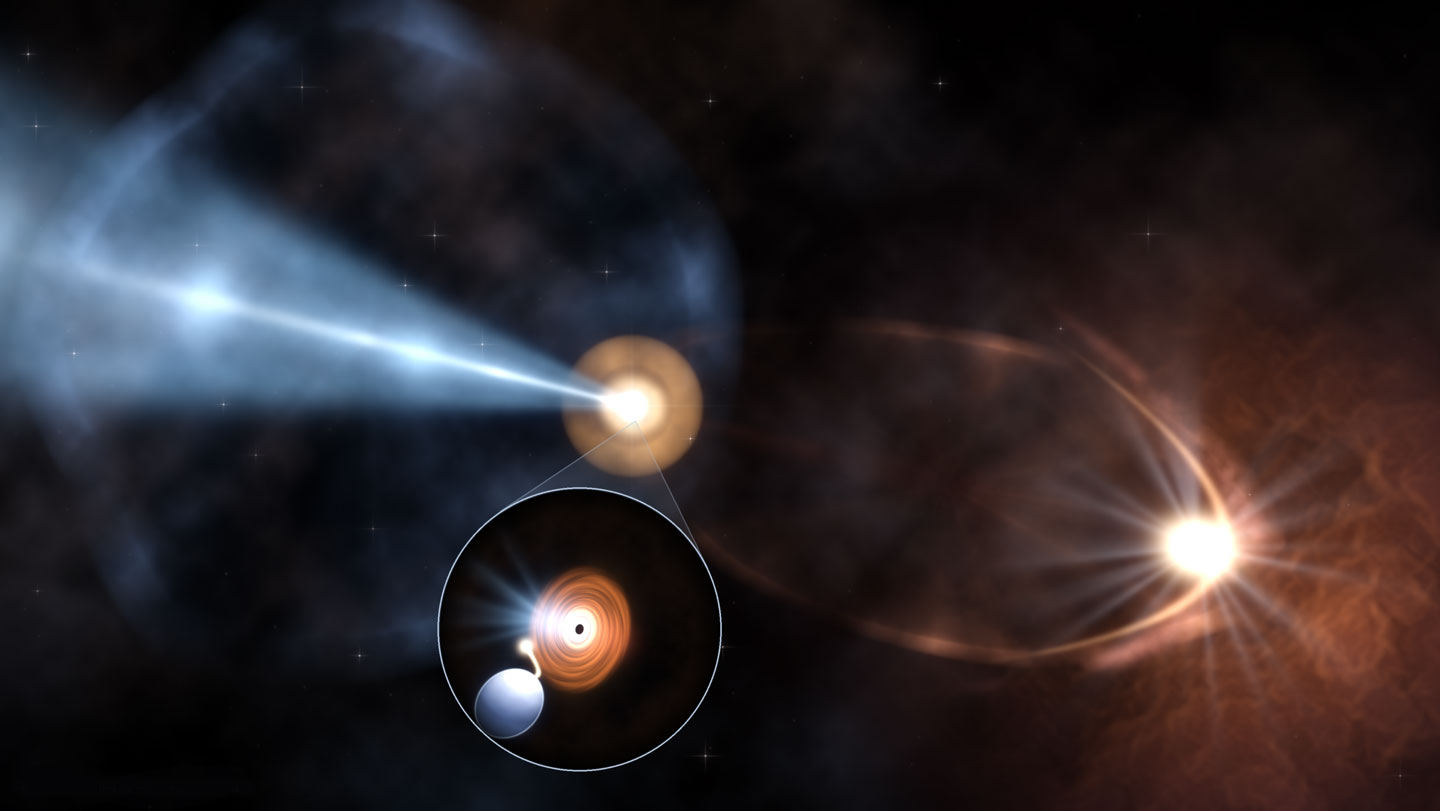
Astronomers may have spotted a fun-sized version of one of the brightest and most mysterious cosmic objects. An elusive microblazar, a scaled-down form of the giant, ravenous black holes that haunt the distant universe, seems to have cropped up in our own Milky Way galaxy.
Even more intriguingly, the exotic object may explain the longstanding mystery of how some of the highest-energy particles in the universe came to be, researchers report in a forthcoming paper in Astronomy & Astrophysics.
Blazars are a particular form of quasars, supermassive black holes whose gravity pulls surrounding material into a whirling disk. In this extreme environment, the quasar flings superheated material out in a pair of jets like the axle of a wheel. A blazar is any quasar that points one of its jets approximately toward Earth.
Astronomers haven’t found quasars or blazars anywhere near Earth, but for nearly 35 years they have hunted for miniature ones in the Milky Way. Such a microquasar consists of a small black hole devouring a large star and sending jets of material spewing out into space. Because they are so much smaller than quasars, material falls into them faster than their massive counterparts.
“What takes days or weeks to change in a microblazar would take thousands of years in a supermassive blazar,” says astrophysicist Pedro Luque-Escamilla of the University of Jaén in Spain. “It’s a perfect scale model where we can watch a ‘cosmic movie’ in fast-forward.”
Luque-Escamilla and his colleague Josep Martí have spent two decades hunting for these hyperactive objects in archival telescope data, with little success. “We found many candidates in the past,” Martí says. “They turned out to be extragalactic objects,” full-sized and slower-changing.
The pair’s luck changed as they pored over a 1983 catalog produced by a Dutch-American spacecraft and spotted an object referred to as IRAS 18293−0941. When Martí and his colleague cross-referenced this catalog with modern observations by radio telescopes, they saw a small but very bright emission with additional light coming from only one side. That’s “the fingerprint of blazars,” Martí says.
The researchers assumed that, like their previous candidates, IRAS 18293−0941 was a full-sized blazar from beyond the Milky Way. But they were intrigued enough to keep investigating. The team ultimately used data from three different observatories on Earth and in space to pinpoint the location as inside our galaxy after all.
“The authors took a truly multi-wavelength approach, making use of all different types of astrophysical data from many telescopes,” says astrophysicist Alexandra Tetarenko of the University of Lethbridge in Canada, who was not involved in the new research. “This is not only what distinguishes this work from past claims on other microblazar candidates but also makes it far more convincing.”
The scientists also noticed that IRAS 18293−0941 was quite near a known patch of ultrahigh energy particles — particles with energy 100 times higher than the Large Hadron Collider can create, that scientists have struggled to explain what could juice them up to such extremes.
Martí and his colleagues argue this isn’t a coincidence: the “hotspot” marks where the microblazar’s invisible jet pointing away from Earth slams into a cloud of matter, acting as a massive particle accelerator. The team is already working to gather additional observations of the proposed hotspot.
The hotspot observations, as well as observations of the visible jet, should both give scientists a better understanding of the microblazar’s dramatic capacities, Luque-Escamilla says, as if the universe made a special particle accelerator just for scientists. “It’s like comparing a high-tech human laboratory to a supreme cosmic engine,” he says.
