


In a landmark June speech delivered to the Economic Club of New York commemorating the 250th anniversary of the U.S. Declaration of Independence, U.S. Treasury Secretary Scott Bessent talked of a new economic statecraft, rejecting the long-established U.S. commitments to free trade, the free movement of capital, and an open world economy. The speech turned 80 years of U.S. international policy on its head.
The United States would now practice the “disciplined use of America’s economic power in service of our sovereignty” by weaponizing U.S. assets, including the dollar and U.S. control of the international payments system, by building national capacity and by requiring the world to accept U.S.-imposed protocols. This would, Bessent said, entrench U.S. global leadership even if it meant imposing sanctions not just on adversaries but on long-friendly countries where necessary. These allies would be subject to “non-negotiable obligations.”
The speech followed a November 2024 note by Stephen Miran, who would later become chair of U.S. President Donald Trump’s Council of Economic Advisers, that envisaged a “Mar-a-Lago Accord” with the United States restructuring the global economic order entirely in its national interests. Both signaled that the decades-old Washington Consensus no longer had the support of Washington itself. If in the past the United States acted multilaterally in a unipolar world, now it would act unilaterally—despite the fact that ours is becoming a multipolar world.
We cannot overstate the importance of the changes now underway. Just as three Western-led world orders—the Concert of Europe after 1815, the League of Nations from 1918 to 1939, and the United Nations Charter-led order of 1945—rose and fell in the last two centuries, so too the fourth order, the U.S.-led liberal international order triumphantly announced by George H.W. Bush in 1990, is now declared by its authors to be dead, having lasted little longer than today’s average marriage. But the question that matters is whether we are condemned to return to a world divided into spheres of influence or to a U.S.-China “one world, two systems” future or, simply, to disorder. Or is a fifth and stable world order now possible, and, if so, could it be grounded in something more solid than temporary marriages of diplomatic convenience? And what form might it have to take if we are to restore the domestic legitimacy that the post-1990 order lost—and failed fully to recover—after the global financial crisis?
- Unemployed people fill out forms at a jobs fair in Hefei, in China’s Anhui province, on Nov. 11, 2009. AFP/Getty Images
-

A line of men gathered alongside a large bus on a street framed by tall modern buildings in the background. - Migrant workers line up for a bus to return them to labor camps after a day of work in Dubai on July 11, 2008. Ghaith Abdul Ahad/Getty Images
Having spent the better part of the last two years traveling through the post-industrial towns of Britain and parts of Europe and the United States, and through the corridors and inner sanctums of international institutions whose authority has been visibly ebbing, what I have discerned everywhere is the same compound of anger and grief. Indeed, what strikes me most is the consistency with which people across countries as different as Nigeria and Norway, Brazil and Belgium, India and Ireland, identify the same underlying experience of having been promised something only to be let down and realizing, for the first time, that they are unlikely to be better off than their parents. It is the feeling that the system serves others, not them—a loss of the sense of belonging to a community capable of collective action.
But what has also struck me—and this is the source of hope—is that beneath the anger and grief is a persistent, almost defiant desire for things to be different. It is not surprising that no politician today is going to be elected on a “steady as she goes” platform, akin to the successful British Conservative slogan of “Safety First” in the 1920s or the famous German slogan of “No Experiments!” that won the day in 1957. Those were the eras when incumbency was not a dirty word. No longer. Every election has now become a change election, and no one can be elected or reelected without promising a version of change.
Populist nationalist parties are leading the polls in most major Western economies. Their popularity reflects something more than the predictable anti-incumbent reaction when governments have fared badly or been in power for a long time. Instead, we are seeing something more like an anti-system revolt, as once-fringe parties perform best on the claim that they represent the people against the establishment, whether that be political or business elites. But if we are to find the reasons for this shift, we must first understand what is actually broken and in particular the depth of the changes underway in our world.

An employee walks past newly made U.S. flags at a factory in Fuyang in China’s Anhui province on July 13, 2018.AFP via Getty Images
Historians will look back on three ruptures, each turbocharged by recent wars and each reinforcing the others. Each is a product of the shifting of the world’s economic center of gravity now underway from West to East, as Asia has come to account for the majority of global manufacturing and economic activity.
First, the geopolitical rupture. The world is moving from the certainties of a U.S.-dominated unipolar order to the dangerous unpredictability of a multipolar one, a world with multiple centers of decision-making power but none of them possessing the hegemonic capacity an unrivaled United States once enjoyed to impose global order at will.
Second, the economics rupture. The world is moving—as Bessent’s speech confirmed—from the open trading system that underpinned postwar prosperity to a neo-mercantilist world of tariffs, sanctions, and export and import bans, along with restrictions on investment and technology. This new world is made more dangerous by the capacity of states to weaponize chokepoints in the global economy, whether those be at sea, such as the Strait of Hormuz, or through control of critical minerals or, as in the U.S. case, through a dollar-dominated financial payments system. At its most extreme, it amounts to nothing less than a form of economic warfare.
And third, the political rupture. We are moving from a rules-based international order to a power-based, “might makes right” one, with every single pillar of the traditional world order now under threat: the rule of law, support for human rights, democratic accountability, multilateral cooperation, and global public goods, not least humanitarian aid and environmental stewardship. Bad enough is the return of an across-the-board, “my country first and only” nationalism that we thought had been consigned to history. Worse is its new authoritarian and populist manifestation and the adoption of a zero-sum mindset that has become the operating logic of major-power competition—the view that for me to do well, my competitor must do badly.
And if Bessent laid bare the extent of the rejection of traditional U.S. economic orthodoxy, then Trump’s apocalyptic warning to Iran in April that its “whole civilization will die”—a threat of genocide—reflects the new politics: an assertion as expressed by his closest aide Stephen Miller that the real world is governed by strength, force, and power, with treaties and universal norms nothing more than “international niceties” to be ignored at will.
But in his disowning of international law, Trump is not alone. Chinese President Xi Jinping has declared that reunification with Taiwan “cannot be stopped by any force or anyone,” while Russian President Vladimir Putin has argued that “no one is ready to play by rules set by someone far away.” “History proves that, unfortunately and unhappily, Jesus Christ has no advantage over Genghis Khan,” Israeli Prime Minister Benjamin Netanyahu said in March. “Because if you are strong enough, ruthless enough, powerful enough, evil will overcome good. Aggression will overcome moderation.”
To the three seismic shifts that have led to the breakup of the world order that our generation once believed was here to stay, we must add a fourth shift: a collapse of the domestic compact.
To investigate the frustrations we are witnessing in publics across the world, I commissioned opinion polling in more than 30 countries across both the global north and south in three separate surveys, engaging the views of more than 80,000 people. What the polls discovered both surprised and startled me.
On one level, we find the predictable surface manifestations of widespread popular disappointment: a loss of trust in authority, a nostalgia for times past, and a less tolerant attitude toward people of different backgrounds, especially immigrants, who are blamed for events far beyond their control. But when we ask people what directly affects their lives and what really matters to them, we get closer to the root causes of dissatisfaction. There is a gap—discernible well up the income scale—between the economic expectations people have for themselves and their country and their own experience, which falls far short. People are not naive. They have been promised too much with too little delivered for too long. They instinctively suspect all politicians’ reassurances that a plan will work.
Still, if a sense of relative deprivation were to be the only cause of disappointment, history might suggest a public mood turned to resignation rather than anger. What makes our current time distinctive is that economic stagnation and disappointment have taken hold alongside this fourth rupture, a domestic one, felt in the places in which people live: the hollowing out of local community life, with the collapse or rapid decline of once-vibrant neighborhood organizations, from churches and faith groups to trade union branches, working men’s clubs, women’s institutes, and youth groups. Those are all organizations where people have traditionally come together, often across class and ethnic divides, but which over the last 50 years have been losing millions of members. This erosion of civic life has been compounded by the emptying out of the public square as local political parties are reduced to empty husks, as local newspapers close, and as voluntary activity in almost all areas of public life declines measurably. Almost as important as the disappointment in what too many feel is a broken economy is, according to our results, the widespread perception that society itself is broken, the sense that civic life is fraying and fading away. As our findings reveal across the West but also beyond, around half (45 percent) of adults no longer belong to any local organization, whether sporting, cultural, or civic. Indeed, 67 percent of adults now report having only three or fewer friends, and 13 percent say they have none at all. Not only do 67 percent feel the political system is broken and 66 percent that their own nations have lost touch with the values on which they were built, but a majority (54 percent) say their governments look after others more than they look after people like themselves. Even more worrying for community life is the fact that 40 percent say they have no one beyond their immediate family and close friends that they can count on in a moment of crisis, no one to turn to for help, and no one they feel is on their side.
If our physical infrastructure—roads, railways, and airports—broke down, there would be a public outcry. If our financial infrastructure collapsed, there would be panic. But the failure of our civic infrastructure—our clubs, associations, and the public square itself—is happening in plain view, raising barely a murmur of comment. It is creating a vacuum that populist nationalists exploit, their demagoguery transmitted directly into people’s brains through social media, bypassing the need for grassroots organization and intensifying our current malaise.
Our polling evidence shows that the simple act of bringing people together across social and other divides—whether in schools, workplaces, neighborhood groups, or voluntary associations—reduces populist nationalist voting even as it forges stronger and more inclusive communities. Building greater trust within your neighborhood, which itself evolves through everyday interactions, decreases populist nationalist voting yet further. When backed up by economic policies that address financial insecurity and that have the potential to shift the national mood from economic pessimism to optimism, there’s scope for an even greater reduction in support for populist nationalist parties. Indeed, if these conditions are met, our preliminary conclusions are that the populist nationalist vote share could fall by between 15 and 20 percentage points. On the other hand, in the absence of these changes, populist parties will continue to enjoy support as refuges of last resort and likely will achieve even wider appeal. The bottom line is that if the transformations that we have outlined were to happen across the West, bringing both economic and civic renewal, we could turn back, almost in its entirety, the populist nationalist wave of the last decade. It would make it difficult if not impossible for such parties to form governments.
For in our polling we also discovered something that is no less ignored: a stubborn refusal, even in the most distressed communities I visited, to accept that what is happening to them now is all there is. In fact, large majorities in our polls told us that they retained hope for the future. It is from this refusal to give up—what we interpret as a longing for belonging—that I draw the central argument of this essay.
-

A group of people sitting at a long outdoor dining table set up on a city street under string lights and multi-colored banners. - People eat during an iftar meal at Nelson Mandela Square in Madrid on March 18. Marcos del Mazo/LightRocket via Getty Images
-

People gathered around dining tables inside a brightly lit hall, eating and sharing a meal together. - Congregation members enjoy a meal after a service at Crossway Church in London on April 27, 2013. The international church has a congregation made up of native Londoners as well as people from Ghana, Jamaica, South Africa, Zimbabwe, South Korea, Brazil, Eastern Europe, and the United States. Dan Kitwood/Getty Images
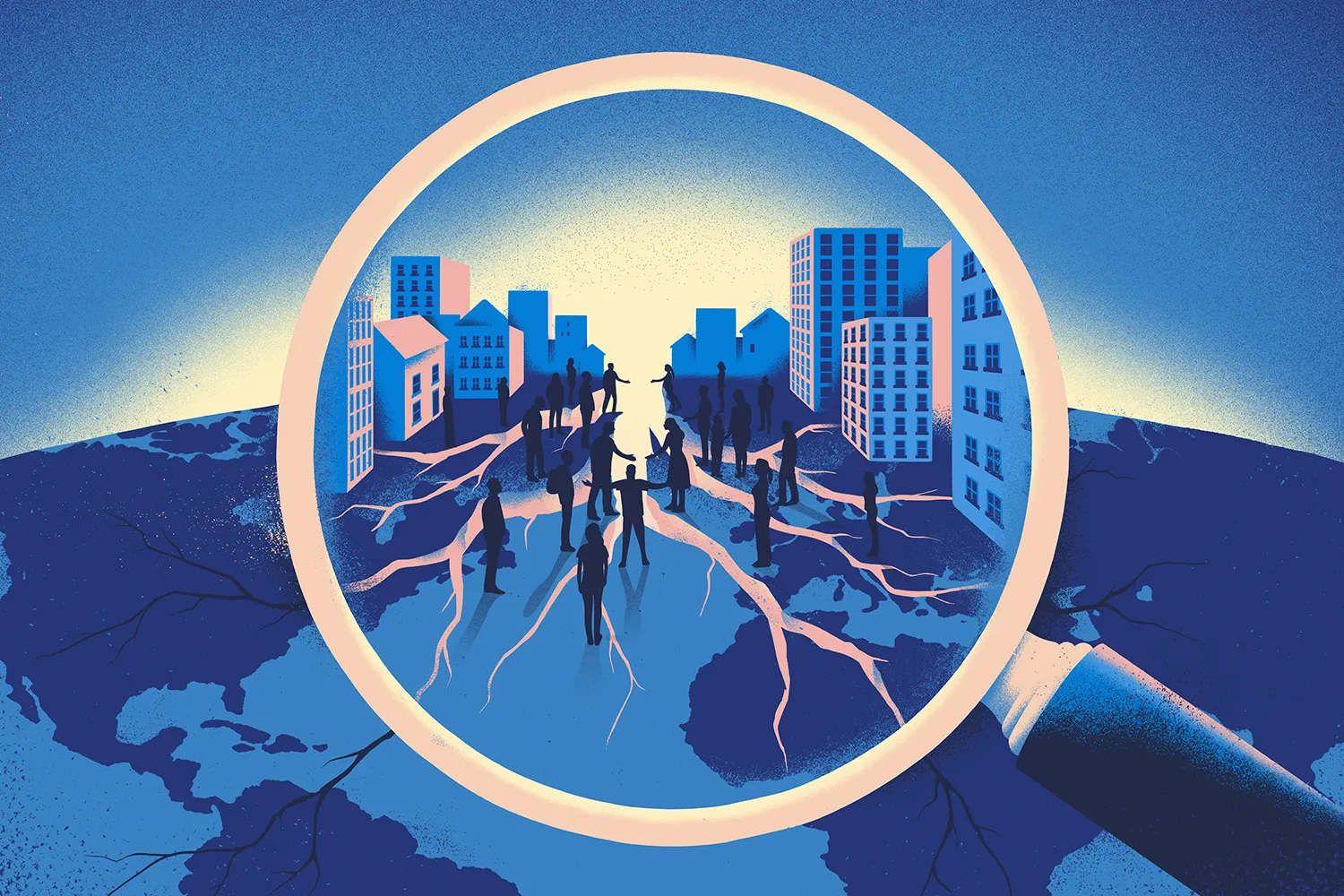
The breakdown of local communities may appear far removed from the breakup of the international order. But for too long, world affairs have been the preserve of diplomats and international relations scholars; national trends, the domain of sociologists and pollsters; and the fate of local communities left to social workers, charity workers, and often unreported community activists—as though all these people operated in separate, unconnected silos.
Our surveys tell a different story. Of course, the global now affects the local in direct and understandable ways. People experience firsthand the impact of events far from home, whether the COVID-19 pandemic, the energy price spikes from the wars in Ukraine and Iran, or the anxiety caused by threats of nuclear proliferation. The very same pressures that have caused the breakdown of the world order strain family finances everywhere and make everyday life in every community more difficult. Recent events have brought home just how much the weaponization of even a single economic chokepoint—the Strait of Hormuz—can disrupt the daily lives of ordinary citizens across the entire world.
Yet the street linking local and global runs both ways, not least because globalization is now seen as a free-for-all that was not fair to all, creating an open but not inclusive economy where the benefits of growth were not evenly shared. But our critical finding is that those who join civic organizations and interact with people of different backgrounds are not only far more resistant to populist nationalist appeals but are also far more likely to favor cooperation across borders—sometimes for self-interested reasons but often from a sense of obligation to people in need. Conversely, people who belong to no civic association and have few contacts across religious, ethnic, or ideological divides are not only more likely to support right-wing populist parties, but they are also the least likely to support any form of international cooperation. So, as the table below covering 10 developed democracies shows, those people in France, Germany, Spain, the United Kingdom, and the United States who are civic to their core are at least 20 percentage points more likely to favor international cooperation. Indeed, if we could shift people from feeling no sense of belonging to feeling even a little, support for international cooperation would rise from 53 percent to nearly 75 percent.
People cannot be expected to think of themselves as global citizens unless they first experience what it is like to be a citizen at home. And so there is no way out of the current and ongoing global breakdown that does not challenge us to repair broken communities, starting at home. That means strengthening local institutions—not just offering greater economic and social security but creating conditions in which people can learn to negotiate and live with their differences and come to see cooperation across past divides as worthwhile. Nationalism at home translates into a lack of internationalism abroad. But reaching out a helping hand within your own community makes you more likely to extend the hand of friendship across borders.
What is to be done?
Crucially, a new world order for the 21st century cannot be built in the manner of the 19th and 20th centuries: diplomatic elites balancing their power behind closed doors, with the public reduced to bystanders. No order that values human rights, the rule of law, and democratic accountability can be built to last without an active, engaged citizenry—one that recognizes that, regardless of our differences, we must find a way to live together. And there is a more pressing reason to act: If we do not, populist nationalists will impose on us their vision of an adversarial world where we are constantly at odds or even at war with one another.
The way forward is best described in terms used by the economist Adam Smith some 250 years ago. He spoke of “circles of sympathy”—what we would now call empathy. That empathy reaches out from an inner circle—the intense loyalties you feel for family and friends—to the less intense but still discernible feelings for an outer circle of people with whom you share your city, country, and planet. For Smith, such empathy is a capacity developed through experience and education, first exercised close to home and then extending outward beyond the garden gate, beyond the city wall, to the nation and, as channels of communication expand and our moral sophistication improves, beyond. Our empathy is like the flame of a candle; it burns brightest for those closest, but even at a distance, reduced to a flicker, and especially when joined by dozens or hundreds or thousands of others, it can still light up the world. And empathy is not a finite resource—your love for family and friends does not entail freezing everyone else. The road to international solidarity does not bypass the local community; it runs through it.
All this challenges one of the most damaging assumptions of our political moment: that people must choose between belonging to a community and belonging to the world—that we can be either “people of somewhere,” rooted but parochial, or “people of anywhere,” global but rootless. The evidence suggests that the opposite is closer to the truth. People of somewhere can also be people of everywhere. The civic core of our societies—those active citizens who participate in groups and cut across lines of difference—is not only less likely to vote for populist nationalists at home but more likely to support countries working together abroad, even where that requires compromise.
Ominously, this virtuous circle could just as easily run in reverse. For a time, civic cohesion may survive as local economies falter, and communities may resist populist appeals under financial pressure—but only for a time. It is hard to imagine a family in deep financial insecurity continuing to back a government whose gaze is turned outward to those in other countries. Where economic decline and civic decline reinforce each other, people turn against not just incumbent parties but the political traditions and systems those parties represent. A vicious cycle ensues: A faltering international system makes the domestic compact harder to sustain, and a weakened domestic compact empowers nationalists who further undermine international cooperation. The task before us is to turn that vicious cycle into a virtuous one.
This is not some abstraction. Policymakers have access to an array of tools within the nation-state that are currently woefully underused.

U.S. President Franklin D. Roosevelt (sitting, left) and British Prime Minister Winston Churchill attend the Atlantic Conference on Aug. 14, 1941, where they issued the Atlantic Charter that defined the Allied goals for the postwar world.Pictures From History/Universal Images Group via Getty Images
In 1941, at a time when the world order was wholly broken and the democracies of the West faced defeat at the hands of Nazism, the United States and Britain signed the Atlantic Charter—later endorsed by nearly every major power of the day. It was unique; it made no distinction between the local and the global and not just set down the geopolitical objectives and the values that ought to underpin a new world order (elaborated over the subsequent decade in the U.N. Charter and Universal Declaration of Human Rights) but enunciated basic domestic commitments, including to social security and the right to work for decent remuneration. U.S. President Franklin D. Roosevelt, who had already proclaimed the Four Freedoms—freedom of speech, of religion, and from want and fear—insisted that the charter recognize the imperative of enlisting the support and enthusiasm of working families with a new social contract at home. Then in the U.K., the sequel, the Beveridge Report, promised to end the five giant evils of want, disease, ignorance, squalor, and idleness.
Once again, in our own time, we need to promote economic, civic, and democratic renewal. Economic policy must do more to address what I dub the “Five Es” undervalued by neoliberals: employment, equality, environment, efficiency, and ethics. Markets promised efficiency but became rigged in favor of vested interests. They promised employment in good jobs but delivered precarious, low-paid work; they promised equality of opportunity but only served to entrench even greater inequality of opportunities and outcomes. And, most important, neoliberalism stripped public policy of any ethical concept of the common good, insisting that there was no such thing as society, and thereby contributed to the very civic fragmentation we now confront. Innovation-led growth, coupled with pro-worker policies in skills, tax, and innovation, remains the path to inclusive and sustainable growth.
Civil society and our democracy can also be supported at home—through start-up grants for local clubs and groups, civic leadership programs, and investment in high-quality public spaces, perhaps inspired by successful community initiatives such as the “indoor town squares” of Finland’s libraries. (Globally, the private sector spends tens of billions of dollars a year on leadership training, yet we rarely apply the same seriousness to civic settings.)
Democracy must be cultivated from within, based on a strong and independent civil society—as well as shifting power away from centralized parties and well-resourced special interests and toward ordinary citizens, through deliberative bodies that complement, rather than replace, representative institutions. We must also confront the threats from without to our democracies, not least algorithmic manipulation of our information supply, which intensifies anger and amplifies the voices of the demagogues.
Domestic reforms will also fail, or underdeliver, if they are not met by new multilateral efforts at cooperation. I propose a new Charter of Interdependence, which in spirit and intention would be the heir to the Atlantic Charter that Roosevelt and Winston Churchill agreed in 1941, laying down the principles of future cooperation. Unlike the charters of 1941 and 1945, both heavily Western in conception, any new set of principles must be co-written, not merely co-signed, by the global south. Western-led international rules cannot be declared universal and simply exported to the rest of the world. And in recognition of the fact that the era of behind-closed-doors diplomacy carving up the world is over, any new charter should be subjected to genuine public consultation.
Based on the common ground I have found not only in my travels but in our public opinion research, I would suggest seven founding principles: human dignity and universal rights that are economic and social as well as civil and political; the sovereign equality of states, without the exclusive spheres of influence now being normalized as a legitimate organizing principle; the rule of law as the basis for relations among states, binding the strong as well as the weak; collective action against war, mass atrocity, and crimes against humanity, applied without double standards; a duty on states to promote active citizenship and protect the civic space where democratic accountability can flourish; equal partnership between North and South in trade, finance, debt, technology, and institutional voice; and collective responsibility for shared risks—climate change, pandemic preparedness, financial contagion, and artificial intelligence safety, acknowledging that no single state can manage these challenges alone. Around these principles we agree on a program of action to make our major international institutions fit for purpose for this new multipolar era.
No single nation can lead this effort alone. There is the possibility, at one extreme, of a G-2 in which the United States and China simply divide the world between them. At the other, a “one world, two systems” future defined by cutthroat competition between the two main powers. Whether you call it “managed strategic competition” or “constructive strategic stability,” once discussed as governing relations between Washington and Beijing, or speak of “strategic autonomy,” it does not resolve the underlying question of effective leadership.
One option remains untested: a coalition of small and medium-sized states led by key middle powers—that is, countries with neither the military weight of the United States, China, or Russia nor the ambition to compete with them but which attract the support of others because of their soft power, which, joined together, would carry substantial economic and institutional heft. Together, countries such as Australia, Brazil, Canada, Japan, South Africa, South Korea, the United Kingdom, and most of the European Union, when allied with much of Africa and Latin America, account for more than half the world’s population and economic output; three-quarters of the votes at the U.N. Security Council, the International Monetary Fund, and the World Bank; and effective control of the World Trade Organization and World Health Organization. Public opinion in these countries remains strongly in favor of multilateral cooperation even in this populist moment: 7 out of 10 people in these middle-power electorates prefer multilateralism to bilateral deal-making. These countries have already shown what is possible through discrete initiatives on climate, nonproliferation, and international humanitarian law. For example, a trade partnership between the EU and the Comprehensive and Progressive Agreement for Trans-Pacific Partnership, if extended to include India, would alone cover 37 percent of world trade (three times the share the United States has now) and 2.5 billion people—a genuine counterweight to the largest powers and a foundation for something more structured than ad hoc cooperation on separate issues.

People light lanterns and send them to the sky along the Lancang River in Xishuangbanna, in China’s Yunnan province, on April 13, 2018.Visual China Group via Getty Images
Let me be honest about the wager this argument requires. It asks us to believe that the anger and disillusionment fueling the populist wave are not a settled preference for nationalism and isolation but a rational, if misdirected, response to failed promises. Our polling supports that belief: Not only do 70 percent of people in middle-power countries favor multilateral cooperation, but in country after country, to my surprise, majorities say they are prepared to make sacrifices for a fairer world. The civic majority exists. It has not been destroyed by populism; it has been disarmed and demobilized by disappointment.
The advance of AI sharpens the stakes—and not only for the economy. René Descartes’s statement that “I think, therefore I am” has echoed across the centuries, but in a world of intelligent machines, what makes us human is the capacity to imagine, to hope, to care, and to be creative—qualities no machine yet possesses. What is encouraging in our survey findings is that more than 70 percent of respondents believe that it is still possible to build a better future for the next generation.
None of the positive instances of cooperation I could enumerate proves that conflict is behind us. But they do prove that collective action works when the will to pursue it exists. It is worth remembering that the word “competition” derives from the Latin competere, which means not to fight one another but to strive together. It is possible to believe that by striving together, a more hopeful and equitable future will be made by citizens who demand it, leaders who choose to pursue it, and institutions that give it shape—by the unglamorous, patient work of rebuilding the civic life from which societies generate the trust on which everything else depends.
That future is not in the gift of presidents or prime ministers. It will not be decided by summit communiqués or by the whims of markets. It will be made by active citizens, by the choices ordinary people make about how to live in their communities, how to treat their neighbors, and whether to demand from their leaders the courage and honesty this moment requires. Surely governments have a role to play not in isolation and from on high but by nourishing a culture of democratic accountability where all have a part and a place to shape events in their own communities and in their countries and in the world beyond. A future worthy of our best ideals calls on us to summon the best in ourselves. The future starts with all of us—and it is ours to shape.
