


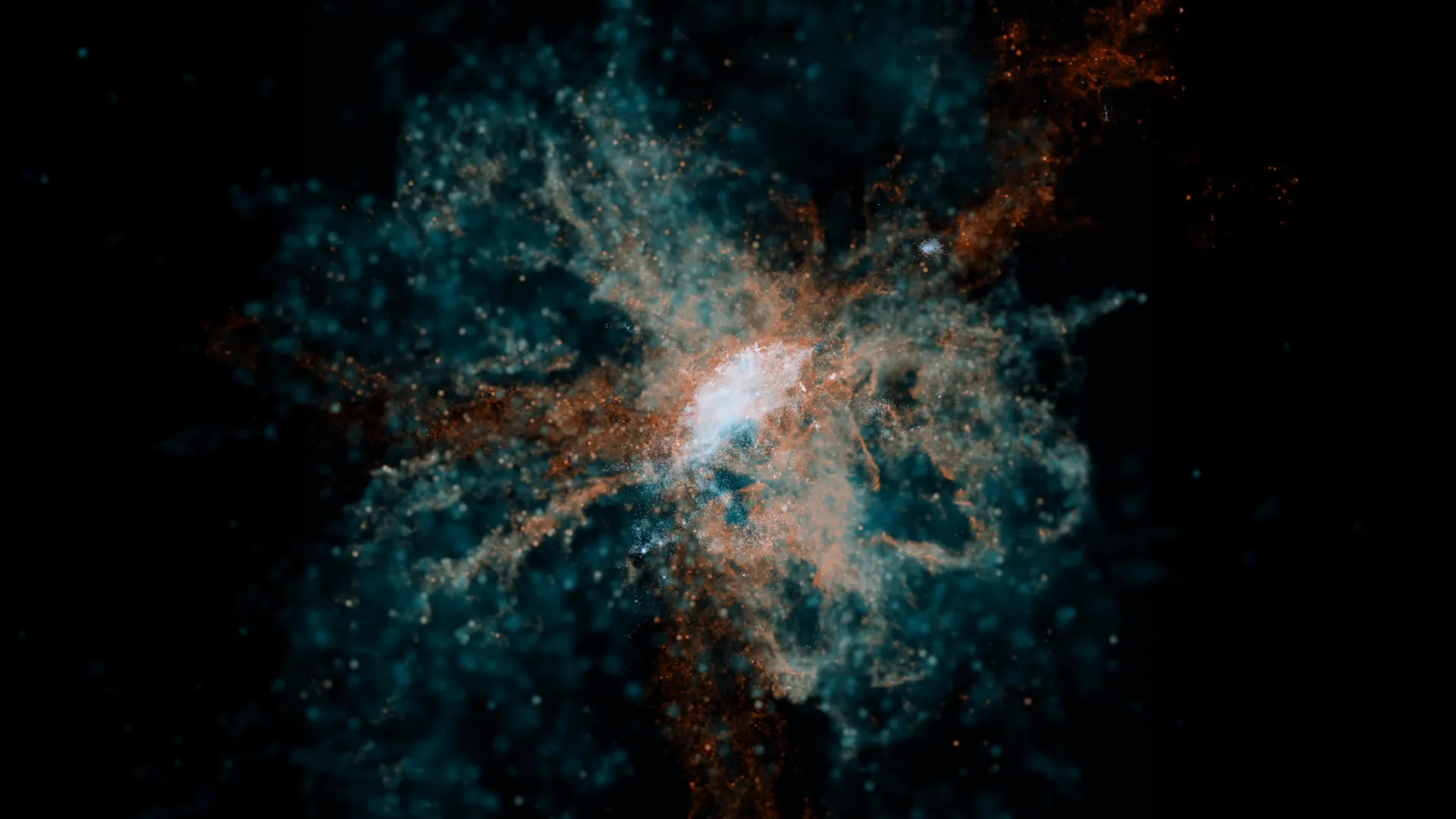
Only about 500 million years after the Big Bang, when the universe was roughly 3% of its current age, some of the first stars and galaxies had already begun to shine. Astronomers have generally expected that much of the gas around these young galaxies would still have been nearly pristine, consisting mostly of hydrogen and helium, the basic elements that dominated the newborn cosmos.
New evidence suggests that picture may be incomplete. A study led by astronomers at the University of Arizona and published in Nature Astronomy indicates that early galaxies were already sending heavier elements such as carbon and oxygen into surrounding space much sooner than expected.
“We observed that heavy elements escaped from galaxies very, very early in cosmic time,” said Yongda Zhu, first author of the paper and postdoctoral researcher at the U of A Department of Astronomy and Steward Observatory. “Not only were the galaxies producing these elements, but they were also dispersing them, possibly seeding other galaxies.”
How the Universe Built Heavier Elements
The earliest universe contained little besides hydrogen and helium, the two simplest elements at the top of the periodic table. As gravity gathered this material into dense clouds, stars began to form. Inside those stars, extreme heat and pressure enabled nuclear fusion and other reactions that created heavier elements such as carbon and oxygen.
When stars reached the ends of their lives, including some that exploded as supernovae, they released those elements into space. That material later became part of new generations of stars and planets and eventually contributed to the chemistry needed for life. The carbon in the human body and the oxygen people breathe were both produced inside earlier generations of stars.
What remained uncertain was how quickly those heavier elements escaped the first galaxies and spread into the wider universe.
JWST Looks Back More Than 13 Billion Years
Zhu and his colleagues focused on three extremely distant galaxies whose light has traveled for more than 13 billion years. The observations show the galaxies as they appeared roughly 500 million years after the Big Bang, during a period called the Epoch of Reionization.
During this era, the first generations of stars and galaxies were reshaping the cosmos by ionizing hydrogen gas between galaxies. In that process, electrons were stripped from hydrogen nuclei. As reionization progressed, ultraviolet light was able to travel more freely through space, helping bring the universe’s cosmic “dark ages” to an end.
“We used the galaxies themselves as background light sources,” said Zhu. “As light from the galaxies traveled toward Earth, it passed through surrounding gas, and we were able to look at the light’s absorption patterns to detect specific elements.”
NASA’s James Webb Space Telescope made these observations possible because of its infrared capabilities, which allow astronomers to study galaxies as they appeared more than 13 billion years ago. Nearly 30 hours of exposure time collected enough light for the team to identify extremely faint absorption features in the spectra of the distant galaxies.
Heavy Elements Were Already Escaping Into Space
During one long night, Zhu manually examined publicly available JWST spectra from hundreds of galaxies. He eventually identified three whose absorption patterns showed evidence of heavy elements including carbon, oxygen and silicon.
The absorption lines were “blueshifted” compared with the redshift of the galaxies themselves. That shift showed that the gas was moving outward, carrying oxygen, carbon and other heavy elements away from the galaxies and into intergalactic space.
Remarkably, the chemical signatures surrounding these infant galaxies looked similar to those found around far more mature galaxies billions of years later. The finding suggests that even at cosmic dawn, galaxies were already manufacturing heavy elements and spreading them into their surroundings.
“Think of these elements, which originated from the galaxies’ stars, as food dye dropped into a cup of water,” said Zhu. “The color begins to spread through the water, and, in a similar fashion, these heavy elements from early galaxies began to escape into space and ‘enrich’ their surroundings.”
Early Baryon Cycling Reshaped the Cosmos
Astronomers call the exchange of material into and out of galaxies baryon cycling. This process shows that galaxies are not completely isolated objects. Instead, they interact with their surroundings as parts of a much larger galactic ecosystem, with material created by one generation of stars being recycled and redistributed.
Finding evidence that baryon cycling was already underway so early may also help explain a long standing mystery involving Population III stars. These hypothetical stars are thought to have been the universe’s first generation, forming from pristine gas made only of hydrogen and helium before heavier elements had spread widely.
If galaxies were already enriching nearby space only 500 million years after the Big Bang, truly pristine gas may have disappeared quickly. As a result, Population III stars may not have remained common for long enough to be easily observed.
“If you start out with pure vanilla ice cream but start mixing in sprinkles soon after, it won’t be long until you can no longer find any pristine, plain, vanilla ice cream,” Zhu said.
