


- Data from remote sensing platforms indicates Indonesia is likely experiencing its worst wildfires crisis in years as a strong El Niño deepens the country’s main dry season over Sumatra and Borneo islands.
- In South Sumatra province, rubber tree growers in the Tempirai customary zone say they use fire only after the end of the dry season, after they have planted food crops, and that fires began to afflict this area of South Sumatra province after the oil palm industry began operating in the peatland.
- That may reflect the relative resilience of oil palm trees to wildfires compared with rubber trees, which are much more vulnerable to incineration.
- “If a fire breaks out here, we’re finished — so right now, fire is our enemy,” one latex tree grower told Mongabay Indonesia.
PENUKAL ABAB LEMATANG ILIR, Indonesia — Sumanti raced her motorcycle past the rubber trees as flames spread through the dry brush. No one had picked up the phone as the wildfire continued to grow out of control on Sept. 5.
“The fire is already approaching our land,” Sumanti, 30, cried out as she drove past a bystander, her voice cracking as she pressed on to find her family.
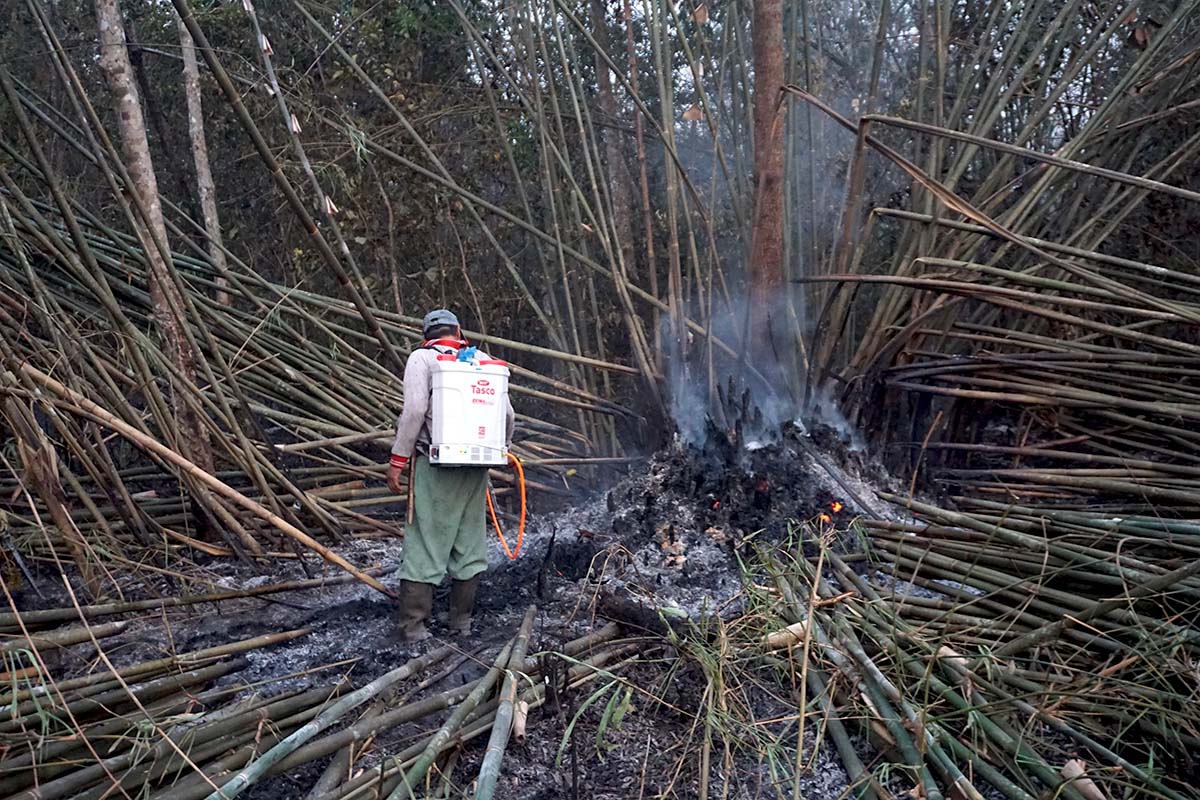
Within half an hour, Sumanti’s relatives had encircled the fire with 35-liter (9-gallon) canisters of water and a sprayer, the kind the family ordinarily used to disperse fertilizer over the soil.
The family of four worked together, scrambling back and forth for hours to haul water from the partially dried-out swamp among the rubber trees.
For two hours, they battled to hold back the flames, but the fire kept cracking through the bamboo and brush.
Economic damage
Sumanti belongs to one of six families who depend on rubber trees and latex production in Talang Turunan Gajah, a hamlet in the village of Tempirai here in South Sumatra province.
As in much of Sumatra and Borneo, the six families here find themselves on the frontline of a wildfire crisis intensified by the El Niño weather phenomenon, as fires spread across the region.
Smoke from Indonesia’s wildfires has crossed borders into Malaysia and Singapore, leading to health advisories in both countries.
The scale of the threat recalls the 2015 Southeast Asian wildfire catastrophe, when fires, fueled by a strong El Niño and positive Indian Ocean Dipole (IOD), caused Indonesia’s daily fire-related carbon dioxide emissions to surpass those of the entire U.S. economy on several days and were estimated to have contributed to more than 100,000 premature deaths across the three countries.
A day before Sumanti worked to fight the fire threatening her family’s livelihood, a wildfire destroyed the 2-hectare (5-acre) smallholding of rubber trees where 41-year-old Hendra tapped latex.
“We’ve lost hundreds of millions of rupiah,” Hendra said, an amount that is at least thousands of dollars. “Now we’re forced to plant new trees — and wait five years for them to produce again.”
Local resident Sadikin, who joined the effort to try and save Sumanti’s land from the fire, said latex production here in Tempirai had crashed due to the long dry season drought, with output plummeting by more than half from around 80 kilograms (176 pounds) per week to just 30 kg (66 lbs).

People here have worried about fires for decades. Previous governments have responded to wildfire crises by banning the use of fire to clear land, with occasional restrictions dating back to the 1980s.
Yet farmers have long used fire to clear new land as well as removing biomass after harvest, replenishing the soil with potassium and other nutrients, and controlling pests such as rats.
But rubber tappers in Tempirai adopt a more cautious approach to fire. Rubber trees are far more vulnerable to wildfire, which can scorch the living tissues beneath the bark and destroy the trees’ ability to circulate water and nutrients.
By contrast, oil palms can be more resilient to fire, partly because their vascular system is spread through the trunk rather than exposed in a highly fragile layer.
Ibrahim, 56, a Tempirai community elder, said a divide exists among people in the area who grow palm oil and those who tap rubber from the trees more vulnerable to fires.
“The wildfires have been rampant since the early 2000s, when the oil palm plantations arrived,” Ibrahim said.
The palm oil industry had planted in both mineral soils and the carbon-heavy peatlands, Ibrahim said, adding that smallholder farmers had also increasingly planted oil palm.
“It’s impossible for people growing rubber to burn the land,” Ibrahim said.

Firebreaks and controlled burns
A Sept. 6 visit by Mongabay found no burned areas in Talang Tanjung Eran and Talang Sebetung, traditional Musi Indigenous territories dominated by small rubber holdings.
During the rainy season, Talang Sebetung is isolated and accessible only by boat, a 1.5-hour journey from Tempirai. People here make a living from tapping rubber, subsistence farming and occasionally fishing in Lake Sebetung and nearby rivers.
“Everything is dry, so if it catches fire, of course it’s going to go,” said Edi Sukari, 42, a resident of Talang Sebetung. “If a fire breaks out here, we’re finished — so right now, fire is our enemy.”
Sebetung Lake, which covers an area the size of a small city park, has almost entirely dried up. Nearby wells have mostly run dry, too, Edi added.
“If the dry season lasts until October or November, we could be facing a water crisis,” Edi said.
The Tempirai people who tap rubber do use fire to prepare the ume, the community’s traditional crop growing zones.
But application of fire is more nuanced and seasonal: Controlled burns are carried out after the end of the dry season, rather than when conditions of the landscape are at the most dangerous.
Mongabay Indonesia found no burned ume land in the Tempirai customary area, and that the fires occurred mostly around, or within, oil palm plantations.
This year, food crops are likely to be planted around October or November, during the transition between seasons.

Changing weather and unpredictable winds mean that when fire is used it must be closely monitored, local people said. Meanwhile, firebreaks are mandatory on the land, and the burning is done in stages.
“If there are indications of strong winds, the fire has to be extinguished immediately,” Ibrahim said. “Most importantly, burning is carried out during the day so it’s visible.”
This knowledge of managing water and controlling fire has been practiced in South Sumatra for centuries.
“Long ago, water management can be seen in the Talang Tuwo inscription, established by the ruler of the Srivijaya Kingdom,” explained Ryllian Chandra, a water policy researcher at Raden Fatah State Islamic University, which is located in Palembang, the capital of South Sumatra province.
The Talang Tuwo inscription is a historical record dated to the year 684 C.E. and written in Old Malay. The inscription documents the creation of a green park and the treatment of ponds and dams under king Sri Jayanasa.
Methods for regulating water near human settlements, passed down through the generations, risked being lost amid the rise of industrial plantations and monocultures, potentially contributing to wildfires and worsening water crises during the dry season, Chandra said.
“It’s vital to restore this knowledge amid the growth of extractive economic behaviors,” he said.

All hands to the pump
After hours of working with her family, Sumanti finally overcame the threat to her land. Worn out and weary, she pointed to the area beyond her family’s property where she said the fire had broken out.
Three local men had arrived with a 15-horsepower pump and a large hose, joining the family’s effort to contain the blaze. When the fire finally relented, Sumanti allowed herself a smile.
As part of the community effort, local people pool money to buy the diesel that powers the water pump.
“There aren’t any firefighters here,” said Sadikin, 46, who owns the water pump used to successfully extinguish the fire. “When there’s a fire in the trees here, the people work together.”
Banner image: A resident of Talang Turunan Gajah extinguishes a fire using simple tools. Image by Muhammad Akbar/Mongabay Indonesia.
This story was first published here in Indonesian on Sept. 16, 2026.
As fires spread in Indonesia, Bornean orangutans run out of forest to flee
Children’s health at risk in south Borneo as El Niño intensifies Indonesia wildfires

