


Welcome back to World Brief, where we’re looking at France’s latest attempt to rein in its deficit, migration policy in the United Kingdom, and a new timeline for China’s possible invasion of Taiwan.
Cost-Cutting Measures
French Prime Minister Sébastien Lecornu unveiled Paris’s 2027 budget proposal on Thursday to a backdrop of political uncertainty, violent student protests, and an anxious bond market. With tensions high, Paris is hoping that new austerity measures will rein in the country’s deficit and prevent opposition lawmakers from holding a no-confidence vote against another one of President Emmanuel Macron’s prime ministers.
Welcome back to World Brief, where we’re looking at France’s latest attempt to rein in its deficit, migration policy in the United Kingdom, and a new timeline for China’s possible invasion of Taiwan.
Cost-Cutting Measures
French Prime Minister Sébastien Lecornu unveiled Paris’s 2027 budget proposal on Thursday to a backdrop of political uncertainty, violent student protests, and an anxious bond market. With tensions high, Paris is hoping that new austerity measures will rein in the country’s deficit and prevent opposition lawmakers from holding a no-confidence vote against another one of President Emmanuel Macron’s prime ministers.
Political instability has long plagued Macron’s tenure. Since taking office in 2017, Macron has had seven premiers, the last two of whom were toppled over their unpopular austerity plans. From protests over farming protections to police brutality to pension reform, Paris has struggled to quell domestic unrest ahead of the country’s presidential election in 2027.
Lecornu is hoping to change the tide. His proposal seeks to increase France’s defense budget from $64 billion to $71.2 billion while freezing public-sector wages and hiking taxes. “This budget enables us to get back on track towards consolidation through a significant effort,” Finance Minister Roland Lescure said, adding that savings were estimated to be worth around $60.7 billion in total.
Whether that is enough to inject life back into the country’s sluggish economy, though, is unclear. France’s inflation rate rose to 3.4 percent year-on-year in September, its deficit is expected to hit 5.4 percent of GDP by the end of 2026, and 10-year borrowing costs reached nearly 5 percent on Thursday in their highest level since July 2002.
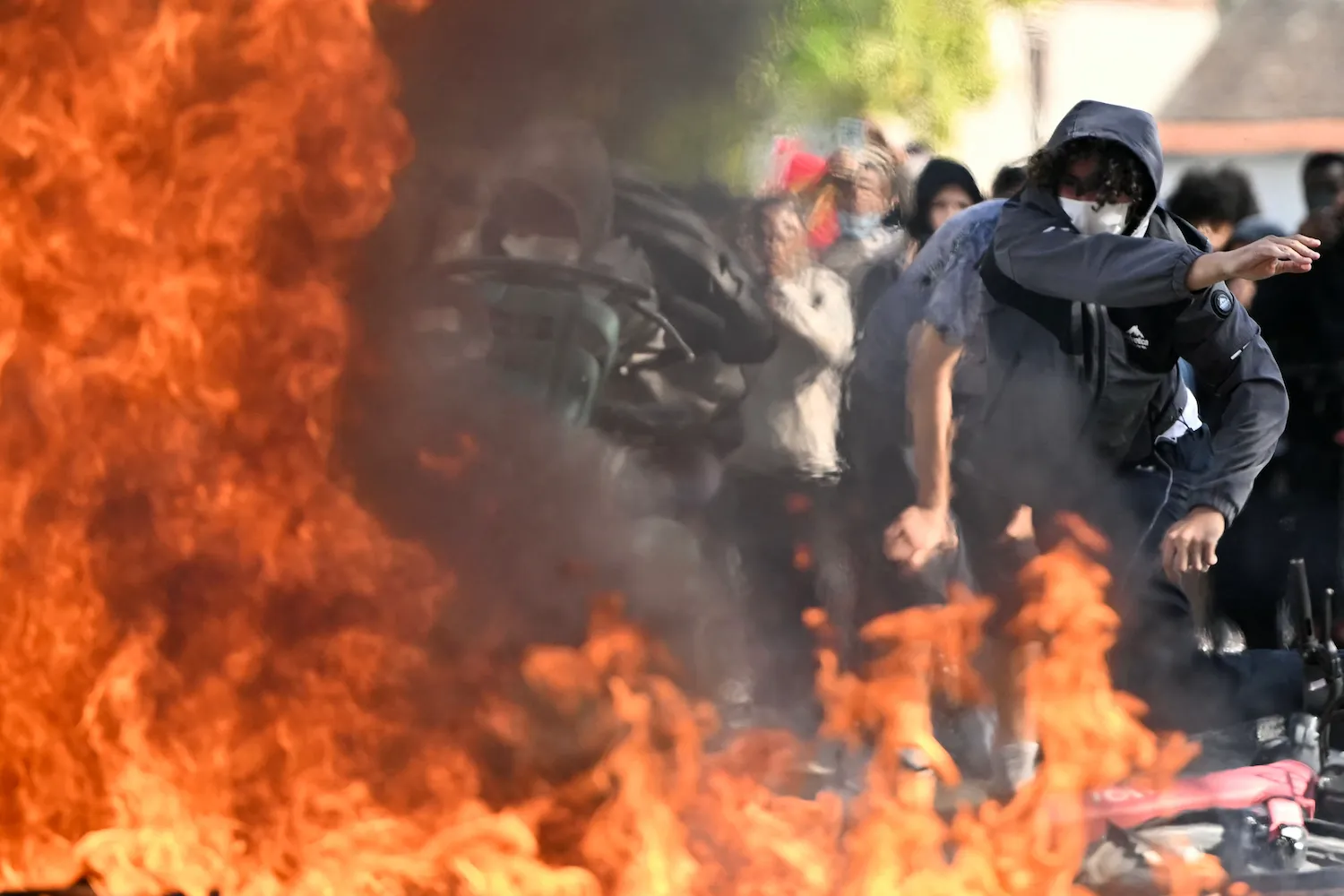
Meanwhile, Macron is struggling to quell sweeping student-led demonstrations over staffing shortages and poor building maintenance. This week, protesters started fires near at least two French schools, and teachers at a third institution were inadvertently splashed with gasoline. Violent clashes with police—which began last week and have only worsened with Thursday’s budget announcement—have led to dozens of people injured and hundreds of students arrested. Protesters have accused security forces of using tear gas, Education Minister Édouard Geffray has called on affected schools to hold classes remotely, and Lecornu’s office has convened a crisis meeting to address the situation.
All this instability may be good news for France’s far-right National Rally party, which hopes to capitalize on souring public opinion to oust Macron’s centrist coalition come 2027. Precedent is in its favor. In 2024, National Rally swept snap elections to become the largest party in the lower house, though it fell short of a majority. Then this past weekend, National Rally and its right-wing allies secured a record 14 seats in France’s Senate, effectively quadrupling the anti-migrant party’s standing in the 348-seat body and granting it enough representation to form its own caucus for the first time.
Today’s Most Read
What We’re Following
Scrapping “one in, one out.” A yearlong trial migration deal between France and the United Kingdom expired on Thursday, after Paris chose not to renew it. The pilot “one in, one out” policy—struck in 2025—allowed Britain to return migrants who illegally crossed the English Channel back to France in exchange for those who applied to enter the country via official means.
Paris had fought against reupping the deal, arguing that London should negotiate a broader deportation agreement with the entire European Union. “Why do we have to manage this border on our own?” French Interior Minister Laurent Nuñez said. “We believe that France should not have to bear the burden alone, and that it would be better to incorporate it into an agreement between the European Union and the United Kingdom.”
The British-French agreement never reached its full potential. By September, only around 1,400 people had returned to France under the policy, marking a small fraction of the more than 41,000 individuals who had tried to enter Britain via small boats last year. And although the number of asylum-seekers in the United Kingdom was down 43 percent in 2026 compared to the same period last year, experts said the reduction was more due to French policing and weather than the migration deal’s success.
Delayed invasion? U.S. officials believe that Chinese forces are increasingly unlikely to invade Taiwan before 2028, Reuters reported on Thursday, despite Chinese President Xi Jinping ordering his country’s military to be ready to seize Taipei by 2027 if needed. Instead, officials predict that Xi will wait until after Taiwan’s general election in January 2028 before making a decision in the hopes that a more China-friendly government will take power.
Analysts have long stressed that Xi’s 2027 readiness deadline—which Beijing has never publicly confirmed—is about military preparedness, and not necessarily a timeline for an invasion. But Beijing has never ruled out the use of force on Taiwan, which it considers an inviolable part of China. However, U.S. officials now believe that China’s military readiness setbacks, driven in part by Xi’s anti-corruption crackdown in the Chinese Communist Party, as well as the island’s upcoming election will delay a potential invasion.
During Xi’s visit to the White House last week, the Chinese president urged Trump to oppose Taiwanese independence, marking one of his most explicit calls for a policy change. It is unclear if that appeal worked; however, U.S. Ambassador to China David Perdue told Fox News on Sunday that Trump—in an effort to downplay U.S. arms sales to Taipei—had asked Xi if Beijing would like to buy weapons from Washington.
Disappearing ice. Glaciers in Switzerland have shrunk by about one-fifth in size since 2021, according to a stark new report published by Glacier Monitoring Switzerland (GLAMOS). This year alone, Swiss glaciers lost more than 5 percent of their ice following a winter season with little snow, as well as intense and prolonged heat waves—amounting to “extraordinary ice loss,” the researchers said. “Alpine glaciers have no chance of surviving in the long term under such conditions,” GLAMOS and the Swiss Academy of Sciences said in a statement.
The researchers’ findings come as Europe, the world’s fastest-warming continent, reels from a brutal summer that has laid bare how ill-equipped the continent is to deal with climate change. Months of punishing heat, wildfires, and drought have taken an immense economic and human toll; Germany alone saw more than 10,000 heat-related deaths this year, according to Reuters.—Christina Lu
Odds and Ends
He may be little, but he is fierce. Meet Comando, the newest member of the Mexican National Guard’s canine force. The 13-month-old Chihuahua is being trained to assist in search-and-rescue efforts while also serving as a mascot for the four-legged unit. Standing at just 8 inches tall and weighing only 15 pounds, Comando is the smallest recruit on a task force consisting almost entirely of German shepherds and Labrador retrievers. When out on patrol, Comando is often seen wearing a tactical vest, helmet, goggles, and head-mounted camera—all while boasting his typical puppy cuteness.
