


- Dickson Kaelo grew up herding livestock, while living alongside wildlife. He remembers what it meant when lions killed cattle, elephants destroyed crops or a hyena got into a boma and killed animals a family depended on.
- Nearly three decades ago, fresh from college, he began working with elders in his community to find a way for livestock, wildlife and people to share the same landscape. His first attempt of building community conservancies worked for a while — and then collapsed.
- Today, Kenya has roughly 240 conservancies (land set aside by communities, individual landowners, groups or companies primarily for wildlife conservation) covering close to 15% of the country. Kaelo says their growth has brought benefits, but also problems: Elite capture, poor deals with private investors, land disputes and conservancies that have simply failed.
- Kaelo, who is also the CEO of the Kenyan Wildlife Conservancy Association, was recently in New York, U.S., for Climate Week, held alongside the United Nations General Assembly. Mongabay’s David Akana caught up with him to discuss the promise, challenges and future of community-led conservation.
NEW YORK — Long before Dickson Kaelo became one of the leading voices for community conservancies in Kenya, conservation was something much more personal.
He grew up with livestock. His father was a veterinarian. And he knew firsthand the uneasy relationship between pastoralist communities and wildlife: Lions killing cattle, elephants destroying crops, hyenas taking goats — sometimes dozens of sheep in a single night.
“That’s their (communities’) food. That’s what they sell to get fees to take their children (to school),” Kaelo, a member of Kenya’s semi-nomadic pastoralist Maasai community, told Mongabay.
Fresh from college nearly three decades ago, Kaelo began wondering whether there was another way, something between conflict with wildlife and a conservation model that excluded communities from protected areas. Working with elders near the northern Maasai Mara, he helped organize a community trust (an organization created by community members to collectively manage land, resources or revenues for their shared benefit) in 1998. It built dams and dispensaries, supported hundreds of students through scholarships and experimented with generating tourism income while keeping livestock on the landscape.
Then it fell apart. While Kaelo was away studying wildlife, the land under the care of the trust was subdivided into individual holdings. He considered abandoning conservation altogether.
“One part of me was saying, it’s time to give up and go out to the city and do something,” he recalled. Instead, Kaelo returned to the same landscape with a belief that land could be privately owned but still managed collectively. Between 2004 and 2012, he says, that effort helped create eight community conserved areas covering 870 square kilometers (336 square miles). Much of the work was unpaid. His wife joked that he might as well have become a Catholic priest, because he was giving so much of his time to the community without pay while they had young children at home.
That journey eventually took Kaelo from the Maasai Mara to the national stage. He joined the Kenya Wildlife Conservancies Association in 2013. Today, he says, the association’s member conservancies collectively cover about 10 million hectares (24.7 million acres), or roughly 15% of Kenya.
But Kaelo is candid about the challenges of community conservation. Some conservancies struggle with elite capture and poor governance. Some communities have entered unfavorable deals with tourism and other private investors. Land disputes remain unresolved. Some conservancies have stagnated for decades; others have disappeared altogether. And even organizations advocating community-led conservation remain heavily dependent on outside donors whose priorities can determine what gets funded.
During the recent Climate Week New York City, Mongabay’s David Akana sat down with Kaelo to discuss that journey. The interview has been edited for length and clarity.
Mongabay: What brought you to New York?
Dickson Kaelo: I came with my colleague mainly because of a big challenge we have in Africa. We have a lot of communities across Africa that are beginning to bring conservation back to their communities through community conservancies and wildlife management areas. But one critical thing they all lack is the support they need to become effective.
We thought of two mechanisms. One is a partnership involving 65 African organizations that work at the grassroots level. We came together, working with Maliasili [a Kenyan-based entity working to empower local-led conservation organizations], and created a fund called Vuma [a $65 million pooled fund providing multi-year, unrestricted core funding to Africa’s leading community-led conservation organizations], as a way of aggregating resources to get to the lowest level. We are responding to the need by funders to work at scale, but we also want to learn across our network. Our message is that if communities are protecting a global heritage in our wildlife, the global community needs to invest in it.
Mongabay: Have you made progress raising money for Vuma?
Dickson Kaelo: We have made a lot of progress. We started this journey two years ago. We formed a committee with individuals from each of our organizations, and they have been meeting every Tuesday over the last year to discuss what Vuma should look like.
Based on that, we started fundraising. We are targeting $65 million for our partners over the next five years, and we are about $10 million short of that target. We got some good leads and met people here in New York who are asking us questions. Some partners are also offering matching funds. We are hoping to close the gap by the end of the year.
And this is just the beginning. The need is huge. Protected areas cover only about 16% of the African continent. The balance will have to include privately managed and community-managed spaces, and these are areas that are often not funded by governments.
Mongabay: You have spent decades developing community conservancies in Kenya. What evidence have you seen that they actually improve people’s livelihoods?
Dickson Kaelo: For me, this started as a lived experience. Living with wildlife while herding and looking after cattle is not always an easy relationship. There are tensions when lions kill livestock, elephants destroy crops or hyenas steal goats. Sometimes a hyena can get into a boma (enclosed area where cattle, sheep, goats or other animals are kept, especially at night, to protect them from predators and theft) at night and kill 50 or 60 sheep belonging to a family. That is their food and their livelihood. They sell those animals to pay school fees for their children.
Fresh from college, with very little knowledge of how the world worked, I felt there had to be a happy midway between that conflict and excluding communities from protected areas, as happened through the national park movement.
In 1998, I started organizing my own community, working with our elders, and created the Koyiaki Lemek Wildlife Trust in the northern part of the Maasai Mara. We brought together two group ranches.
For the first time, we were able to build two dams in our community. We started three dispensaries and sponsored 420 students through a scholarship program.
I saw how it became a game changer. By managing the land better, livestock suffered fewer losses during droughts and there was more grass during the wet season. That meant more milk to feed children and to sell. Cattle also grew faster and could be sold in the market.
That was my first clear evidence that a community conserved area could integrate our pastoralist lifestyle while introducing new ways of earning income.

We also started with three lodges for tourists. At the time, we were managing a portfolio of about 80 million shillings, which was roughly equivalent to $1 million a year then.
My background was in livestock. My father was a veterinarian, and I wanted to continue that legacy of taking care of livestock for the community. But I realized that most rangelands have both livestock and wildlife, and the two were not being managed in a way that improved livelihoods together — so that one plus one equals three.
I went to university to study wildlife. When I came back, I had more knowledge and had also seen what a community conserved area could do. I wanted to do it more professionally and at scale.
But while I was at university, the trust collapsed because the community went through a privatization process that subdivided the land into individual holdings. For me, that was a disaster.
Part of me thought it was time to give up and go to the city. But another part said: There was success. The fact that land has been privatized doesn’t mean its use has to be privatized. You can still have private land that is communally managed.
Between 2004 and 2012, we created eight community conserved areas covering about 870 square kilometers (336 square miles), with about 20 tourism facilities.
It was hard work, and it was underfunded. Most of the time I was working as a volunteer. I didn’t have a salary. My wife used to complain that I should have become a Catholic priest because I was giving all my time to the community while we had small children.
That experience is part of what inspires me to come to places like New York. I saw community champions on the ground struggling to make ends meet while doing something that is important to the whole world.
At the same time, you see NGOs with a lot of money, buying vehicles, hosting workshops and doing consultancies, studies and baselines. But do those things translate into saving biodiversity on the ground? Often not.
Mongabay: That work eventually led to the Maasai Mara Wildlife Conservancies Association.
Dickson Kaelo: I realized it was time to create an association so that it wasn’t just me running all over the place with my limited capacity and skills. We could employ more people, have others doing the same work and mentor the next generation to take over that space. That association became the Maasai Mara Wildlife Conservancies Association.
When I left in 2012, the work continued. Today there are about 25 conservancies, compared with the eight I had worked on. The area expanded from about 870 square kilometers (336 square miles) to roughly 1,700 square kilometers (656 square miles). Tourism facilities grew from fewer than 20 to about 50. Those conservancies and tourism facilities now generate up to about $10 million annually, which is shared across households.

Mongabay: How do you make sure those tourism benefits are distributed equitably?
Dickson Kaelo: A critical challenge we wanted to solve was: How do we make tourism beneficial? In the past, tourism facilities were inside the national reserve or on its edge, which meant they mainly benefited the landowner where the camp was located. Benefits were also dependent on tourists actually arriving.
We wanted to move away from that model. We started by finding like-minded tourism operators and calculating the opportunity costs communities were foregoing by not putting the land to other uses, particularly agriculture.
We would ask: If this area were converted into farms, what would people earn? We then needed tourism to generate part of that income, with livestock generating the other part.
We were fortunate to find tourism operators willing to work with us. For them, it also made sense to have an exclusive area where tourist numbers were regulated. The model we eventually developed meant that land was leased and payment was made whether or not a tourist bed was occupied. That shifts the risk away from the community. The tourism operator has to work hard to market the product and bring in guests, because the payment to the community remains a cost whether tourists arrive or not.
Previously, an operator could charge high fees, operate for three months and then close the camp and remain profitable. But the community is foregoing other land uses throughout the year and changing how it manages the land to accommodate tourism. That cost should not be borne by the community alone.
Each operator therefore signs a license to operate with a community-owned company, which leases land from the individuals in that area. The community leadership and tourism operator create a jointly owned management company that collects the tourism revenue. The money is then distributed every month, whether tourists are there or not.
Instead of earning a lot during three months and then receiving nothing for the rest of the year, people receive a predictable monthly amount. The money goes directly into people’s accounts rather than through a committee of elders. That also increased transparency. We live in a very patriarchal system. Previously, if a man received 20,000 today, 10,000 tomorrow and 5,000 another day, women in the household might not know what was coming in.
With a fixed monthly payment, the wife, husband and children know how much the household is receiving. It becomes predictable. People can even use that predictable income to access loans and invest in other activities.

Mongabay: Have you actually seen those payments translate into improved living conditions?
Dickson Kaelo: Yes. I was involved in a research project with the International Livestock Research Institute that allowed me to travel across southern Kenya and northern Tanzania. I could see the difference between communities participating in these programs and others. It was day and night.
I saw differences in the number of children going to school and improvements in school quality, because parents could pay. I saw differences in housing. When we started counting different types of houses in 2002, most were mud houses. By 2010, there were almost no mud houses in that particular region.
I could also see it during harambees — when Kenyans come together to raise money for someone who is sick, for a death in the family or for a child who needs school fees. In areas with conservancies, people could surpass the fundraising target very quickly. In another village, they might need three rounds of fundraising to raise the same amount.
I could see it in the health of livestock as well. But we were also concerned about the next generation. If communities remained entirely dependent on livestock while grazing land wasn’t increasing, the next generation could become jobless.
So we asked: Why don’t we expand people’s skills to include tourism so that they can participate in the tourism industry? We established the Wildlife Tourism College of Maasai Mara. We initially trained about 20 people; now we are doing close to 100. We have done that for more than 10 years. It is about building new skill sets so communities can participate in economic activities beyond livestock.
Mongabay: How did this experience eventually lead to the Kenya Wildlife Conservancies Association (KWCA)?
Dickson Kaelo: In June 2011, I held a meeting with representatives from the tourism ministry and the community. I told them: The need is too much for me. Either you clone me so there are several of me, or we create an association.
We created the Maasai Mara Wildlife Conservancies Association. I joined the board and we recruited someone I had worked with in one of the conservancies to become CEO. We started employing more people and creating local jobs.
Before I could make much more progress, I was asked to help replicate the model nationally. Kenya had looked at Namibia and an association there called NACSO (Namibian Association of Community-Based Natural Resource Management Support Organisations). There were meetings about replicating something similar in Kenya. I attended one, and communities said: We like the idea, but we want to modify it. We don’t want to be pooled together with NGOs, because they have the muscle, the voice and the money, and they could overwhelm our interests.
They wanted an association specifically for private and community groups working in wildlife conservation. The Kenya Wildlife Conservancies Association was born in 2013.

Mongabay: What did you want the association to achieve?
Dickson Kaelo: When I joined in April 2013, I was given a small rented office, three months’ rent and a budget of $100,000 for the year. Then I was told: Good luck. I knew the organization would be dealing with policy, and I am not a lawyer, so one of the first people I brought onto the team was a lawyer.
We then asked the Kenya Wildlife Service to help fund our first engagement with communities. They agreed, and we held 14 regional meetings asking communities: Now that the association has been formed, what do you want it to do for you? What can you do for the association? Will you become members?
Two things came through very clearly. Communities wanted government recognition for what they were doing, but they did not want to be overregulated. They wanted an enabling policy environment that allowed them to experiment.
We also wanted community rangers to be recognized. We made about 20 recommendations for the Wildlife Conservation and Management Act, and almost 18 were adopted. Among the important ones were recognition that communities and private landowners could form conservancies and that those conservancies would be recognized as conserved areas. That was a very big milestone for us.
Mongabay: KWCA has grown significantly since then. What changed?
Dickson Kaelo: In 2016, we had 78 conservancies. Now we have about 240. One reason is that communities have seen that conservancies do not necessarily mean losing their land.
Many communities living next to protected areas were traumatized by the history of national parks. They had been evicted when some protected areas were created in the 1940s and 1950s. When we first talked about creating conservancies, people would say: Maybe this is just another way to expand the park and eventually take our land.
We had to send a different message: A conservancy is an area that the community manages. You own the land, you create the legal structure and you benefit from it. Anybody coming from outside should be there to enable you to do that. It is multiple-use land.
After 15, 20 or even 30 years in some places, communities have seen that the government has not come and taken their land. So interest has increased significantly. Every year perhaps 10 to 20 new conservancies are formed because communities approach us. We are actually overwhelmed by the number of people coming to us saying they want to create a conservancy.

Mongabay: But can conservation really be described as community-led when so much of its funding still comes from international donors? Doesn’t the person providing the money ultimately influence the agenda?
Dickson Kaelo: That’s a challenge. When money comes from somewhere and comes with conditions, you are almost always forced to adopt some of those conditions to get the money. What we are trying to do now is move from community-based conservation toward community-led conservation.
In the old model, priorities were often decided in cities — sometimes offshore, where large aid organizations would meet and decide that their priorities for the next three years were A, B, C and D. Then they would tell you to apply.
The priorities had already been outlined. The only way to get the funding was to write a proposal that fitted them. To some extent, you tried to twist what you wanted to do to fit their priorities, but it didn’t really become what you wanted.
Even the budget lines often don’t provide the flexibility to do what communities actually need. The funding may be for travel, consultancies and workshops. What communities want is a ranger on the ground. They want boots. They want a road. They want an office. They want a signpost.
It is almost the opposite of what is being prescribed. Then you are told the project is for one year, two years or three years, and you have to report every quarter. You end up building a team just to respond to donor requirements.
Another challenge is what donor money cannot fund. When you look closely, many of the things they won’t fund are actually the things that could make the difference. For example, donor funds often don’t want to finance a lease program that puts money into the pockets of communities that have to live with this land.
Communities can come to meetings because there is a meeting, because there are new faces or because there is lunch. But that doesn’t necessarily translate into action on the ground. That is one reason we established Vuma.
If we really want to achieve 30 by 30, and if we want conservation to become a preferred option for communities living in biodiverse areas, we have to focus on funding that allows them to do what they really need to do.
Mongabay: Are you seeing donors change their approach?
Dickson Kaelo: I think the mindset is shifting. Years ago, communities were not getting USAID funding for conservation at the community level. Organizations like ours had almost no chance.
From around 2015, USAID began saying that a proportion of its funding needed to go to the people on the ground. For me, that showed what was possible. More organizations are beginning to think about small grants and funding Indigenous communities for conservation work.
So it is happening. But I’m not sure it is happening at the same rate as biodiversity loss. The risk of losing biodiversity is moving faster. That shift needs to accelerate. Funders globally need to stop designing everything from comfortable offices and start designing programs around the needs of the communities actually conserving these areas.
Mongabay: Is that part of the thinking behind the Kenya Conservancy Fund?
Dickson Kaelo: Yes. Even if funding begins reaching national organizations such as KWCA, that still isn’t necessarily reaching the ground. Sometimes a community just needs 120,000 shillings — about $1,000 — to register its legal entity. Without that, they are stuck. So we created the Kenya Conservancy Fund.
We spent about three years designing it, working with partners and communities and using our national leaders’ and managers’ conferences to understand what conservancies actually need.
We found that conservancies are at very different stages. A newly formed conservancy may need community engagement, legal registration, boundary marking and help resolving conflicts.
At the next stage, it may need an office, an entrance gate, an access road or a dam that helps keep wildlife in the conservancy.
Later, it may want a tourism investor, but the investor asks: How do I get construction materials to the site? Then the conservancy needs a road, a bridge or water. It may need a management plan.
Eventually, it may be strong enough to develop a carbon project, build a community-owned lodge or start projects for women and young people. The problem with the old funding model is this one-size-fits-all approach. We wanted to tailor funding to the different needs and stages of conservancies.
We are currently supporting 12 conservancies and expect to support up to 38 by the middle of next year, with grants of between $50,000 and $80,000.
It’s not enough, but it gets the ball rolling. Ultimately, we want conservancies to reach a point where they can generate their own money and fundraise for themselves.
Mongabay: What needs to happen for conservation to become genuinely community-led rather than simply community-based?
Dickson Kaelo: We want to move the vehicle from community-based to community-led conservation. One way to do that is to ensure communities are in control, have the right capacity and have their own money so they can become more independent. Otherwise, they can end up signing agreements simply because they need money tomorrow.
That is core for us. Even though we have created a large network, the majority of our conservancies are still struggling for various reasons.
Some entered agreements with the private sector where the lawyer involved was paid by the private company, so the agreement wasn’t negotiated on a level playing field.
Sometimes communities don’t have the capacity to understand the potential of their land and therefore cannot price themselves correctly.
Sometimes they are being advised by an ecologist who understands ecology but doesn’t have business knowledge, so mistakes are made in agreements with the private sector.
There is also a problem with incentives. Agriculture is still more incentivized than conservation. A landowner moving into agriculture may get subsidized loans, government machinery and an extension officer to help.
But if you want to conserve wildlife, you may be told to prepare a management plan and conduct studies — all of which cost money you may not have. The playing field isn’t equitable.
Mongabay: Elite capture has also been identified as a problem in community conservancies. How serious is it?
Dickson Kaelo: This is something I have personally confronted. When a largely less-educated community is managed by a few people, and given the respect communities traditionally have for their leaders, it can be very easy for elite capture to happen if you get the wrong person.
Holding a leader accountable is not always easy. In the past, leaders often did not abuse that trust because there were strong cultural beliefs about the consequences of doing the wrong thing.
But once money begins flowing, the few gatekeepers or more educated opinion leaders can sometimes try to benefit themselves rather than the community. We have seen cases where communities have banned a tourism facility or opted out because they were unhappy with their leadership.
We therefore do a lot of governance training. We have developed governance tools covering things such as how to organize and chair meetings and the principles of good governance. We also arrange exchanges so communities can visit conservancies where we think progress is being made.

Mongabay: How can ordinary community members know how much money their conservancy earns and where that money goes?
Dickson Kaelo: It remains a challenge, particularly in community conservancies. We are trying to make sure conservancies have accounting systems and accountants, and that the money collected is made public.
We encourage that information to be presented during annual general meetings. For us, one of the metrics of membership is that a conservancy has to demonstrate that it is holding annual general meetings.
Those meetings should involve other partners, including ourselves, so that we can help drive transparency.
We are also in a second phase of changing the law and want standards that include reporting requirements so that income is declared and put on a platform communities can access.
Mongabay: We cannot finish this interview without talking about land tenure. How important is it to whether community conservation succeeds?
Dickson Kaelo: Land ownership and land policy determine to a large extent whether conservancies and community conserved areas will function. In Kenya, we are dealing mainly with community land and private land. Conservancies on private land tend to grow faster because there is certainty about who owns the land and where the boundaries are.
Before 2016, many communities, especially in northern and northeastern Kenya, lived on what were called trust lands. The government held the land on behalf of communities under an old and ambiguous law.
After the Wildlife Act was adopted in 2013, one of the things we started working on was changing that system. That contributed to the 2016 Community Land Act.
The challenge is that implementation has been very slow. Unless we improve implementation, unregistered community land has no clear boundaries, and that creates conflict. Sometimes what is characterized as cattle theft actually has an underlying land dimension.
For me, land tenure is the foundation of conservation. Future conservation funding needs to prioritize land rights and land ownership, including delineation and beaconing of boundaries. That gives communities confidence to manage land because they know it is theirs.
When ownership isn’t clear, it becomes a free-for-all. Communities have little motivation to manage the land successfully if outsiders can simply come and take advantage of it.
Mongabay: You have described carbon markets as a potential opportunity. How do you see them fitting into community conservation?
Dickson Kaelo: First, I want to clarify something: The roughly 15% of Kenya we are talking about is managed by the communities that are members of our association. We don’t manage it; they do. Our role is to enable them.
We are looking at different ways communities can earn income from their land so that keeping it natural makes economic sense.
Livestock is one. Ecotourism is another. Well-designed ecotourism can generate returns, but it can also go wrong if communities aren’t organized well enough to negotiate the right contract or if they partner with someone focused only on profit rather than conservation.
Then we ask: What other options are there? When carbon credits were introduced, we thought: Everything we are already doing is about looking after the land so there is more grass, more trees, less degradation and less bare ground.
It made sense that money could come from those polluting the environment — not as a license to pollute, but more as a punishment. That’s how I view it.
If that cost is painful enough, perhaps companies begin asking how they can pollute less. At the same time, that money should reach people looking after the land, suffering the impacts of pollution and doing something about it.
But when we started engaging with carbon credits, we found the system very, very complex, very long and very prone to capture by third-party intermediaries — what people in Kenya sometimes call “carbon cowboys.”
You don’t necessarily know what the market price was or how much filters down. The whole thing has almost been designed not to work for communities.
We are interested because some projects have generated additional income for our member conservancies. But if a much greater proportion of the money could actually filter down to the ground, it could be transformative.
We have been working with the government on a regulatory framework and a registry, and I am hopeful that something better can emerge — something that works for communities.
Mongabay: The global community wants to protect 30% of land and marine areas by 2030. Is there a danger that the drive for 30×30 could come at the expense of people living on those lands?
Dickson Kaelo: There is a danger if the ambition to conserve 30% by 2030 is approached using a fortress conservation model that excludes communities. We have seen places where areas communities traditionally lived in and managed have been converted into national parks or national reserves and communities forcibly evicted. If that is the model, I don’t see it working.
But there is already evidence that when we support communities to self-organize, they can manage their land. Remember, they are not doing it for the global community. They are doing it for themselves.
A better-managed area is good for the community. We can continue investing in parks and reserves because some species need those areas. But many other species do well in community conserved areas.
If the role of the global community is to support communities to live sustainably in well-managed environments, we can still achieve conservation goals without excluding people.
Mongabay: We have talked about successes. Where has the conservancy model failed?
Dickson Kaelo: Every journey has its casualties. The conservancy movement cannot be perfect. There have been a lot of failures. There are areas that used to be conservancies that have been converted and cleared. There are landowners who were part of conservancies but moved out because they found what they considered a better use for their land.
And we have conservancies that are still where they were 20 years ago. They haven’t really grown because land issues haven’t been resolved or communities have internal disputes.
There are also places where people simply don’t want conservation. They want to grow avocados or other crops, or towns are expanding into these areas.
It is very challenging work. It requires a lot of time, and things can go wrong very quickly. Sometimes we also fail to engage everybody. You might be developing a conservancy with people living in the community and forget that there are community members living in cities who weren’t engaged. They can then raise concerns through social media and other channels.
It is a tough job. But if it doesn’t work, we risk ending up with protected areas becoming increasingly isolated, surrounded by other land uses. Africa could lose much of its biodiversity and also lose its competitive advantage.
Other parts of the world lost much of their biodiversity many years ago. Why would Africa want to reach the point where we have to spend millions restoring what exists naturally today?
Mongabay: Given those challenges and continuing biodiversity loss, what gives you hope?
Dickson Kaelo: What gives me hope is 20 years of observing what is happening and seeing more conservancies coming up, even with very little money available.
Across Africa, there is a movement of local communities self-organizing under different names, community-based natural resource management, conservancies or whatever name they use and beginning to see their natural resources as important assets.
I also see a shift among global funders who are beginning to say: We need to change the way we fund conservation. But what really gives me hope is talking to villagers who say they believe they are better off with their natural spaces and with wildlife.
I talk to elders who say they want their children, and their children’s children, to be able to see an elephant — not in a zoo, but in real life. I also see young people using technology, doing virtual safaris and posting beautiful photographs of places they have visited. It makes me realize that people actually care about the environment.
Sometimes we think we are doing conservation for the sake of conservation. But we are part of nature. If we don’t conserve it, we are the ones who will ultimately suffer the consequences.
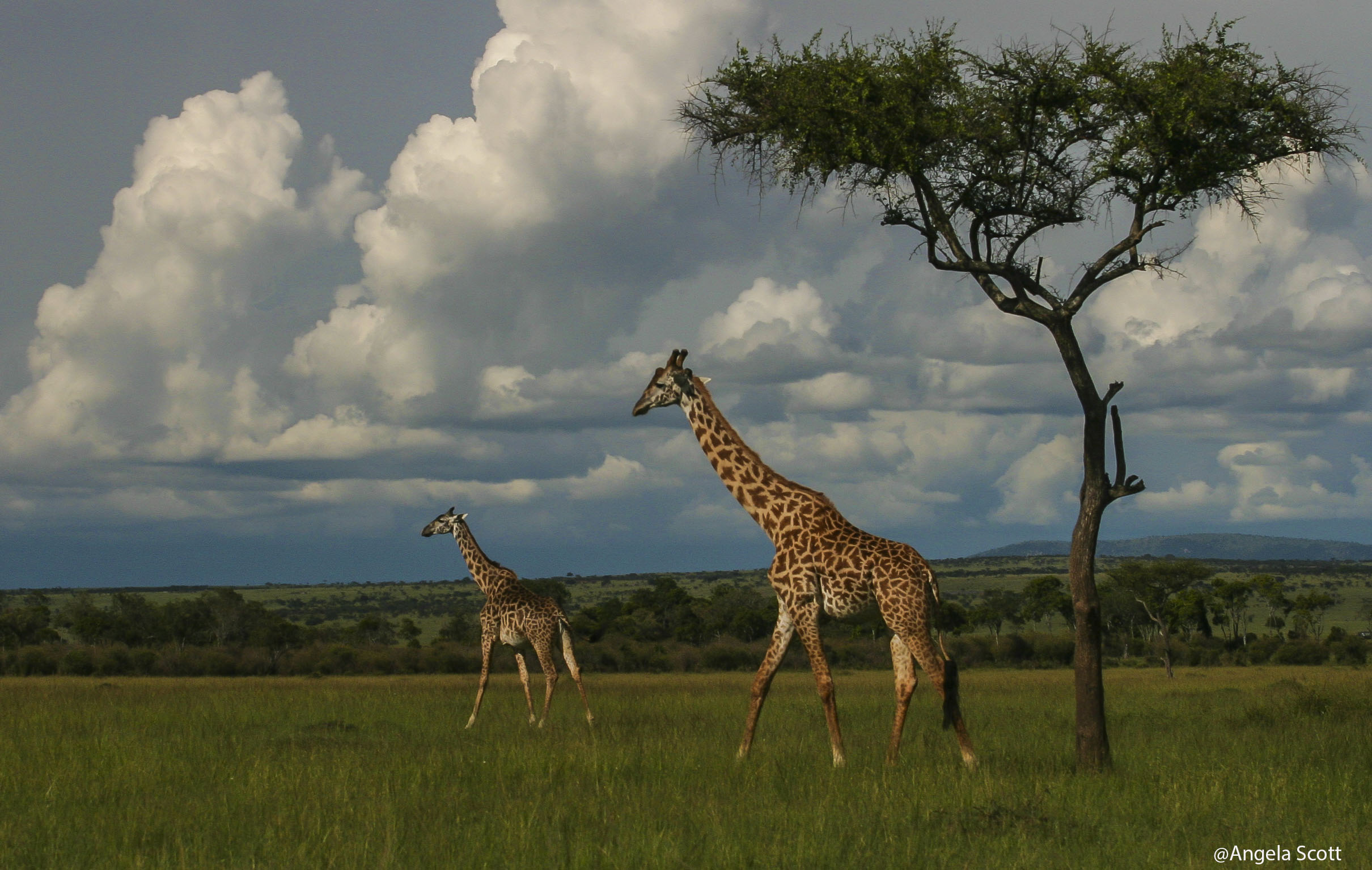
Banner image: Giraffes roam Kenya’s open savannas. Image by Angela Scott.
Five more community-led African groups join global landscape restoration network
The sacred humans-bird connection in Ethiopia’s wetlands: Interview with Abebayehu Aticho

