

Close Menu
NCIJ Network NCIJ Network
    What's Hot

    Ethereum Gets Another Privacy Boost as Aztec Brings Back zk.money

    September 30, 2026

    NASA Opens 2027 Human Lander Challenge for Lunar Communications

    September 30, 2026

    China Brief: Was Xi’s Meeting With Trump a Bust?

    September 30, 2026
    Facebook X (Twitter) Instagram
    Trending
    • Ethereum Gets Another Privacy Boost as Aztec Brings Back zk.money
    • NASA Opens 2027 Human Lander Challenge for Lunar Communications
    • China Brief: Was Xi’s Meeting With Trump a Bust?
    • News live: Alan Kohler announces retirement from ABC after 31 years; six Australian universities in top 100 global rankings | Australia news
    • England v Czech Republic: Czechs prepare for Wembley 30 years after Euro ’96
    • Is ChatGPT your new Google Workspace alternative? Meet Space, Pages, and slides
    • Russia’s Star Blizzard Targets 100+ Organizations With Fake Event Invites to Deliver Backdoor
    • Hut 8 locks in $1B credit line, but faces 40% liquidity rules
    • About
      • Our Team
      • Editorial Policy
      • Editorial Independence
      • International Support
    • Trust & Standards
      • AI Usage Policy
      • Conflict of Interest Policy
      • Corrections Policy
      • Ethics Policy
      • Fact-Checking Policy
      • Source Protection
    • Get Involved
      • Guide for Sources
      • Support Independent Journalism
    • Legal
      • Cookie Policy
      • Privacy Policy
      • Terms of Use
    Facebook X (Twitter) Instagram
    NCIJ Network NCIJ Network
    Wednesday, September 30
    • Home
    • World
    • Ai
    • Business
    • Politics
    • Health
    • Crypto
    • Science
    • Technology
    • Cybersecurity
    • Defense & Security
    • Economy
    • Energy
    • Europe
    • More
      • Fact Check
      • Investigations
      • Opinion & Analysis
      • Environment
    NCIJ Network NCIJ Network
    Home»Fact Check

    Don’t expect to look up and see a ‘2-moon night’ on Sept. 29, 2026

    NCIJ NETWNCIJ NETWORKBy NCIJ NETWNCIJ NETWORKSeptember 29, 2026 Fact Check No Comments4 Mins Read
    Share
    Facebook Twitter LinkedIn Pinterest Email

    Claim:

    There will be a “two-moon night” on Sept. 29, 2026.

    Rating:

    Context

    The celestial object referenced in the posts making the claim, asteroid 2025 PN7, is not visible to the naked eye, binoculars or even amateur telescopes. Because its orbit around the sun is very similar to Earth’s own orbit, 2025 PN7 is considered a “quasi-moon.”

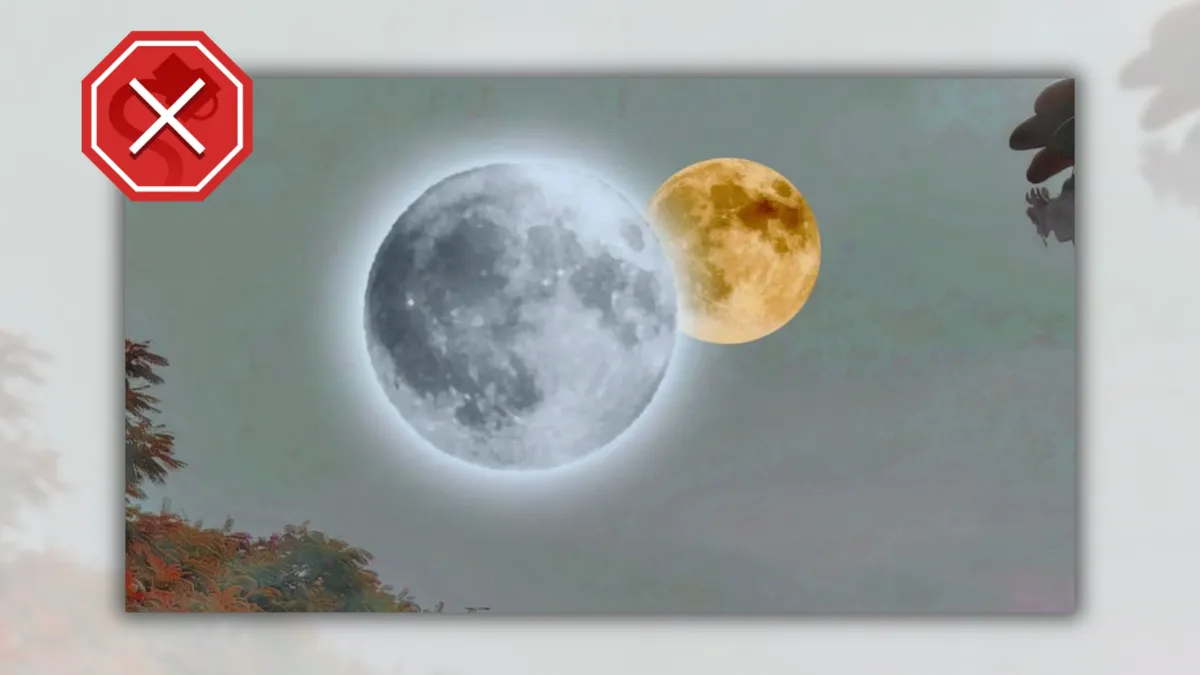
    In late September 2026, some Facebook pages spread a rumor that Sept. 29 would be a “two-moon night.” For example, text on an image in one Facebook post (archived) claimed that “Earth may seem to have two moons in the sky.” The text of the post read:

    😯👉🌙✨ A RARE “TWO-MOON” NIGHT IS COMING! ✨🌙

    On September 29, 2026, skywatchers may notice an unusual celestial event. Earth’s natural Moon will share the night sky with asteroid 2025 PN7, a small object described as a temporary quasi-moon. 🌌🔭

    Although 2025 PN7 is not a true second moon, its unusual relationship with Earth makes it an interesting object to learn about.

    It’s a beautiful reminder that our cosmic neighborhood is constantly changing. Look up, find a clear and dark location, and enjoy the night sky! 🌠✨

    Other Facebook pages (archived) posted videos (archived) sharing claim, which largely depicted the moon alongside a smaller, brown-hued version of itself. Snopes readers searched the site and sent emails asking whether the claim was true.

    However, the asteroid referenced in the posts, 2025 PN7, is not visible to the naked eye, binoculars or even amateur telescopes. Therefore, we’ve rated this claim false.

    On NASA’s September 2026 skywatching tips page, a “two-moon night” is not named among the listed “skywatching highlights” for the month. That’s because there won’t be a visible “second moon” in the sky.

    The reason why is that asteroid 2025 PN7 is too small, too far away and not nearly bright enough to be visible, according to NASA’s small-body database. Let’s break down the specifics:

    The asteroid has a diameter of about 60 feet, according to the Las Cumbres Observatory, or approximately the length of a bowling lane. That’s less than one-third the length of a Boeing 787 passenger airplane, which is between 186 and 224 feet long. The moon, on the other hand, has a diameter of 2,159 miles, about a quarter of Earth’s diameter.

    Not only is this asteroid much, much smaller than the moon, it’s also much farther away. The average distance of the moon from Earth is about 238,000 miles, according to NASA. The space agency’s small-body database says that, at its closest approach in 2026 (visible on Page 12 of the closest approach table), 2025 PN7 was nearly 2.8 million miles from Earth — more than 11 times the distance from the moon to Earth.

    Astronomers quantify how visible stars, planets, asteroids and other celestial objects are in the sky through a measure called apparent magnitude. Brighter objects have lower values, while dimmer objects have higher values. The sun has an apparent magnitude of -26.5, while the full moon has an apparent magnitude of -12.5.

    Unsurprisingly, asteroid 2025 PN7, which is both much smaller and much farther away than the moon, is not nearly as bright as the moon. NASA’s small-body database records the apparent magnitude of objects over time through a table called an Ephemeris. On Sept. 29, the apparent magnitude of the asteroid is 24.373. On its brightest night in 2026 — Aug. 4 — its apparent magnitude was just under 21.

    According to the Australia Telescope National Facility, people can usually see objects up to an apparent magnitude of approximately 6.5 with the naked eye when there is a clear, dark sky with no light pollution. With binoculars, a person might be able to see up to an apparent magnitude of 10. With an amateur telescope, a person may be able to see objects up to 14 or 16 apparent magnitude.

    As a “quasi-moon,” asteroid 2025 PN7 actually orbits the sun. It appears to orbit the Earth like an actual moon only because its orbital path around the sun is very similar to Earth’s own. 

    For further reading, we previously fact-checked the claim that 2025 PN7 was temporarily a “second moon” orbiting Earth.

    2moon dont expect night Sept
    NCIJ NETWNCIJ NETWORK
    • Website

    Keep Reading

    Experts Question the White House’s Defense of Taxpayer-Funded Ads

    Did Trump tell Tucker Carlson ‘we all die anyway’ to dismiss Iran war concerns?

    Did Japan ban Israeli tourists? Here’s the truth

    Andy Burnham’s first Labour Party conference speech as PM: fact checked – Full Fact

    Viral NATO video isn’t a ‘new ad campaign’ – Full Fact

    12 rumors about Trump renaming things, examined

    Add A Comment
    Leave A Reply Cancel Reply

    Editors Picks

    Ethereum Gets Another Privacy Boost as Aztec Brings Back zk.money

    September 30, 2026

    NASA Opens 2027 Human Lander Challenge for Lunar Communications

    September 30, 2026

    China Brief: Was Xi’s Meeting With Trump a Bust?

    September 30, 2026

    News live: Alan Kohler announces retirement from ABC after 31 years; six Australian universities in top 100 global rankings | Australia news

    September 30, 2026
    Latest Posts

    Bitcoin collateral: MARA’s $600M Long Ridge financing

    August 7, 2026

    Truck Brake Controller’s Safety Recall Doubled as Hidden Security Fix

    August 7, 2026

    The best classic slasher movie you’ll never watch

    August 7, 2026

    Subscribe to News

    Get the latest sports news from NewsSite about world, sports and politics.

    NCIJ Network is an independent digital news platform delivering trusted investigative journalism, European and global news, in-depth analysis, and fact-based reporting with accuracy, transparency, and integrity.

    Facebook X (Twitter) Instagram Pinterest YouTube

    Ethereum Gets Another Privacy Boost as Aztec Brings Back zk.money

    September 30, 2026

    NASA Opens 2027 Human Lander Challenge for Lunar Communications

    September 30, 2026

    China Brief: Was Xi’s Meeting With Trump a Bust?

    September 30, 2026

    Subscribe to Updates

    Get the latest creative news from FooBar about art, design and business.

    Type above and press Enter to search. Press Esc to cancel.