

Close Menu
NCIJ Network NCIJ Network
    What's Hot

    Instinct founder said more than 50% of transactions on the platform are travel-related

    September 29, 2026

    Nebius Opens 2026 Physical AI Awards: Five $150K Compute Prizes, Nine Judges, and an October 25 Deadline

    September 29, 2026

    Automated AI agent used to breach cybersecurity nonprofit DIVD

    September 29, 2026
    Facebook X (Twitter) Instagram
    Trending
    • Instinct founder said more than 50% of transactions on the platform are travel-related
    • Nebius Opens 2026 Physical AI Awards: Five $150K Compute Prizes, Nine Judges, and an October 25 Deadline
    • Automated AI agent used to breach cybersecurity nonprofit DIVD
    • Peter Brandt Says Bitcoin May Hit $600K By 2029, Calls XRP A ‘Fool Coin’
    • This suitcase-sized spacecraft could hear the universe before stars existed
    • Long After Wildfire Smoke Is Gone, Heavy Metals Could Still Be Harming Survivors’ Lungs
    • History Shows Why Trump Shouldn’t Ban Diesel Exports
    • 12 rumors about Trump renaming things, examined
    • About
      • Our Team
      • Editorial Policy
      • Editorial Independence
      • International Support
    • Trust & Standards
      • AI Usage Policy
      • Conflict of Interest Policy
      • Corrections Policy
      • Ethics Policy
      • Fact-Checking Policy
      • Source Protection
    • Get Involved
      • Guide for Sources
      • Support Independent Journalism
    • Legal
      • Cookie Policy
      • Privacy Policy
      • Terms of Use
    Facebook X (Twitter) Instagram
    NCIJ Network NCIJ Network
    Tuesday, September 29
    • Home
    • World
    • Ai
    • Business
    • Politics
    • Health
    • Crypto
    • Science
    • Technology
    • Cybersecurity
    • Defense & Security
    • Economy
    • Energy
    • Europe
    • More
      • Fact Check
      • Investigations
      • Opinion & Analysis
      • Environment
    NCIJ Network NCIJ Network
    Home»Cybersecurity

    Official MCP Python SDK Flaw Can Let Malicious Servers Steal OAuth Credentials

    NCIJ NETWNCIJ NETWORKBy NCIJ NETWNCIJ NETWORKSeptember 29, 2026 Cybersecurity No Comments4 Mins Read
    Share
    Facebook Twitter LinkedIn Pinterest Email

    Swati KhandelwalSep 29, 2026Identity Security / Artificial Intelligence

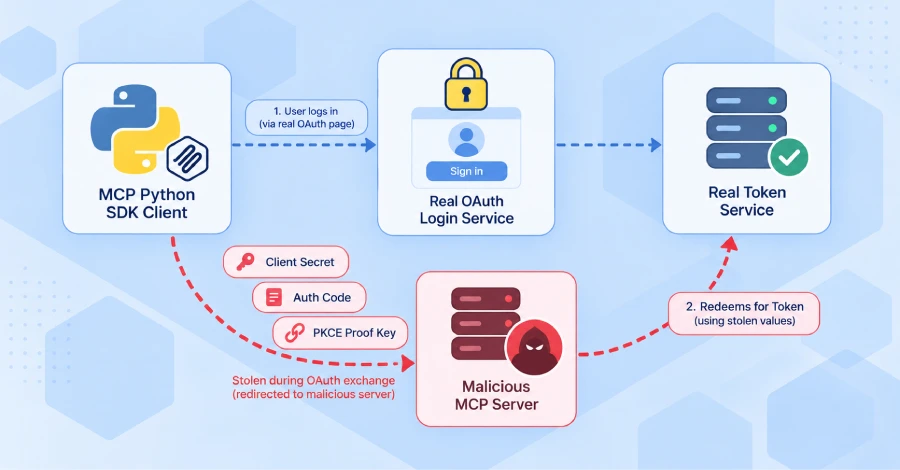
    A malicious MCP server could trick an application built on the official MCP Python SDK into handing over the OAuth credentials it uses to log in to a real service, the SDK’s maintainers said in a security advisory.

    Affected versions sent the client secret, the authorization code, and the PKCE proof key to a token endpoint the attacker controlled. The fix is in versions 1.30.0 and 2.2.0.

    The Model Context Protocol (MCP) is an open standard for connecting AI applications to outside tools and data, and this package is its official Python SDK for building MCP servers and clients.

    With the stolen credentials, the attacker can request a valid access token from the real login service. Cycode, the security firm that reported the flaw, demonstrated that full exchange in a test and says the resulting token carries whatever permissions the app was granted. The client secret is long-lived, so it keeps working until it is changed.

    The flaw is rated high (7.5) for the two providers that run without a person present. Scored for the interactive provider, where someone has to start the sign-in, it is 6.5. No CVE had been assigned as of September 29.

    How a server steals the credentials

    When an MCP client needs to log in, it asks the server it is connecting to where its login service, called the authorization server, can be found. On the affected versions, the SDK did not always check that answer. A malicious server could point it at a login service of the attacker’s choosing, either by naming the attacker’s own server or by serving login details that name the user’s real service while sending the credentials elsewhere.

    Cybersecurity

    The client then sends its secret, its authorization code, and its PKCE proof key to the attacker instead of the real service. The proof key is a one-time value designed to prevent a stolen authorization code from being reused, so handing it over defeats that protection as well.

    With the interactive provider, the person still has to approve a sign-in. Cycode says the page they approve is the genuine login page, so nothing looks wrong. The two machine-to-machine providers need no sign-in and no person at all.

    Who is affected

    An application is affected if it uses the SDK as an MCP client over HTTP with one of the OAuth providers OAuthClientProvider, ClientCredentialsOAuthProvider, PrivateKeyJWTOAuthProvider, or the deprecated 1.x RFC7523OAuthClientProvider, and it can connect to a server it does not fully control while holding credentials for a real login service. MCP servers built with the SDK, local (stdio) clients, and clients that attach their own tokens are not affected.

    Line Affected Fixed in
    1.x 1.9.1 through 1.29.1 1.30.0
    2.x 2.0.0 through 2.1.1 2.2.0

    What to do

    Upgrade to 1.30.0 on the 1.x line or 2.2.0 on the 2.x line. In the fixed versions, the client works out which login service it expects before fetching any details and refuses any that name a different one.

    Upgrading is not the whole fix for two of the providers. If you use ClientCredentialsOAuthProvider or PrivateKeyJWTOAuthProvider, the advisory says “upgrading changes nothing until you also pass issuer=” to name the login service those credentials belong to. Without it, they still follow whichever server the MCP server points them at.

    Cybersecurity

    On 1.30.0, the warning about this is a standard deprecation warning, which Python hides by default, so it is easy to miss. The deprecated RFC7523OAuthClientProvider has no issuer= option at all, so move to one of the other two providers.

    After upgrading, clear any stored OAuth client registrations once, because older ones are not tied to a login service and stay that way. If a client may already have connected to an untrusted server, rotate its client secret and revoke its tokens at the login service. On older versions, there is no workaround other than connecting only to MCP servers you trust.

    Disclosure

    The issuer checks shipped in the 1.30.0 and 2.2.0 release notes on September 7, listed under behavior changes rather than as a security fix. The advisory followed on September 28, the same day Cycode published its writeup. The advisory credits eight reporters, including Cycode’s researcher.

    Neither the advisory nor Cycode reports any attacks using the flaw, and none has been reported elsewhere.

    Credentials Flaw Malicious MCP OAuth official Python SDK Servers Steal
    NCIJ NETWNCIJ NETWORK
    • Website

    Keep Reading

    Automated AI agent used to breach cybersecurity nonprofit DIVD

    Catch threats before they escalate with real-time Identity Telemetry

    Hackers Use ChatGPT Custom GPTs in ClickFix Attacks

    Reco Raises $55 Million for Agentic Security

    Vietnamese man charged in $16 million ‘pig butchering’ crypto scam

    Dutch Police Arrest 24-Year-Old Amsterdam Man in ShinyHunters Investigation

    Add A Comment
    Leave A Reply Cancel Reply

    Editors Picks

    Instinct founder said more than 50% of transactions on the platform are travel-related

    September 29, 2026

    Nebius Opens 2026 Physical AI Awards: Five $150K Compute Prizes, Nine Judges, and an October 25 Deadline

    September 29, 2026

    Automated AI agent used to breach cybersecurity nonprofit DIVD

    September 29, 2026

    Peter Brandt Says Bitcoin May Hit $600K By 2029, Calls XRP A ‘Fool Coin’

    September 29, 2026
    Latest Posts

    Bitcoin collateral: MARA’s $600M Long Ridge financing

    August 7, 2026

    Truck Brake Controller’s Safety Recall Doubled as Hidden Security Fix

    August 7, 2026

    The best classic slasher movie you’ll never watch

    August 7, 2026

    Subscribe to News

    Get the latest sports news from NewsSite about world, sports and politics.

    NCIJ Network is an independent digital news platform delivering trusted investigative journalism, European and global news, in-depth analysis, and fact-based reporting with accuracy, transparency, and integrity.

    Facebook X (Twitter) Instagram Pinterest YouTube

    Instinct founder said more than 50% of transactions on the platform are travel-related

    September 29, 2026

    Nebius Opens 2026 Physical AI Awards: Five $150K Compute Prizes, Nine Judges, and an October 25 Deadline

    September 29, 2026

    Automated AI agent used to breach cybersecurity nonprofit DIVD

    September 29, 2026

    Subscribe to Updates

    Get the latest creative news from FooBar about art, design and business.

    Type above and press Enter to search. Press Esc to cancel.