


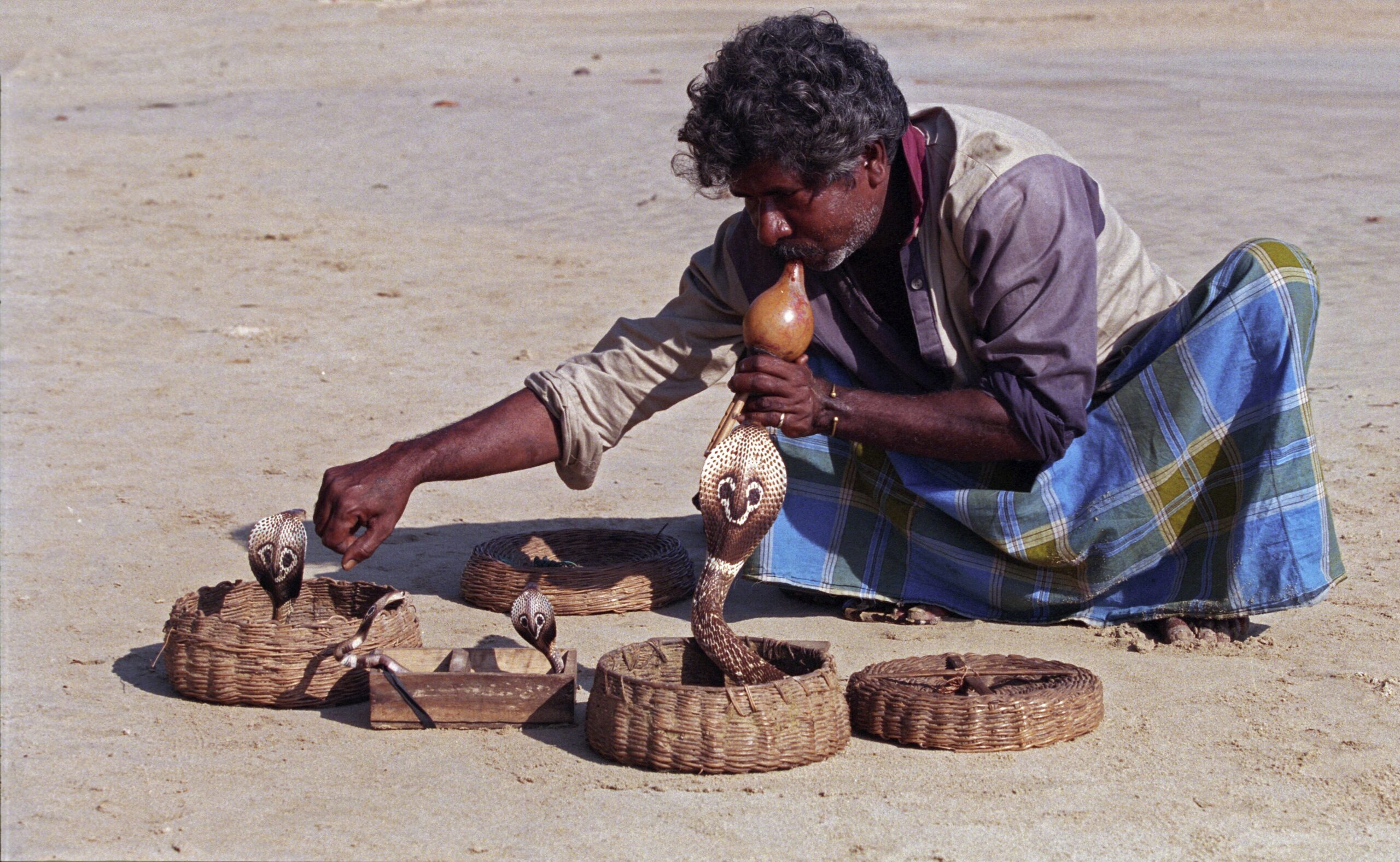
- In Sri Lanka, the traditional snake charming culture is fast fading as changing livelihoods, modern entertainment and attitudes toward wildlife reshape the island’s nomadic community, the Ahikuntika tribe.
- During the act of snake charming, cobras do not respond to the music itself, but to the movement of the charmer and instrument, which they perceive as a potential threat, herpetologists say.
- Breaking a cobra’s venom fangs, which the snake charmers do, does not necessarily prevent it from developing replacement fangs, while deliberate fang removal can cause injury and raise animal-welfare concerns, conservationists say.
- Researchers recommend using the existing traditional knowledge of snakes to be redirected toward conservation action, as harmful practices associated with wildlife performances are disappearing.
COLOMBO – For generations, the sight was familiar in towns and villages across Sri Lanka of a man playing a flute sitting on his haunches next to a woven basket, from which a cobra raised its gently swaying hood, drawing a curious crowd of onlookers.
The performance appeared almost magical, as the cobra would seem to have been charmed by the flute’s notes, moving its hood rhythmically like performing a dance. But behind the spectacle was a community with its own traditions, knowledge and relationship with snakes — one that is quickly fading away.
Known locally as the Ahikuntika, this small nomadic tribe is also referred to as Sri Lanka’s gypsies or Sri Lankan Telugus. They’ve traditionally traveled from place to place, and men have performed as snake charmers and monkey performers, with the women primarily associated with fortune-telling or soothsaying. Historical accounts describe temporary settlements and an itinerant lifestyle in which families moved between communities to earn a living through performances and traditional livelihoods.
Today, however, snake charming has become rare.
“During our childhood, we could regularly see snake charmers. They were often seen near markets, while groups of itinerant performers would also travel from village to village, announcing their arrival by beating a small hand drum,” recalled 75-year-old retired schoolteacher Chandrasena Liyanarachchi.
Sri Lankans have a long-inherited fear of the venomous cobras (Naja naja), yet also accord them cultural significance, and often watch cobra performances with a mixture of fascination and fear. As children, Liyanarachchi said, they were particularly fascinated by the way the cobra appeared to sway to the charmer’s horn or flute.
“Those were the days when entertainment options were limited. There were no televisions, and only a few households had radios, so these performances were something we looked forward to and remembered,” Liyanarachchi told Mongabay.
A culturally significant performance
Sri Lankan pioneering herpetologist Anslem de Silva said he also remembers encountering snake charmers regularly during his childhood in Matara, in the south of the island country. “Our house was located within the Matara Fort area where the locally famous “Pacha Gaha,’ a huge banyan tree, stood near the court complex where a lot of snake charmers gathered,” de Silva recalled. “I used to watch them handling snakes and used to talk with them to get more information.”
Those childhood encounters would eventually help shape a career for de Silva where he became one of Sri Lanka’s pioneering herpetologists and an internationally recognized snake expert.
But what audiences saw as a snake responding to music was something quite different biologically. “The term ‘snake charmer’ comes from the traditional belief that these performers can charm or hypnotize snakes through music. But scientifically, that is not what is happening,” de Silva said.
“Snakes do not hear airborne sounds in the same way humans do. They are much more sensitive to vibrations, and, during these performances, the snake is actually responding mainly to the movement of the charmer and the instrument rather than to the music itself,” he told Mongabay.
“What appears to be a dance is essentially the snake following the movement of the [instrument] while remaining alert to what it perceives as a potential threat, so it also pops out its hood which is in fact the warning display,” de Silva said.
The close handling of a cobra also carries a genuine risk. The spectacled cobra, traditionally at the center of these performances, is venomous and its bite can cause serious medical consequences, including paralysis of the muscles linked to breathing.
One present-day snake charmer told Mongabay that performers sometimes catch cobras from forested areas and deliberately destroy their fangs to reduce the risk of being bitten. He said the practice was taught by previous generations and people were still using the ‘defanging’ practice.
For the performers, however, the cobra is only one part of a broader livelihood based on displaying and interacting with wild animals.
Preference for nonvenomous snakes
The Indian rock python (Python molurus) is Sri Lanka’s largest snake and is the species often carried by the snake charmers. Because they are nonvenomous, spectators are allowed to touch them or pose for photographs. Some performers also use toque macaques (Macaca sinica), training the monkeys to perform acts while the performer narrates the show.

The monkeys are dressed in fancy clothing and made to perform tricks. Donations from audiences are the main source of income for the traditional snake charmers, but nowadays they are moving away from the risky occupation toward farming and even fishing.
The decline of these performances reflects a much broader transformation in the lives of the local nomadic community. People who once traveled between villages are increasingly settling in permanent homes. One established Ahikuntika settlement is in Tambuttegama in the north-central Anuradhapura district, where families have adapted to changing economic conditions and have taken up other occupations while retaining elements of their cultural traditions.
For some, this transition means having to leave behind the itinerant life altogether. But it also raises a difficult question: What happens to the knowledge accumulated by generations of people whose lives were closely connected with the island’s snakes?
Animal welfare concerns
With snakes often confined in small containers that restrict normal movement and behavior, and monkeys tethered for prolonged periods and repeatedly transported and trained to perform for crowds, the practice raises concerns about stress, inadequate space, poor husbandry and the animals’ ability to express normal behavior. In the case of venomous snakes, practices such as forced handling and fang removal can also result in injury, infection and impaired feeding.

Herpetologist Dushanth Kandambi, who has worked with the Snake Venom Research Laboratory and Herpetarium at the University of Colombo, Sri Lanka, has witnessed some of these welfare concerns firsthand.
Kandambi said wild cobras can potentially live for decades and recalled how a cobra in his care lived about 20 years although it was already a full gown snake by the time it was handed over to him. Meanwhile, snakes kept under poor captive conditions by performers could survive for much shorter periods, he said. Kandambi recalled an incident when he was called to rescue a cobra found by the side of a road. The severely malnourished snake was later suspected to have escaped from a snake charmer: Its fangs had been removed, and despite efforts to provide appropriate food, the snake did not survive.
“The venom of the snake also contains some digestive chemicals, so even if a snake without venom fangs could catch and consume prey, it can’t properly digest without those enzymes,” Kandambi told Mongabay.
Barefoot conservation educators
Kandambi described another encounter that shows the risks associated with incomplete understanding of fang replacement. While examining a cobra in a performer’s possession, Kandambi found that the snake had fully developed venom fangs. When he pointed this out, the performer was reportedly surprised and attempted to break the fangs again, despite Kandambi’s objections. Such incidents, Kandambi said, illustrate how practices passed down generations can sometimes persist without any understanding of biology.
The relationship between snake charmers and wildlife is not unique to Sri Lanka. Similar traditions have existed for centuries in parts of India, Africa and the Middle East.
In India, wildlife protection laws introduced in 1972 effectively ended the legal use of wild snakes in traditional performances, although the practice has continued in some areas. Research by the NGO Wildlife Trust of India (WTI) found that members of the nomadic Jogi-Nath snake charming community retained extensive traditional knowledge of venomous snakes. Villagers sometimes call on them to remove snakes from homes and agricultural areas, potentially preventing the animals from being killed.
The researchers suggested that such knowledge could instead be channeled into conservation efforts. They proposed the training of former snake charmers as “barefoot conservation educators” who could help with snake awareness, rescue and release while developing alternative livelihoods. At the same time, the research documented welfare problems associated with keeping wild snakes, including poor husbandry, forced feeding and fang removal.
Banner Image: A snake charmer attempts to make a snake more responsive by bringing his hand closer to its hood. Image by Jerzy Strzelecki via Wikimedia Commons (CC BY 3.0)
Cite this article
Malaka Rodrigo (2026). Sri Lanka’s disappearing snake charmers carry a legacy of fear and fascination. Mongabay Conservation news. DOI: https://doi.org/10.66709/news-331088

